
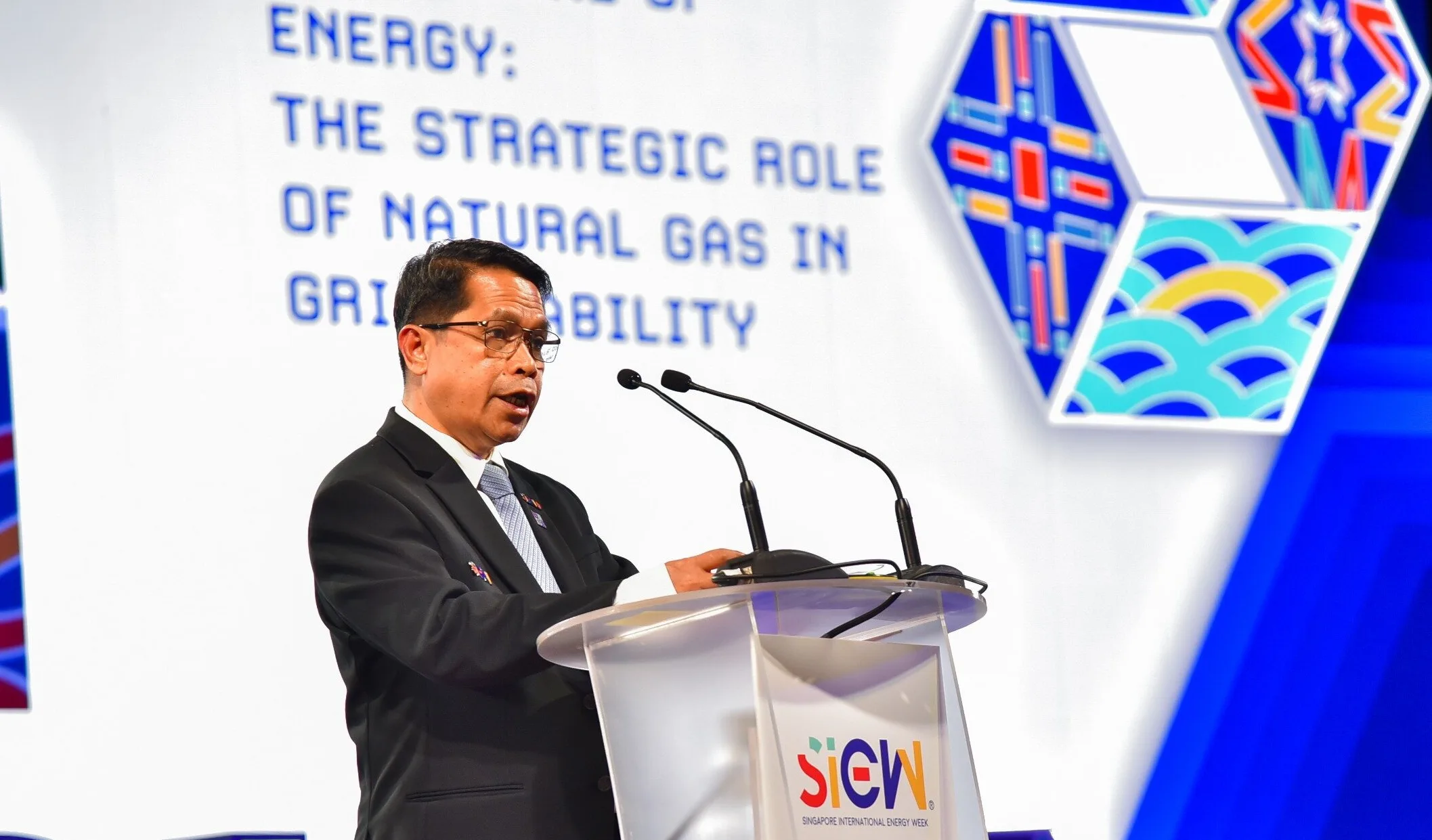
ASIATODAY.ID, SINGAPORE — Indonesia has officially invited ASEAN member states to strengthen regional energy integration through joint cooperation in developing the Trans-ASEAN Gas Pipeline (TAGP) — a cross-border project designed to enhance energy connectivity, security, and sustainability across Southeast Asia.
The initiative was presented by Laode Sulaeman, Director General of Oil and Gas at the Ministry of Energy and Mineral Resources (ESDM), representing Minister Bahlil Lahadalia, during the Singapore International Energy Week (SIEW) 2025 Summit.
“The Trans-ASEAN Gas Pipeline is more than an energy infrastructure project — it is a symbol of collaboration, trust, and shared commitment among ASEAN nations to build a sustainable and integrated energy future,” Laode stated in his keynote address on Tuesday, October 27, 2025.
Laode emphasized that Indonesia’s national energy policy is aligned with President Prabowo Subianto’s Asta Cita vision, which prioritizes energy resilience and industrial downstreaming as key pillars of economic transformation.
To achieve these goals, Indonesia continues to boost oil and gas production through clean technologies and expanded exploration partnerships.
As of September 2025, Indonesia’s oil production reached 605,000 barrels per day, while natural gas output remained steady at 6.8 billion standard cubic feet per day (BSCFD).
The government aims to increase gas production to 12 BSCFD by 2030, supported by the launch of 75 new oil and gas working areas between 2025 and 2027, adoption of Enhanced Oil Recovery (EOR) technologies, and reactivation of idle fields.
Indonesia is also reinforcing domestic infrastructure, including the Cirebon–Semarang and Dumai–Sei Mangke gas pipelines, along with the development of Floating Regasification Units (FRUs) to enhance interregional connectivity and reduce logistics costs.
Accelerating the Energy Transition
Aligned with its Net Zero Emission roadmap, Indonesia continues to accelerate its transition to renewable and low-carbon energy. The country’s installed renewable capacity has reached 15 gigawatts, still a fraction of its estimated 3,600-gigawatt potential.
Ongoing projects include hydropower, geothermal, solar, and bioenergy developments, alongside the implementation of B40 biodiesel in 2025 and B50 in 2026.
“Renewables currently account for 16 percent of Indonesia’s energy mix. Our goal is to raise this share to 36–40 percent by 2040,” Laode noted.
Under the Electricity Supply Business Plan (RUPTL) 2025–2034, Indonesia projects an additional 69 gigawatts of generation capacity, with over 60 percent sourced from renewables and energy storage systems.
Trans-ASEAN Gas Pipeline: The Backbone of ASEAN Energy Integration
Indonesia views the Trans-ASEAN Gas Pipeline as a cornerstone for advancing regional energy security and cost efficiency. Through this initiative, ASEAN nations can share resources, diversify supply chains, and strengthen collective energy resilience.
“The future of ASEAN’s energy security depends on our ability to connect, collaborate, and innovate. TAGP will serve as a foundation for sustainable and equitable energy growth in the region,” Laode emphasized.
To realize this vision, Indonesia is deepening collaboration with ASEAN governments, industry players, academia, and international institutions such as the International Energy Agency (IEA) and the International Renewable Energy Agency (IRENA).
These partnerships aim to establish a sustainable, secure, and inclusive regional energy system, positioning Indonesia as a driving force in ASEAN’s energy integration and a key advocate for low-carbon development in the region. (AT Network)
Follow Us at Google News and WA Channel