
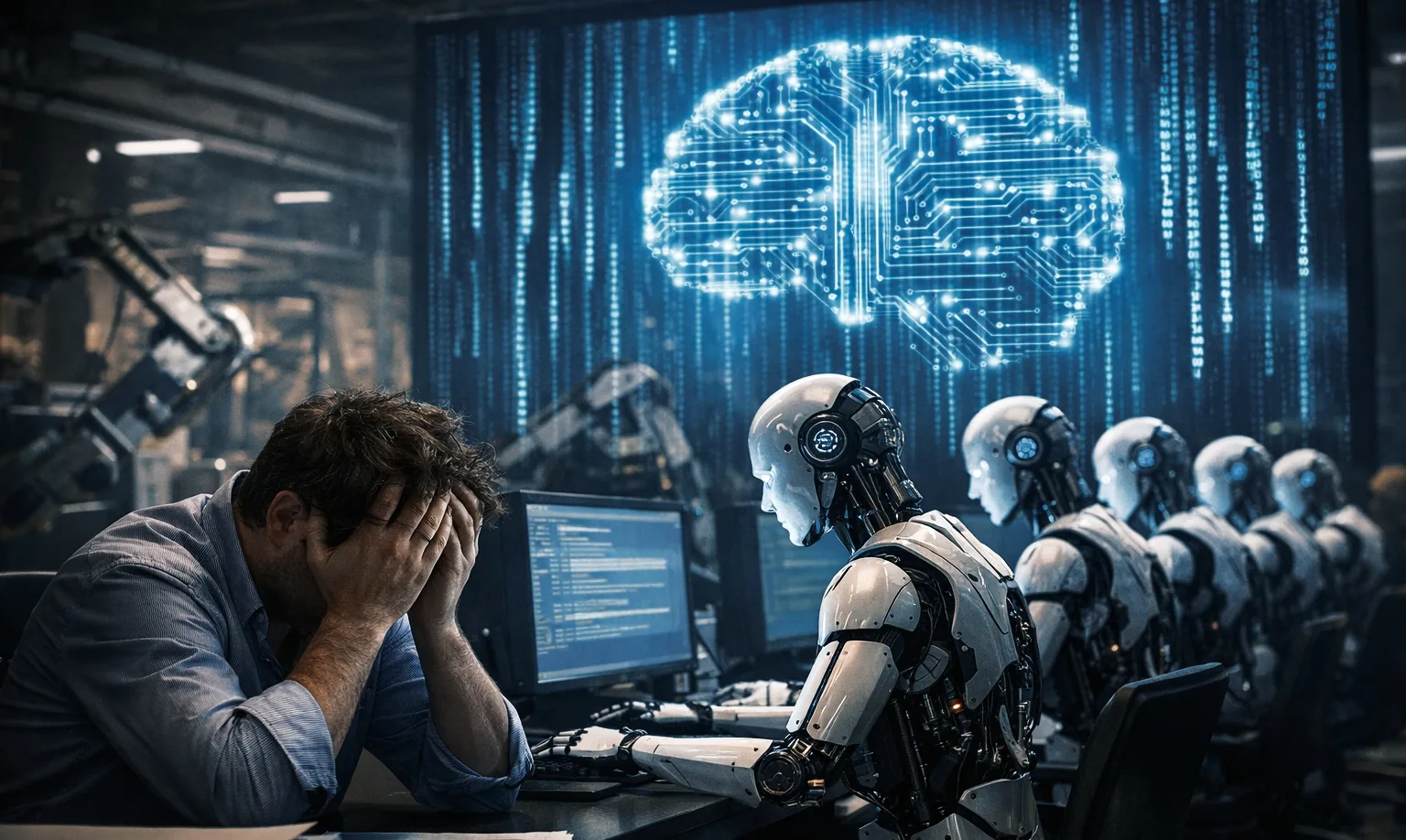
ASIATODAY.ID, NEW YORK — Artificial Intelligence is no longer a tool designed to assist human labour. It is rapidly becoming a force that replaces, governs, and ultimately decides the fate of human workers.
The United Nations has issued a stark warning: without ethical governance, massive investment in education, and global regulation, the world is entering a new phase — one where machines hold more power than the people who created them.
AI is already embedded in classrooms, offices, factories, and high-level decision-making systems. Millions of jobs are at risk of being transformed or eliminated altogether, while technological power becomes increasingly concentrated in the hands of a few global corporations.
According to the UN, if this trajectory continues unchecked, social inequality will deepen and humanity may lose meaningful control over its own future.
UN Secretary-General António Guterres has repeatedly cautioned that the destiny of humankind “must never be left to the black box of an algorithm.”
His warning underscores a growing fear within the UN system: that opaque AI decision-making could override human judgment, accountability, and fundamental rights.
Education: Humanity’s Last Line of Defence
The UN identifies education as the central pillar for survival in an AI-driven future. But this is not merely about introducing AI tools into classrooms. It requires building AI literacy among teachers, students, and workers, ensuring humans understand — and can challenge — the systems shaping their lives.
UNESCO estimates that the world will need 44 million new teachers by 2030, warning against the illusion that technology can replace human development.
“AI can manage data,” UNESCO experts stress, “but it cannot nurture human values, ethics, or social bonds.”
Mass Job Losses Loom — But the Real Threat Is Power
Fears of widespread unemployment are no longer speculative. In 2025, the World Economic Forum reported that 41 per cent of employers planned workforce reductions due to AI.
While the International Labour Organization (ILO) predicts that one in four jobs will be transformed rather than destroyed, the nature of work itself is shifting at unprecedented speed.
Machines excel at repetition and pattern recognition. Humans dominate creativity, ethical judgment, and complex social interaction. The problem, the UN warns, is that workers who cannot continuously adapt may be pushed aside — not by failure, but by design.
AI for the Few, Inequality for the Many
The UN has raised alarm over the concentration of AI development within a small group of technology giants. Without deliberate intervention, access to AI could become a new axis of global inequality — widening gaps between countries, economies, and social classes.
UN strategies now emphasize that AI must be treated as a shared global resource, not a private weapon of economic dominance.
Human Rights Are Not Optional
In its landmark Recommendation on the Ethics of Artificial Intelligence, UNESCO insists that human rights must form the non-negotiable foundation of all AI systems. Technologies that threaten dignity, equality, or freedom, the UN argues, should be restricted or banned outright.
Unchecked automation, the organization warns, risks creating systems that discriminate, surveil, and dehumanize at scale.
A Global Reckoning Ahead
The UN is clear: no single government, corporation, or institution can manage the AI revolution alone. Without international consensus, humanity risks sliding into a fragmented future ruled by competing algorithms rather than shared values.
The choice is no longer whether AI will shape the world — it already has. The real question is whether humans will still be allowed to shape it in return. (AT Network)
Follow Us at Google News and WA Channel