
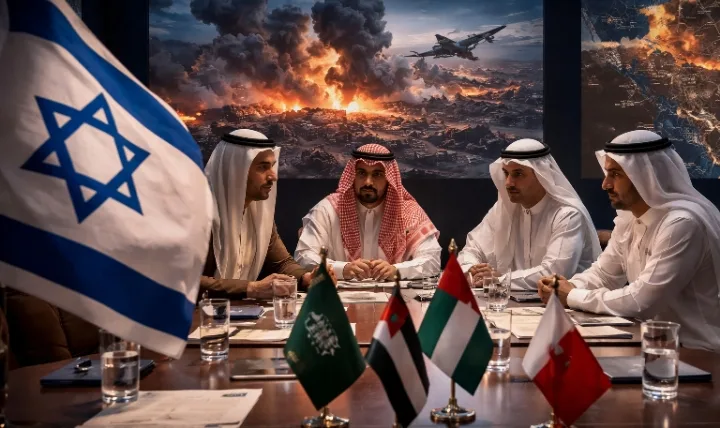
ASIATODAY.ID, JAKARTA – The escalating war between Iran and Israel has evolved far beyond a bilateral confrontation.
What began as a cycle of covert strikes, proxy battles, and shadow warfare has erupted into open confrontation—reshaping alliances and exposing uncomfortable geopolitical realities across the Middle East.
At the heart of this transformation lies a question that has lingered for years: where do Arab states truly stand in the Iran–Israel conflict?
The war has forced answers into the open.
From Shadow War to Open Confrontation
For decades, Iran and Israel fought indirectly—through cyber operations, intelligence campaigns, and proxy forces stretching from Lebanon to Syria and Gaza. But the latest escalation marked a decisive shift. Direct strikes, cross-border missile launches, and overt military mobilizations have drawn regional actors into a widening circle of confrontation.
Iran’s retaliation has not been limited to Israeli territory. It has targeted strategic locations across the region, particularly areas hosting American military infrastructure. This shift reflects Tehran’s long-standing claim that any attack on Iran would not be treated as a bilateral conflict, but as a broader regional war involving those who enable or facilitate it.
In doing so, Iran has effectively pointed a finger at several Arab states.
The Abraham Accords and Strategic Realignment
The turning point in Arab–Israeli relations began in 2020 with the signing of the Abraham Accords. The agreements normalized relations between Israel and several Arab countries, including the United Arab Emirates, Bahrain, and later Morocco. While Saudi Arabia did not formally sign the accords, it engaged in growing informal coordination with Israel.
These agreements were framed as steps toward regional stability, economic cooperation, and technological advancement. Yet security cooperation—particularly intelligence sharing and defense coordination—formed a critical, though less publicly emphasized, pillar of the normalization process.
The Iran–Israel war has now cast that security dimension into stark relief.
Military Infrastructure and Strategic Exposure
Several Gulf states host U.S. military bases, air defense systems, and naval assets. These facilities are vital components of Washington’s regional posture and, by extension, part of the broader strategic environment surrounding Israel’s security.
From Tehran’s perspective, these installations are not neutral. They represent logistical arteries that could support military operations against Iran. As missile and drone exchanges intensify, the risk calculus changes: facilities once seen as defensive assets may now be viewed as legitimate targets.
This dynamic has “unmasked” what critics describe as implicit Arab alignment with Israel’s strategic objectives—particularly the shared goal of containing Iranian influence.
Public Rhetoric vs. Strategic Reality
Official statements from Arab governments have often called for restraint and de-escalation. Many have condemned violence broadly, without explicitly endorsing Israeli actions.
However, the strategic alignment tells a more complex story.
For years, Gulf states have viewed Iran’s regional posture—with its influence in Iraq, Syria, Lebanon, and Yemen—as a direct security threat. Israel, similarly, sees Iran’s missile program and regional proxy network as existential dangers.
This convergence of threat perception has quietly drawn Israel and several Arab governments closer together.
The current war has made that convergence harder to obscure.
Domestic Pressures and Regional Tensions
The exposure of these alignments carries domestic consequences. Public opinion in many Arab societies remains deeply sympathetic to the Palestinian cause and skeptical of normalization with Israel. Escalating war risks widening the gap between political leadership and popular sentiment.
At the same time, ruling elites prioritize regime stability, economic diversification, and security partnerships with Western powers—particularly the United States. In this framework, cooperation with Israel is viewed less as ideological alignment and more as pragmatic statecraft.
The Iran–Israel conflict has illuminated this divide: solidarity rhetoric on one side, strategic calculation on the other.
A Broader Geopolitical Shift
What the war ultimately reveals is not a sudden betrayal or dramatic reversal, but the culmination of a decade-long geopolitical realignment in the Middle East.
Arab states—particularly in the Gulf—have increasingly defined their foreign policy through the lens of:
– Countering Iranian regional expansion
– Securing advanced defense partnerships
– Attracting Western investment and technology
– Diversifying economies beyond oil
Israel, facing similar security threats from Iran, has become a functional—if politically sensitive—partner in this equation.
The war has stripped away ambiguity. It has exposed the reality that regional politics is no longer defined solely by the traditional Arab–Israeli binary, but by a more complex matrix of rivalries, alliances, and strategic survival.
War as a Revealing Force
Wars do not only destroy infrastructure; they dismantle illusions.
The Iran–Israel conflict has laid bare the depth of quiet cooperation between Israel and several Arab governments. It has shown that behind diplomatic caution and carefully worded communiqués lies a shared security architecture shaped by common adversaries and mutual interests.
Whether this exposure strengthens regional blocs or destabilizes internal politics remains uncertain. What is clear is that the conflict has forced the Middle East into a new era—one where alignments are less hidden, and the cost of strategic choices is increasingly paid in the open. (Newsroom)
Follow Us at Google News and WA Channel