
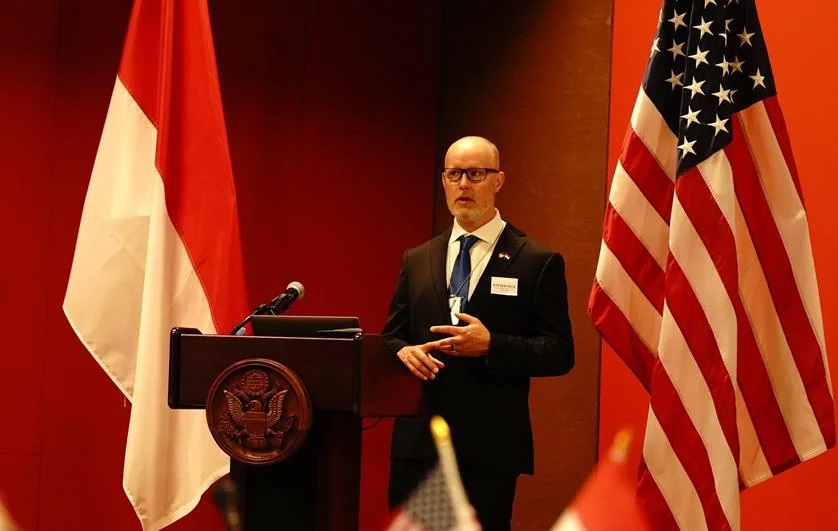
ASIATODAY.ID, JAKARTA – The United States is deepening cooperation with Indonesia to support stronger Environmental, Social, and Governance (ESG) practices in the country’s mining sector, as global demand for critical minerals continues to rise alongside the clean energy transition.
Through the Ambassador Water Expert Program (AWEP), the U.S. Embassy in Jakarta, in collaboration with Indonesia’s Ministry of Environment and Ministry of Energy and Mineral Resources (ESDM), has completed a nine-day technical exchange focused on water quality, environmental monitoring, and responsible mining practices.
Held from June 8–18, 2026, the program brought Steven Rice, a U.S. water systems expert from the National Park Service under the Department of the Interior, to Indonesia to exchange technical expertise and collaborate with Indonesian counterparts on water management challenges associated with mining activities.
The initiative comes as Indonesia strengthens its position as one of the world’s leading producers of critical minerals, particularly nickel, while facing growing expectations from global investors, battery manufacturers, and downstream industries to meet internationally recognized ESG standards.
Strong water stewardship, environmental monitoring, and transparent governance are increasingly regarded as essential for securing long-term investment, maintaining market access, and strengthening resilient critical mineral supply chains.
During the exchange, the U.S. delegation conducted field visits to Lombok and West Sumbawa, where participants examined local water management systems and discussed water quality parameters, treatment technologies, and infrastructure solutions suited to Indonesia’s unique geographical and environmental conditions.
The program brought together a broad range of stakeholders, including Indonesia’s National Research and Innovation Agency (BRIN), PT Amman Mineral, U.S.-based water technology company Ecolab through Nalco Indonesia, Nexus3 Foundation, Bandung Institute of Technology (ITB), Sepuluh Nopember Institute of Technology (ITS), the University of Mataram, and Sumbawa University of Technology.
The exchange concluded with a workshop in Jakarta, bringing together government officials, researchers, academics, industry representatives, and conservation specialists to review field findings and explore opportunities for continued technical cooperation on water quality management and resilient infrastructure.
The initiative also featured a public discussion at @america, the U.S. Embassy’s American Center, titled “Innovation in Action: Water Solutions for the U.S. and Indonesia Toward Responsible Mining.” The panel included BRIN senior limnology researcher Professor Cynthia Henny, Ecolab Senior Director Tomy Suryatama, ITB water engineering expert Muhammad Sonny Abfertiawan, and U.S. water specialist Steven Rice.
U.S. Embassy spokesperson Jamie Ravetz said the technical exchange reflects the expanding partnership between the United States and Indonesia in promoting sustainable water management and responsible mining.
“Our water experts shared America’s environmental management experience while gaining valuable insights from Indonesia’s expertise in managing water infrastructure across geographically diverse mining regions,” Ravetz said on June 26.
Beyond strengthening bilateral cooperation, the partnership could help accelerate the adoption of internationally recognized ESG practices across Indonesia’s mining industry. Improved water governance, stronger environmental management, and enhanced institutional collaboration are expected to support Indonesia’s efforts to attract sustainable investment and reinforce its ambition to become a trusted global supplier of responsibly produced critical minerals—including nickel, a key material for electric vehicle batteries and the broader clean energy transition. (AT Network)
Follow Us at Google News, WA Channel, and LinkedIn