
ASIATODAY.ID, JAKARTA — When Amed arrived in Indonesia several years ago, he felt as though his future had come to a standstill. Forced to flee conflict in Somalia, he spent years living in uncertainty.
Amina experienced a similar journey. Escaping violence, she was compelled to leave behind the life she once knew and begin anew in a country unfamiliar to her.
Amed and Amina are among the approximately 12,000 refugees and asylum-seekers currently living in Indonesia. They come from more than 50 countries, including Afghanistan, Myanmar, Somalia, Sudan, Yemen, Iraq, Sri Lanka, and Palestine.
“Indonesia’s longstanding humanitarian commitment has provided safety and hope for people forced to flee their homes, while demonstrating the importance of shared responsibility,” said Hendrik Therik, UNHCR Spokesperson in Indonesia on June 20, 2026.
“The solidarity shown by various stakeholders proves that protection can be achieved through collaboration, compassion, and concrete action.”
On World Refugee Day 2026, UNHCR, the UN Refugee Agency, is drawing attention to the growing challenge of protracted displacement. According to UNHCR’s Global Trends Report, seven out of ten refugees worldwide live in prolonged displacement situations, often spending years away from home while waiting for durable solutions.
For many, what begins as a desperate search for safety evolves into a lifetime of uncertainty. At the same time, low- and middle-income countries now host 68 percent of the world’s refugees and people in need of international protection.
Humanitarian assistance saves lives, but it does not by itself enable refugees to rebuild their futures. The same reality exists in Indonesia, where many refugees have spent years — and in some cases more than a decade — awaiting long-term solutions.
“For refugees, waiting for years often means losing opportunities and hope. It can lead to frustration and despair. But when refugees are given opportunities to use their skills, continue their education, volunteer, and participate in community life, everyone benefits,” said Emily Bojovic, Senior Protection Officer at UNHCR Indonesia.
Today, Amed leads a refugee-led community organization that helps fellow refugees adapt to life in Indonesia and provides informal learning opportunities for refugee children. Amina, originally from Afghanistan, is not only a mother and wife but also a karate coach who helps members of her community build confidence and resilience.
Refugee-led organizations contribute significantly by providing informal education programs, skills training, peer support, sports activities, and community initiatives that help refugees overcome challenges while strengthening social cohesion.
“At UNHCR, we witness every day the tremendous impact that occurs when refugees are given the opportunity to realize their potential and contribute to the communities around them,” Emily added.
While refugees like Amed and Amina have found ways to thrive, many vulnerable refugees continue to struggle to move beyond mere survival toward greater self-reliance and empowerment. Displacement may alter the course of a person’s life, but it should not erase their ability to learn, lead, and support others. When provided with safety, empathy, and opportunity, refugees can contribute meaningfully, build connections, and strengthen the communities that host them.
World Refugee Day serves as a moment to honor the courage and dignity of refugees while recognizing those who continue to demonstrate solidarity and support. This year’s commemoration carries special significance as it coincides with the 75th anniversary of the 1951 Refugee Convention.
“Seventy-five years ago, from the ruins of the Second World War, the world made a fundamental promise: anyone forced to flee war, conflict, or persecution has the right to safety and protection,” said UN High Commissioner for Refugees Barham Salih.
“That promise is universal and was designed to endure across generations. It was made for our grandparents, for us, and for generations yet to come.”
For nearly 42 million refugees around the world, leaving home is not a choice but a necessity.
At a time when the right to seek asylum is under increasing pressure in many parts of the world, UNHCR expresses its gratitude to Indonesia for maintaining its commitment to protecting those seeking safety.
“For the thousands of refugees who have found protection in Indonesia over the decades, Indonesia has been — and remains — a symbol of humanity,” Hendrik concluded.
WORLD REFUGEE DAY 2026: “ONE GOAL, SAFETY FOR ALL”
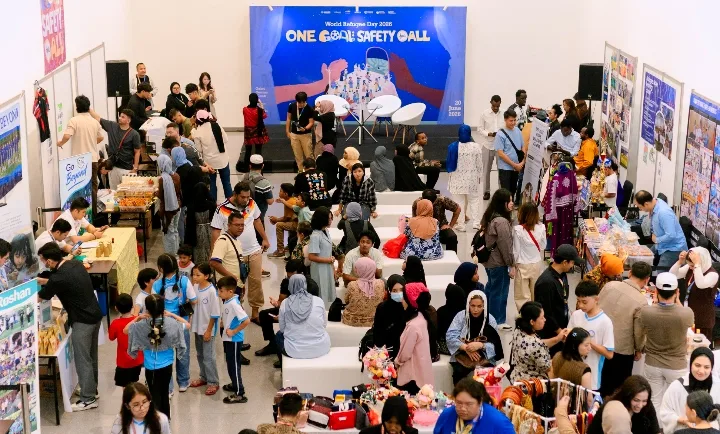
To mark World Refugee Day 2026 in Indonesia, UNHCR is partnering with Indonesian civil society organizations, including Refu+ure Indonesia, Jesuit Refugee Service Indonesia, Yayasan Cita Wadah Swadaya, Bridges for Hope, Islamic Relief Indonesia, refugee-led organizations, community groups, and refugee artists to host a public event titled “One Goal: Safety for All.”
The event will take place on June 20, 2026, at the Oesman Effendi Gallery, Taman Ismail Marzuki, Jakarta.
The program will feature art exhibitions, performances by refugees, a community bazaar, panel discussions, interactive activities, and opportunities for the public to meet refugees and hear their stories firsthand.
Beyond raising awareness, the event aims to foster deeper and more meaningful connections between refugees and Indonesian society.
Many refugees say that their greatest challenge is not only uncertainty about the future but also social isolation from everyday life. Through conversations, shared activities, and cultural exchange, the event seeks to create spaces where people can connect beyond labels and legal status, recognizing one another simply as fellow human beings.
As one refugee participant shared:
“As refugees, our sense of isolation fades when Indonesians greet us with a smile and invite us to share simple moments of everyday life. Sit with us. Taste our food. Listen to our stories firsthand. Play football with us.”
This message reflects the spirit of this year’s campaign: inclusivity begins when people meet, connect, and build relationships so that everyone can feel safe.
World Refugee Day reminds us that safety means more than being free from danger. It also means having the opportunity to belong, participate, and contribute.
UNHCR calls on governments, civil society organizations, the private sector, educational institutions, faith-based organizations, media professionals, journalists, and the broader public to continue working together toward a future where everyone can live in safety and realize their full potential, regardless of their background or legal status. (Midwan)
Follow Us at Google News and WA Channel