
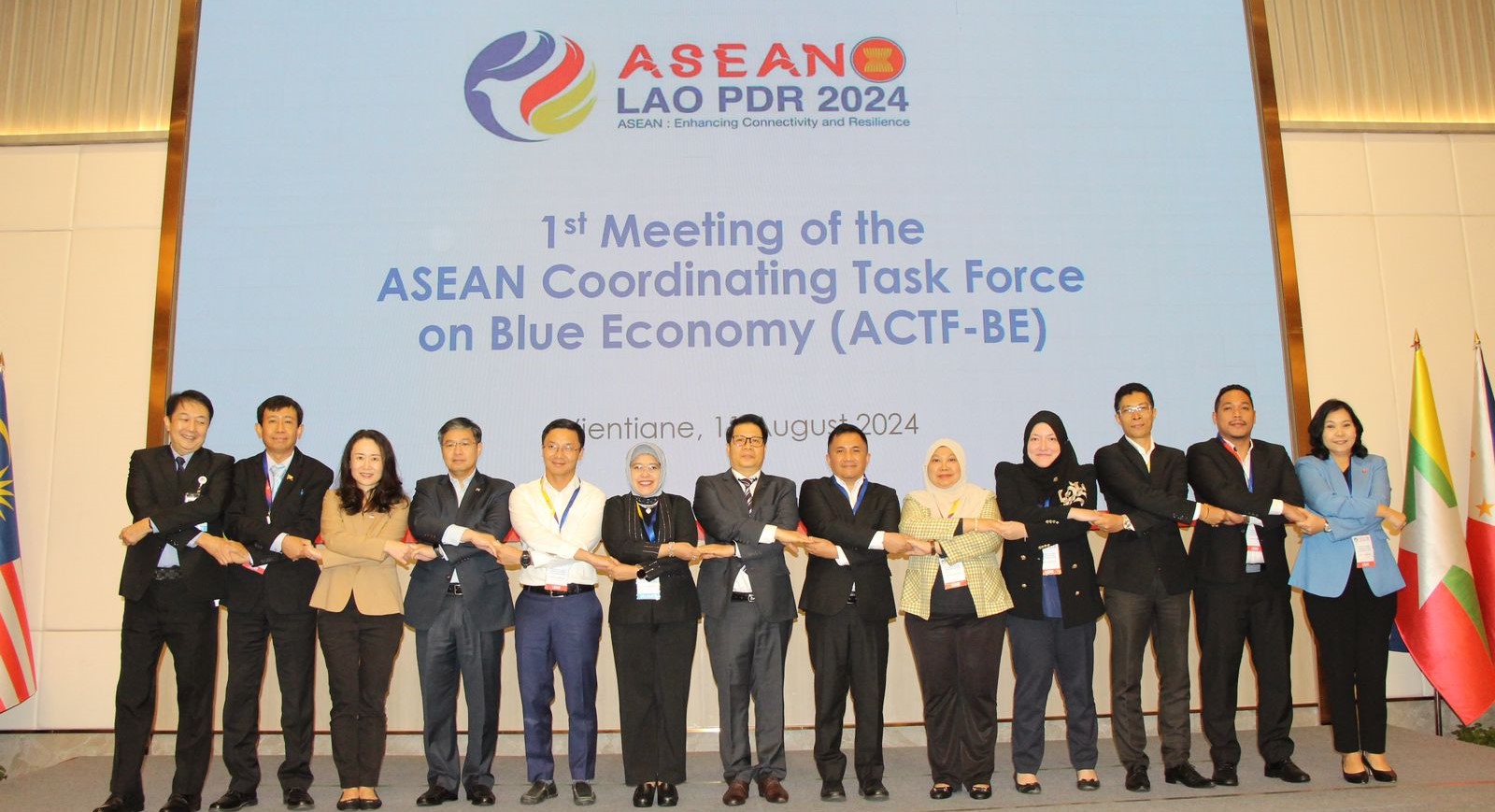
ASIATODAY.ID, LAOS – In order to support the Chairmanship of Laos in ASEAN in 2024, the Indonesian Government through the Ministry of Foreign Affairs and the Ministry of National Development Planning as co-organizers, has succeeded in assisting Laos as Chair of ASEAN in organizing the 1st ASEAN Coordinating Task Force on Blue Economy ( ACTF-BE) and 2nd ASEAN Blue Economy Forum at Lao Plaza Hotel, Vientiane, Laos, 10-11 August 2024.
ACTF-BE is a cross-pillar ASEAN mechanism which was formed based on the agreement of the ASEAN Foreign Ministers at the 34th Meeting of the ASEAN Coordinating Council (ACC). This Task Force is tasked with dealing with the Blue Economy issue holistically as a cross-pillar ASEAN issue involving various different sectors.
In carrying out its role, ACTF-BE is responsible to ACC and ensures effective collaboration and coordination, including reporting on the implementation of all ASEAN Blue Economy initiatives. Apart from that, ACTF-BE also facilitates cooperation and capacity building between ASEAN member countries and external parties in the field of the Blue Economy.
The implementation of the 1st ACTF-BE was preceded by The 2nd ASEAN Blue Economy Forum which is a continuation of The 1st ASEAN Blue Economy Forum which was held on 2 – 4 July 2023 in Belitung, under the chairmanship of Indonesia in ASEAN in 2023. This series of activities succeeded in bringing together representatives from the 10 ASEAN member countries (AMS), Timor-Leste, the ASEAN Secretariat, as well as representatives from sectoral bodies and stakeholders related to Blue Economy issues within and outside the region.
In the opening of the 2nd ASEAN Blue Economy Forum, H.E. Dr. Manothong Vongsay, Deputy Minister of Industry and Commerce of Lao PDR, expressed his deep appreciation to the Indonesian Government.
“We would like to express our appreciation to the Indonesian Government and ERIA for their support in organizing this activity [2nd ASEAN Blue Economy Forum] and the first meeting of the ASEAN Coordinating Task-Force on Blue Economy,” he said.
He also emphasized the importance of innovation and collaboration by stating, “through collaboration, we can exchange knowledge, share views, and develop cohesive strategies”.
Deputy for Economic Affairs at the National Development Planning Agency, Amalia Adininggar Widyasanti, as Shepherd ACTF-BE added that “By strengthening cooperation and collaboration in the field of the blue economy, I am confident that ASEAN can lead the development of the blue economy globally, [by] exploiting the potential of the sea and its resources water, driving economic growth, innovation and shared prosperity.”
Apart from that, this forum also reiterated that the Blue Economy aims to become an engine for ASEAN’s economic growth in the future, as well as offering the potential for significant “win-win future for all” economic benefits for ASEAN.
In this 2nd ASEAN Blue Economy Forum, a number of practical recommendations related to the Blue Economy were produced that ASEAN could consider, including: (i) the formation of a regional science, technology and innovation alliance to encourage technology adoption in the blue economy; (ii) engaging the private sector to drive technology commercialization; and (iii) co-financing in pilot projects and research and development in blue priority sectors.
The results of the meeting were then presented by Indonesia at the ACTF-BE meeting to become recommendations in preparing the ASEAN Blue Economy Implementation Plan.
As part of the 2nd ASEAN Blue Economy Forum, participants were also invited to visit the Nam Ngum 1 Hydropower Plant, a hydroelectric power plant. The plant utilizes the current of the Nam Ngum river, a tributary of the Mekong, and provides around 50% of Laos’ electricity needs.
In his speech, H.E. Grata Endah Werdaningtyas, Indonesian Ambassador to the Lao People’s Democratic Republic, emphasized that “The Mekong River means the mother of all rivers, where many tributaries and smaller river flows from various countries in the region meet. This makes the Mekong River a river that connects people’s lives in Laos, Myanmar, Thailand, Vietnam, Cambodia and China. The Mekong River is a source of life and livelihood for hundreds of millions of people in the region.”
In 2023, the theme of Indonesia’s Chairmanship in ASEAN will be “ASEAN Matters: Epicentrum of Growth”. One of Indonesia’s achievements is the adoption of the ASEAN Blue Economy Framework by ASEAN leaders at the 43rd ASEAN Summit in Jakarta. This framework aims to make the Blue Economy an engine new economic growth in the region that is inclusive and sustainable, in line with Indonesia’s Blue Economy framework.
For this reason, the implementation of a series of Blue Economy activities by Laos with the support of Indonesia is a positive step to continue to ensure the sustainability of Indonesia’s priorities and ensure that Blue Economy issues continue to be discussed in ASEAN.
Furthermore, the ASEAN Coordinating Task-Force on Blue Economy will meet annually to identify, monitor and report on Blue Economy initiatives in ASEAN, with the aim of making the Blue Economy a new growth engine in the region.
In the future, it is hoped that the ASEAN Blue Economy Forum can become a regular annual forum to become a forum for communication and coordination for ASEAN member countries in order to build awareness and encourage the involvement of various stakeholders in sharing knowledge and experiences related to the Blue Economy.
It is hoped that Malaysia as Chair of ASEAN 2025, and the subsequent leadership of ASEAN can continue the commitment that has been established by making the ASEAN Blue Economy Forum a regular annual forum to discuss Blue Economy issues in ASEAN. (AT Network)
Follow Us at Google News and WA Channel