
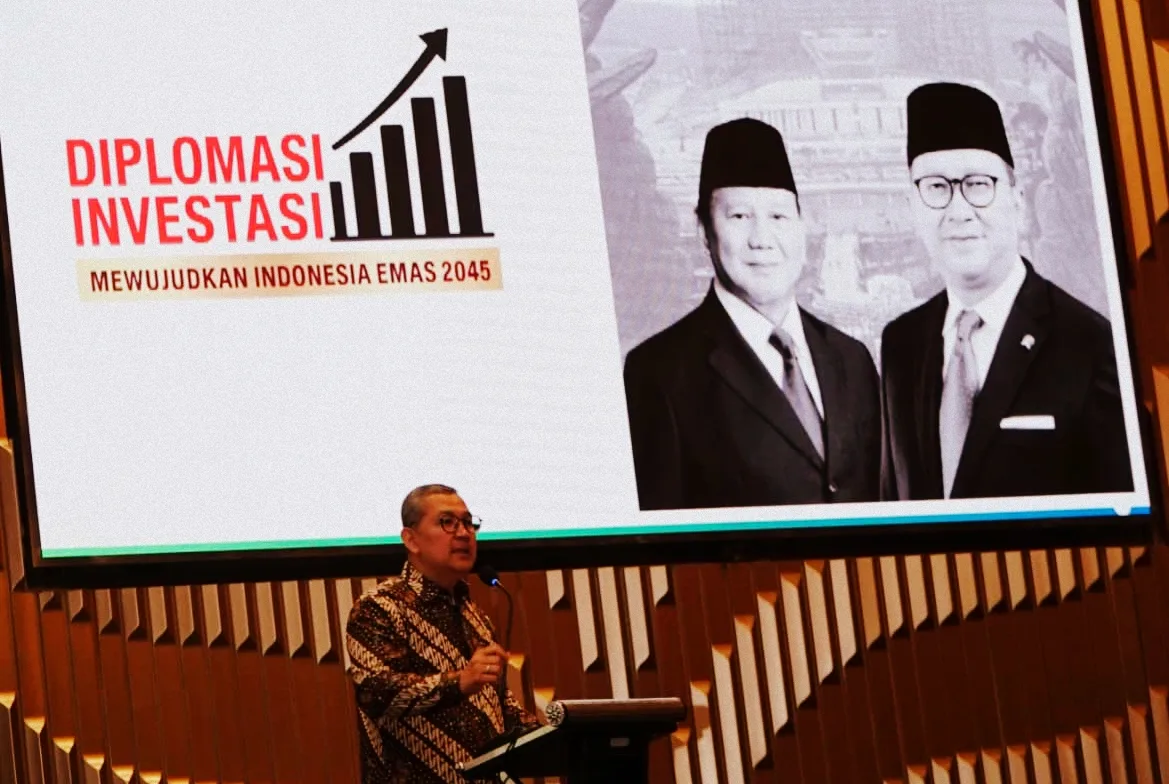
ASIATODAY.ID, MALANG — The Ministry of Investment and Downstreaming of the Republic of Indonesia / Indonesian Investment Coordinating Board (BKPM), through the Deputy for Investment Cooperation, convened a workshop on Formulating Indonesia’s Position Papers for International Investment Agreements under the theme “Investment Diplomacy to Enhance Investment Realization” at Grand Mercure Malang Mirama, Thursday, October 16, 2025.
This event marked an important step in strengthening the foundation of Indonesia’s investment diplomacy, aimed at fostering high-quality and sustainable investment realization.
The event opened with a keynote address by Prof. Dr. Tirta Nugraha Mursitama, Ph.D., Deputy for Investment Cooperation at the Ministry of Investment and Downstreaming/BKPM. The Ministry of Investment and Downstreaming of the Republic of Indonesia / Indonesian Investment Coordinating Board (BKPM),
He emphasized that investment diplomacy is an integral part of Indonesia’s national strategy to establish international agreements aligned with development priorities and investment realization goals.
The Government remains committed to enhancing bilateral and multilateral investment cooperation, including the recent conclusion of the Indonesia–Canada Comprehensive Economic Partnership Agreement (CEPA) signed in late September, which features a new investment chapter. The agreement is expected to stimulate greater investment inflows from Canada to Indonesia.
The workshop featured a panel discussion moderated by Dr. Rini Setiani Sutrisno Modouw, Director of Bilateral Cooperation, and brought together speakers from multiple sectors — including representatives from the Ministry of Foreign Affairs, BPJS Employment (BPJS Ketenagakerjaan), PT PLN (Persero), and academia from Universitas Brawijaya.
The panel addressed key strategic issues such as the formulation of Indonesia’s position in international investment agreements, the role of social security in supporting both foreign and domestic workers, investment opportunities in renewable energy, and the evolving role of investment diplomacy amid global economic dynamics.
One of the main highlights was the discussion on employment-based social protection, recognized as a crucial factor in strengthening Indonesia’s overall investment climate. drg. Faizal Rachman, MH.Kes., AAK., CRGP., Deputy for Special Program Participation and Agency Affairs at BPJS Employment, emphasized that “sustainable investment must be built upon a strong foundation of social protection.
Social security is not only a safeguard for workers but also a risk mitigation instrument and a guarantee for sustainable investment through a productive and dignified workforce.”
From the energy sector, Daniel Karmel Fernando Tampubolon, S.T., M.E.M., Executive Vice President for New and Renewable Energy at PT PLN (Persero), presented the vast potential and opportunities in Indonesia’s renewable energy sector. On this occasion, the Ministry of Investment and Downstreaming/BKPM and PT PLN (Persero) also signed an addendum to their Cooperation Agreement (PKS) on electricity provision and investment acceleration in the power sector.
The primary objective of this initiative is to strengthen Indonesia’s negotiating position in international investment forums while ensuring that resulting agreements promote competitive and sustainable investment.
Through this approach, Indonesia aspires not only to be an attractive investment destination but also an active partner in shaping a fair and mutually beneficial global investment architecture.
The event was attended by Mayor of Malang, Dr. Ir. Wahyu Hidayat, M.M., university leaders, business representatives, associations, and more than 100 participants — including students from several universities across Malang such as Universitas Brawijaya, Binus University, Universitas Muhammadiyah Malang, Universitas Ma Chung, and Universitas Islam Malang.
The participation of students was seen as vital in cultivating a deeper understanding among the younger generation regarding the importance of international investment agreements in driving Indonesia’s economic development.
In his closing remarks, Prof. Tirta highlighted that “investment diplomacy must serve as an instrument ensuring that every international agreement translates into tangible investment realization on the ground.”
He further noted that inclusive position paper development — accommodating diverse stakeholder interests — strengthens Indonesia’s bargaining power in international forums while providing legal certainty and protection for investors.
The Ministry of Investment and Downstreaming/BKPM remains steadfast in its commitment to strengthening Indonesia’s investment diplomacy, ensuring that every policy contributes directly to job creation, value-added growth, and the acceleration of national economic transformation. (AT Network)
Follow Us at Google News and WA Channel