
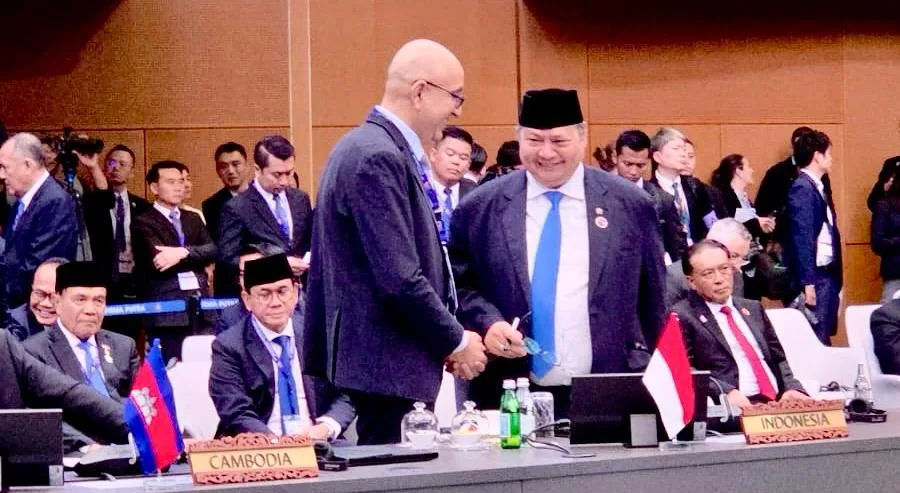
ASIATODAY.ID, KUALA LUMPUR — Indonesia is taking bold steps toward becoming Asia’s new economic powerhouse, as the nation asserted its leadership role at the 5th Regional Comprehensive Economic Partnership (RCEP) Leaders’ Summit held in Kuala Lumpur, Malaysia, on Monday, October 27, 2025.
Representing President Prabowo Subianto, Coordinating Minister for Economic Affairs Airlangga Hartarto led the Indonesian delegation and delivered a strong call for institutional strengthening within RCEP — including the establishment of a Permanent RCEP Secretariat in Jakarta.
“Indonesia stands ready to host the RCEP Secretariat. This is a crucial step to enhance coordination, transparency, and ensure the continued relevance of RCEP amid global economic shifts,” Airlangga declared during his intervention at the summit.
RCEP: The World’s Largest Economic Bloc
RCEP is the world’s largest free trade agreement, comprising 15 member countries — the 10 ASEAN nations along with China, Japan, South Korea, Australia, and New Zealand. Together, they represent 28.6% of the world’s population and 28% of global GDP.
The partnership continues to attract new interest, with Hong Kong, Sri Lanka, Bangladesh, and Chile having submitted formal applications for accession, highlighting RCEP’s growing significance in shaping Asia-Pacific’s economic future.
This year’s summit focused on two key issues: defining the strategic direction of RCEP implementation amid regional economic challenges and adopting the Joint Leaders’ Statement on RCEP, reaffirming member states’ commitment to an open, transparent, and rules-based multilateral trading system under the principles of the World Trade Organization (WTO).
Indonesia Leads the Regional Economic Agenda
As the Country Coordinator for RCEP, Indonesia plays a central role in steering the partnership’s policy direction. Airlangga, who delivered the first intervention at the leaders’ meeting, emphasized the need to strengthen RCEP’s institutional structure to keep the agreement dynamic and effective in a fast-changing global economy.
“RCEP must go beyond being a symbolic agreement. It should serve as a concrete engine for regional economic integration that is inclusive, resilient, and sustainable,” Airlangga asserted.
Concrete Steps Toward a Stronger RCEP
At the conclusion of the summit, RCEP Leaders officially adopted the RCEP Leaders’ Statement, underscoring collective commitments to:
Maintain open, free, and rules-based trade and investment flows;
Reduce trade barriers and enhance facilitation;
Fully implement the RCEP Agreement;
Encourage accession for new members; and
Establish a Permanent RCEP Secretariat, with Indonesia emerging as the leading candidate to host it.
The leaders also endorsed preparations for a General Review on RCEP, set to begin in 2027, to ensure the agreement remains relevant and adaptive to global economic transformations.
Jakarta Rising: The Future Hub of Asian Integration
Indonesia’s assertive stance at the RCEP Leaders’ Summit marks a turning point in the nation’s regional diplomacy — signaling a transformation from a participant to a regional leader driving economic integration across Asia.
With its strategic Indo-Pacific position, robust domestic economy, and commitment to ASEAN centrality, Indonesia is poised to anchor the next phase of Asia’s economic growth — reaffirming Jakarta’s place as the new hub of regional cooperation and prosperity. (AT Network)
Follow Us at Google News and WA Channel