
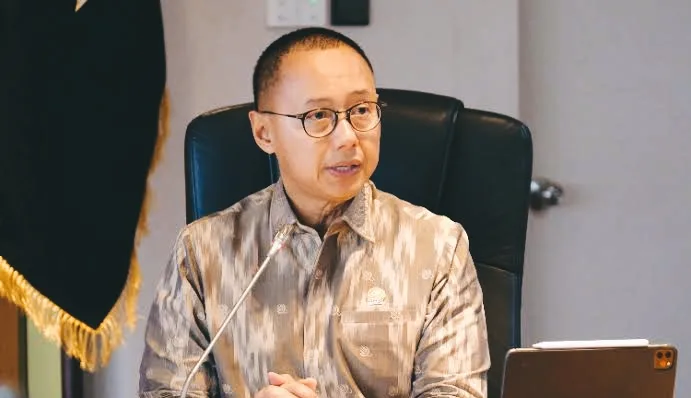
ASIATODAY.ID, JAKARTA – A member of Commission XII of the Indonesian House of Representatives, Eddy Soeparno, stated that increases in non-subsidized fuel prices are reasonable given the continued rise in global oil prices.
According to Eddy, fuel products outside the government-subsidized categories—namely Pertalite and Solar—are subject to market pricing mechanisms. Therefore, failing to adjust prices would place a financial burden on the government, state-owned energy firm Pertamina, as well as private fuel distributors.
“Non-subsidized fuel must adjust to prevailing market conditions. So price increases are not surprising. If prices remain unchanged, it would burden Pertamina and the state budget. For private companies, I believe the situation is similar,” Eddy said on May 4, 2026.
As previously reported, Pertamina raised prices for Pertamax Turbo and Pertamina Dex in mid-April 2026. Price adjustments were also implemented in early May by private operators such as BP Indonesia and VIVO.
BP set the price of BP Ultimate Diesel (CN 51) at IDR30,890 per liter, an increase of IDR5,430. VIVO applied the same price for its Primus Plus (CN 51), also rising by IDR5,430.
This week, Pertamina announced further adjustments for non-subsidized fuels including Pertamax Turbo, Dexlite, and Pertamina Dex. Meanwhile, prices for Pertamax and Pertamax Green remain unchanged, as do subsidized fuels Pertalite and Bio Solar. The latest prices for the Jakarta region are as follows:
– Pertalite (RON 90): IDR10,000 per liter – unchanged
– Bio Solar (CN 48): IDR6,800 per liter – unchanged
– Pertamax (RON 92): IDR12,300 per liter – unchanged
– Pertamax Green (RON 95): IDR12,900 per liter – unchanged
– Pertamax Turbo (RON 98): IDR19,900 per liter – up IDR500 from April 18, 2026
– Dexlite (CN 51): IDR26,000 per liter – up IDR2,400
– Pertamina Dex (CN 53): IDR27,900 per liter – up IDR4,000
Eddy emphasized that price fluctuations for non-subsidized fuel are expected under a market-based system.
He added that prices could also decline when global oil prices fall.
The Vice Chairman of the People’s Consultative Assembly also urged the government to take strategic steps to strengthen Indonesia’s energy security against potential crises.
He expressed hope that the government and Pertamina can significantly reduce reliance on imported energy sources, thereby enhancing national resilience during global energy shocks.
“With our continued dependence on fossil fuels—particularly those influenced by global markets—any volatility in world oil prices will always pose risks to our economy,” he said.
Eddy further highlighted the need to accelerate the development of renewable energy, including geothermal, solar, wind, and bioenergy sourced domestically.
He stressed that this transition is essential not only to reduce import dependency and mitigate global risks, but also to promote a cleaner and healthier environment.
“I firmly believe that achieving energy security is just as critical as ensuring national security. Energy transition is no longer an option—it is a necessity,” Eddy concluded. (Silvia Andriani)
Follow Us at Google News and WA Channel