
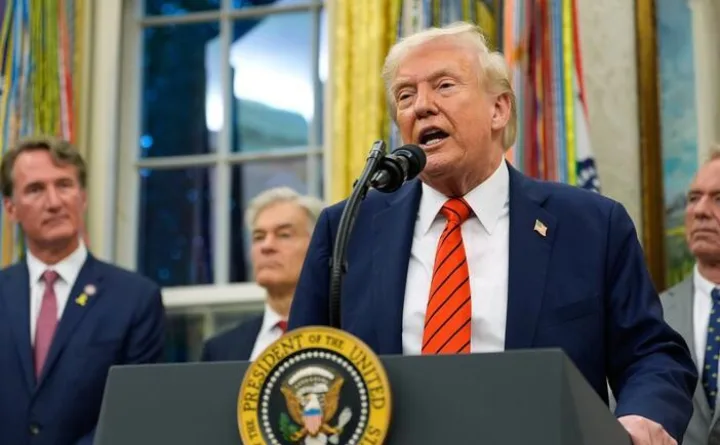
ASIATODAY.ID, WASHINGTON — The administration of U.S. President Donald Trump has introduced a new round of tariffs on imports from 60 trading partners, including Indonesia and several major Asian economies, in the latest move to tighten Washington’s global trade policy.
The U.S. Trade Representative (USTR) announced that the new tariffs will take effect on Friday (July 24, 2026), with duties ranging between 10% and 12.5%.
U.S. Trade Representative Jamieson Greer said the tariffs were designed to address what Washington described as unfair trade practices, including concerns over forced labor in global supply chains.
The new measures represent another step by the Trump administration to rebuild a broader tariff framework after previous global tariff policies were challenged and partially overturned by the U.S. Supreme Court.
Indonesia Included in 10% Tariff Group
Indonesia is among the countries subject to a 10% tariff, alongside several key U.S. trading partners, including India, Malaysia, Canada, the United Kingdom, the European Union, and Taiwan.
The U.S. government said countries placed under the 10% tariff category have committed to adopting and enforcing measures aimed at preventing imports linked to forced labor.
Asia Among the Most Affected Regions
Asia is one of the regions most affected by the new tariff policy, given its central role in global manufacturing and supply chains.
Besides Indonesia, Asian economies included in the tariff list are:
Bangladesh
Cambodia
India
Indonesia
Malaysia
Pakistan
Sri Lanka
Taiwan
China
Hong Kong
Japan
Kazakhstan
New Zealand
Philippines
Singapore
South Korea
Thailand
Vietnam
Many of these economies are major exporters of electronics, automotive components, textiles, semiconductors, machinery, and consumer goods to the U.S. market.
Full List of 60 Countries Facing Trump’s New Tariffs
Countries Subject to 10% Tariff
Argentina
Bangladesh
Cambodia
Canada
Ecuador
El Salvador
Guatemala
Honduras
India
Indonesia
Jordan
Malaysia
Mexico
Pakistan
Sri Lanka
United Kingdom
Trinidad and Tobago
European Union
Taiwan
Countries Subject to 12.5% Tariff
Algeria
Angola
Australia
Bahamas
Bahrain
Brazil
Chile
China
Colombia
Costa Rica
Dominican Republic
Egypt
Guyana
Hong Kong (China)
Iraq
Israel
Japan
Kazakhstan
Kuwait
Libya
Morocco
New Zealand
Nicaragua
Nigeria
Norway
Oman
Peru
Philippines
Qatar
Russia
Saudi Arabia
Singapore
South Africa
South Korea
Switzerland
Thailand
Türkiye
United Arab Emirates
Uruguay
Venezuela
Vietnam
Tariffs Raise Inflation Concerns in the U.S.
Economists warned that the new tariffs could increase import costs and potentially fuel higher prices for American consumers.
Importers often pass additional tariff costs along through higher prices, affecting household goods, electronics, vehicles, and manufactured products.
Investment bank Macquarie previously estimated that countries affected by the tariff measures represent around 99% of total U.S. imports, although exemptions could reduce the overall impact.
Trump Uses Section 301 Trade Authority
The Trump administration is using Section 301 of the U.S. Trade Act of 1974 as the legal basis for the new tariffs.
The provision allows Washington to impose trade measures against countries considered to have adopted policies that harm U.S. economic interests.
The latest action follows a series of additional tariff announcements by Trump, including a 50% tariff on selected Canadian products, a planned 100% tariff on generic drug manufacturers starting in 2028, and 25% tariffs on several Brazilian goods.
The new tariff regime places fresh pressure on Asian exporters as governments and businesses assess the impact on global supply chains, investment flows, and access to the U.S. market. (AT Network)
Follow Us at Google News, Instagram and LinkedIn