
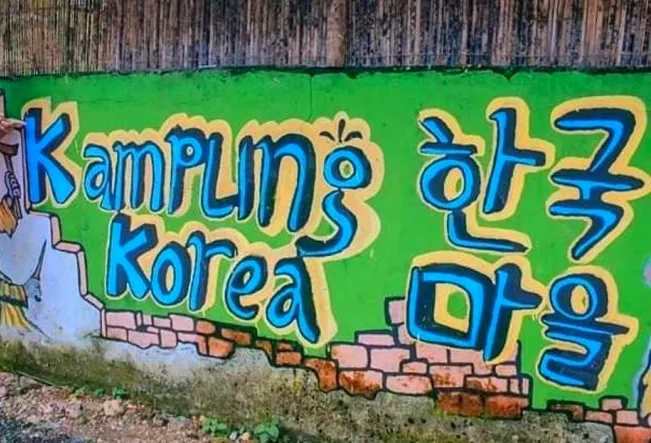
ASIATODAY.ID, BAUBAU — In a quiet corner of Buton Island, far from the global spotlight, an extraordinary cultural encounter is taking place.
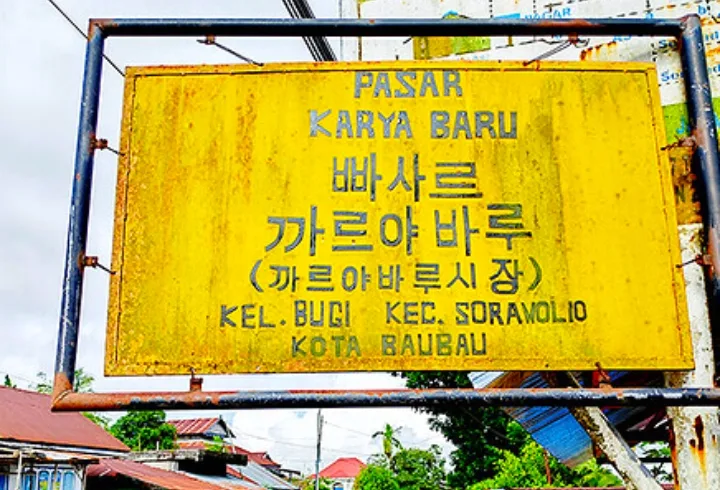
Street signs written in Korean characters stand alongside traditional Indonesian landscapes. Schoolchildren learn to write using the same alphabet used in South Korea, yet the words they write belong to an indigenous language that has existed for generations.
This is Kampung Korea (Korean Village) in Baubau, Southeast Sulawesi, a unique community where the Korean writing system Hangeul has become a tool to preserve the local language of the Cia-Cia people.
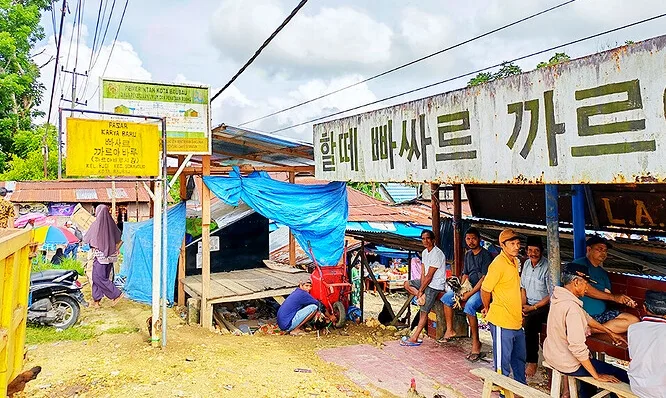
Located in Bugi Village, Sorawolio District, around 15–18 kilometers from Baubau City, the village has gained international attention for its rare combination of local heritage and cross-cultural cooperation.
The story of Kampung Korea is not about replacing one culture with another. It is about how communities can embrace innovation while protecting their roots.
Saving a Language Through a New Writing System
Indonesia is one of the world’s most linguistically diverse countries, home to hundreds of ethnic groups and more than 700 local languages.
However, many indigenous languages face challenges as younger generations increasingly shift toward dominant languages used in education, media, and daily communication.
The Cia-Cia language of Buton Island experienced a similar challenge.
Although spoken by tens of thousands of people, Cia-Cia historically existed mainly as an oral tradition. Without a widely used writing system, preserving its vocabulary, stories, and cultural knowledge became increasingly difficult.
The search for a solution began in 2005 during the International Symposium on Nusantara Manuscripts held in Baubau.
During the event, Korean linguist Professor Chun Tai-Hyun noticed similarities between the phonetic patterns of the Cia-Cia language and the structure of Hangeul, the scientific writing system developed in Korea during the Joseon Dynasty.
His observation led to further linguistic studies involving Indonesian cultural researchers and Korean language experts, including the Hunminjeongeum Research Institute.
After years of research and discussion, the Baubau government introduced the adaptation of Hangeul for writing the Cia-Cia language in 2009.
When Korean Letters Carry Buton’s Voice
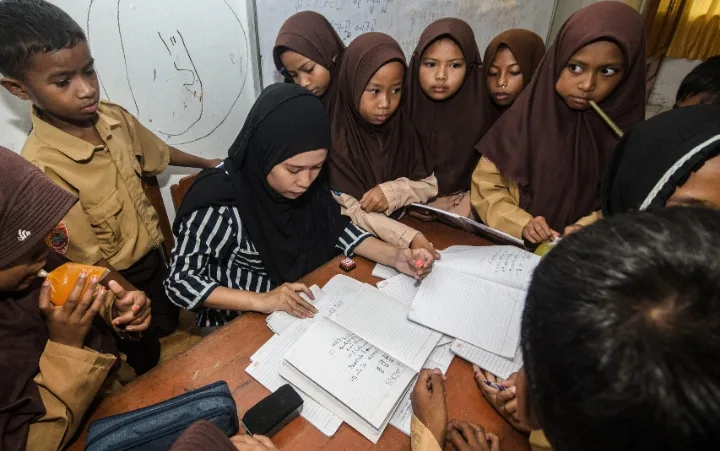
The adoption of Hangeul did not change the identity of the Cia-Cia people. Instead, it provided a new method to document and teach their own language.
In schools across Baubau, students learn how to write Cia-Cia words using adapted Hangeul characters. The program aims to encourage younger generations to continue using and appreciating their ancestral language.
Teachers in Bugi Village explain that the initiative is focused on language preservation, not cultural replacement.
The students still speak Cia-Cia in their daily lives, while Hangeul functions as a written medium that helps record their heritage.
This experience offers an important lesson for the world: cultural exchange can strengthen local identity when it is embraced with respect and purpose.
A Unique Experiment in Cultural Preservation
The use of Hangeul for Cia-Cia has generated discussions among academics and cultural observers.
Supporters argue that languages are living traditions that naturally evolve over time. They see the adaptation of Hangeul as a creative solution to protect a language from disappearing.
They point out that many cultures throughout history have adopted external writing systems while maintaining their own identity and traditions.
However, some observers have questioned whether a foreign script is the most appropriate choice, highlighting traditional writing systems from the Buton region, including Buri Wolio, which has historical connections with local culture.
Researchers emphasize that continuous evaluation, linguistic studies, and community involvement remain essential to ensure that the writing system serves the needs of native speakers.
The discussion reflects a global challenge faced by indigenous communities everywhere: how to preserve heritage while adapting to a rapidly changing world.
From Language Preservation to Cultural Tourism
Over the years, Kampung Korea Baubau has evolved into more than a language preservation initiative. It has become a cultural destination showcasing the creativity of the local community.
Young residents have transformed the village with colorful murals, cultural landmarks, and public spaces decorated with Hangeul inscriptions.
Visitors can explore streets marked with Korean characters, learn about the history of the Cia-Cia people, and experience a rare cultural blend between Southeast Sulawesi and South Korea.
Traditional Korean clothing such as hanbok has also become part of the visitor experience, offering tourists a glimpse of the cultural connection between two distant regions of Asia.
Yet behind the visual appeal lies a deeper message: this village represents a community’s determination to ensure that its language and identity continue to live.
A Small Village with a Global Message
Kampung Korea Baubau demonstrates that cultural diplomacy does not always begin with governments or large institutions. Sometimes, it begins with ordinary communities protecting their heritage.
The connection between Cia-Cia and Hangeul represents a unique form of Indonesia–South Korea cultural cooperation — built through language, education, and shared knowledge.
For Indonesia, a nation celebrated for its extraordinary cultural diversity, the story of Baubau reflects a larger mission: ensuring that local identities remain alive in an increasingly interconnected world.
For South Korea, the story highlights the global influence of Hangeul beyond its national borders.
From a small village on Buton Island, Kampung Korea Baubau delivers a powerful message:
Heritage survives when communities are willing to innovate, collaborate, and create new bridges between cultures. (AT Network)
Follow Us at Google News, Instagram and LinkedIn