
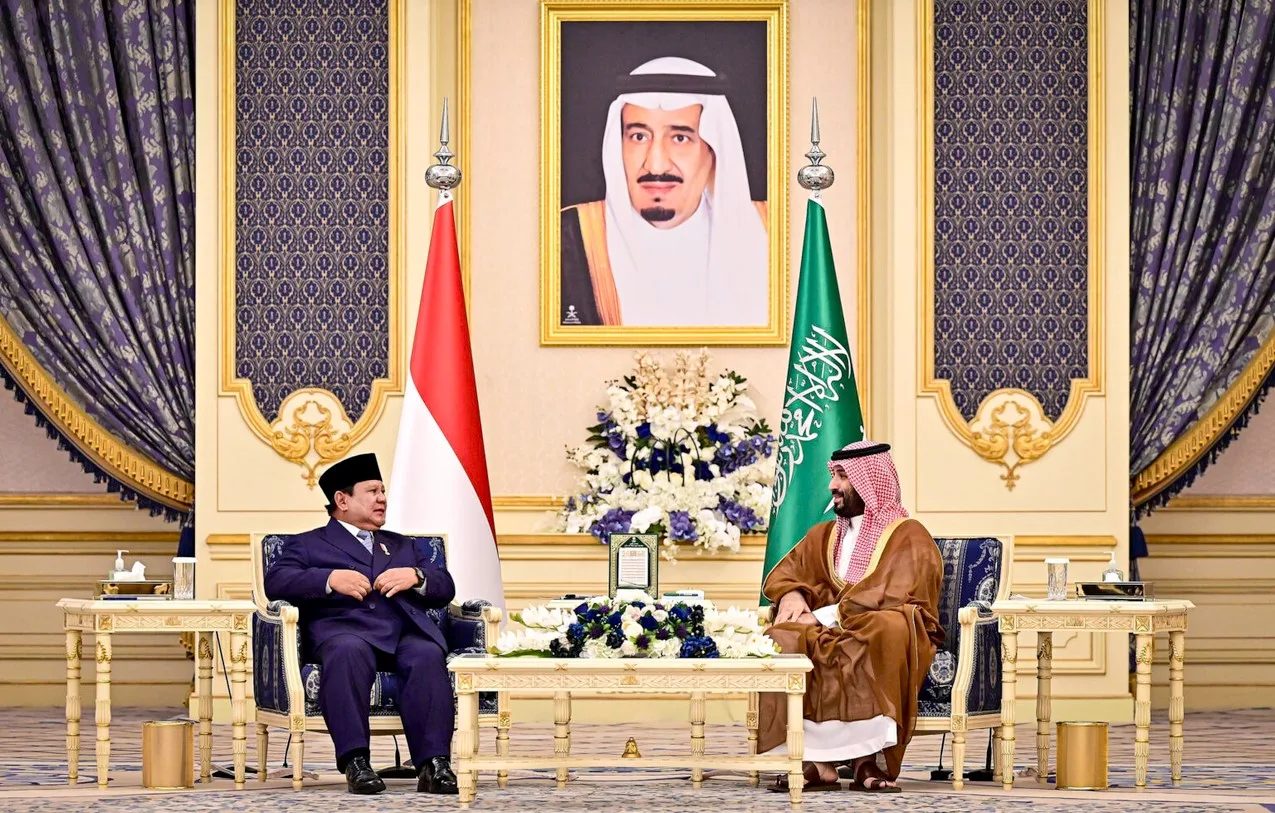
ASIATODAY.ID, JEDDAH – Indonesia and Saudi Arabia have entered a new phase of strategic bilateral relations. Indonesian President Prabowo Subianto and Saudi Crown Prince and Prime Minister Mohammed bin Salman bin Abdulaziz Al Saud (MBS) reaffirmed their commitment to expanding cross-sectoral cooperation during a bilateral meeting held at Al-Salam Palace in Jeddah on Wednesday, July 2, 2025.
The meeting produced a joint statement underscoring a shared vision to strengthen collaboration in economy, investment, energy, healthcare, defense, and regional peacebuilding. A landmark achievement from the visit was the signing of the Minutes of Meeting for the Indonesia–Saudi Arabia Supreme Coordination Council (SCC) — a high-level mechanism to streamline and institutionalize future strategic initiatives between both countries.
Strengthening Bilateral Trade and Economic Ties
President Prabowo and Crown Prince MBS highlighted the significant growth of bilateral trade, which has reached approximately USD 31.5 billion over the past five years, positioning Saudi Arabia as one of Indonesia’s key trade partners in the Middle East.
Both leaders stressed the importance of boosting trade volume, empowering the private sector, and convening regular business forums through the Saudi–Indonesian Business Council. They also called for the swift conclusion of the Indonesia–Gulf Cooperation Council (GCC) Free Trade Agreement, following positive negotiation rounds in September 2024 and February 2025.
USD 27 Billion in Investment Deals and Clean Energy Cooperation
During the visit, a series of MoUs were signed between Indonesian and Saudi private sector entities, with total investments reaching USD 27 billion. These agreements span clean energy, petrochemical industries, and aviation fuel services.
Indonesia commended Saudi Arabia’s vital role in maintaining global oil market stability and reaffirmed the importance of energy security. Both countries agreed to enhance cooperation in: Crude oil supply and downstream derivatives, Refinery and petrochemical projects, Renewable and sustainable energy development, Energy efficiency and carbon management, Clean hydrogen technologies, Artificial intelligence for sustainable energy innovation.
In the mining and mineral resources sector, collaboration will include geological data sharing, exploration, modern processing technologies, and investment facilitation.
Expanding Strategic Cooperation in Health, Digital Economy, and Security
The joint statement also emphasized cooperation in healthcare, particularly in improving Hajj and Umrah services. The countries pledged to support pharmaceutical and vaccine production, medical technology development, and capacity-building for human resources.
Further collaboration will span the digital economy, judiciary systems, labor mobility, culture, tourism, youth and sports, education and scientific research, agriculture, fisheries, and food security.
In defense and security, both parties agreed to enhance joint efforts against terrorism, violent extremism, cyber threats, and information sharing for mutual regional stability.
Indonesia–Saudi Arabia Supreme Coordination Council (SCC) Officially Formed
A key outcome of the visit was the establishment of the Supreme Coordination Council (SCC) between Indonesia and Saudi Arabia. The SCC will serve as an institutional platform to coordinate strategic partnerships under the guidance of both countries’ Foreign Ministers.
The SCC model mirrors Saudi Arabia’s existing strategic frameworks with the United States and China, cementing Indonesia’s position as a trusted strategic partner in Southeast Asia.
“We agreed to elevate cooperation in all sectors. Alhamdulillah, the meeting was highly productive,” President Prabowo remarked after the summit.
Joint Call for Global Action on Palestinian Peace
In their joint statement, President Prabowo and Crown Prince MBS issued a firm call to the international community to take concrete action to end the humanitarian crisis in Gaza and support sustainable peace in the region.
Both leaders condemned the use of blockades and starvation as weapons and rejected all forms of forced displacement of Palestinians. They reaffirmed their support for the two-state solution, including the establishment of an independent Palestinian state with East Jerusalem as its capital.
Indonesia and Saudi Arabia also: Supported political solutions for the Yemen crisis through the Jeddah Forum, Welcomed the lifting of sanctions on Syria by the US, UK, and EU, Advocated for peaceful resolution in Sudan through inclusive dialogue and a lasting ceasefire. (AT Network)
Follow Us at Google News and WA Channel