
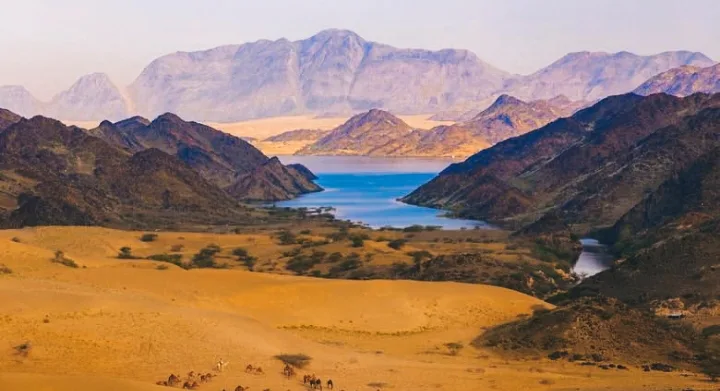
ASIATODAY.ID, JEDDAH — Located south of Al-Qunfudhah Governorate, Wadi Hali stands as one of the most iconic valleys along the Tihama coast. More than a striking natural landscape, Wadi Hali is a living historical marker—a vital source of life that has shaped human settlement and local civilization since ancient times.
With its lush green scenery, crystal-clear waters flowing between verdant banks, and sky reflections that create a sense of natural harmony, Wadi Hali offers a rare blend of fertility and beauty. Its most remarkable feature is its year-round water flow, an exceptional phenomenon in the typically arid Tihama region.
This continuous water supply has transformed Wadi Hali into a critical agricultural artery. Expansive plains, towering palm groves, and fertile farmlands produce grains, vegetables, dates, and mangoes.
Beyond irrigation, the gentle murmur of flowing water sets the daily rhythm of nearby villages, sustaining livelihoods and anchoring economic stability for generations.
Historically, local communities have relied on the valley as the foundation of their social and economic resilience.
Today, Wadi Hali is gaining renewed recognition for its environmental and cultural significance, offering strong potential for eco-tourism and rural tourism development.
The valley’s landscape is also dotted with historical and archaeological sites, forming a distinctive blend of natural splendor and cultural heritage.
As a living testament to the deep bond between people and land, Wadi Hali remains an enduring part of the coastal memory—preserved by its fertile soil and passed down through generations. (SPA)
Follow Us at Google News and WA Channel