
ASIATODAY.ID, JAKARTA – Southeast Asia is stepping into the global nuclear technology arena with growing ambition.
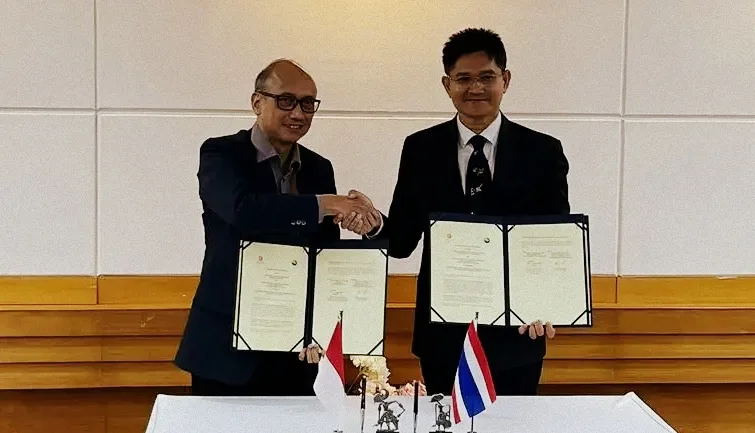
Indonesia’s National Research and Innovation Agency (BRIN) has officially partnered with the Thailand Institute of Nuclear Technology (TINT) in a strategic move to accelerate cyclotron development—key infrastructure for producing radioisotopes essential to modern medicine and industry.
The agreement, signed Tuesday, March 31, 2026 at the B.J. Habibie Building in Jakarta, signals more than diplomatic cooperation. It reflects a bold regional push to reduce dependence on imported radioisotopes and strengthen ASEAN’s technological sovereignty.
At the heart of the collaboration is the development of a 13 MeV DECY Cyclotron prototype and its beam line, a critical system used to produce medical isotopes for diagnostics and cancer treatment.
Edy Giri Rachman Putra, BRIN’s Deputy for Human Resources in Science and Technology, stressed that the partnership must go beyond formalities.
“We are not stopping at a memorandum of understanding. This must translate into concrete action to strengthen nuclear and accelerator technologies across Asia,” he said.
BRIN is also expanding the scope of cooperation through researcher and student exchanges, alongside the development of a regional research collaboration platform—an effort aimed at building an integrated innovation ecosystem within ASEAN.
TINT Executive Director Thawatchai Onjun described the partnership as a gateway to broader nuclear research integration in Southeast Asia. He noted that similarities in infrastructure, expertise, and research focus between the two institutions create strong potential for synergy while minimizing duplication.
“We share many common strengths—from infrastructure to human resources. This creates a powerful foundation for mutual learning and advancement,” he said.
Meanwhile, Syaiful Bahri, Head of BRIN’s Nuclear Energy Research Organization, emphasized that the collaboration will move toward more structured joint research agreements, particularly in advanced fields such as accelerator and nuclear fusion technologies.
BRIN has also opened its research ecosystem to Thai scientists, engineers, and students—signaling a shift from symbolic cooperation to deep, cross-border scientific integration.
As part of the implementation phase, TINT delegates are scheduled to visit BRIN’s nuclear research facilities in Serpong, Banten, as well as the 13 MeV DECY Cyclotron facility in Babarsari, Sleman, Yogyakarta.
This partnership marks a pivotal moment: ASEAN is no longer just a participant in global technology—it is positioning itself as a future hub for nuclear innovation, spanning healthcare, industry, and beyond. (AT Network)
Follow Us at Google News and WA Channel