
ASIATODAY.ID, BEIJING — East Asia’s strategic landscape is entering a more confrontational phase. In a calculated dual move, China has tightened export controls on Japan while simultaneously reinforcing strategic ties with South Korea, sending a clear geopolitical message to the region: Taiwan remains Beijing’s non-negotiable red line.
On Tuesday, January 6, 2026, China’s Ministry of Commerce announced immediate restrictions on exports to Japan of so-called “dual-use” goods—civilian products that could potentially be repurposed for military applications. The decision marks a sharp escalation in Sino-Japanese tensions and highlights the growing fusion of economics and security in Asia’s power politics.
China Tightens the Screws on Japan
“Exports of all dual-use items to Japanese military users, for military purposes, or to end-users that could enhance Japan’s military capabilities are prohibited,” the ministry said in an official statement.
While Beijing did not disclose a detailed list of affected products, it categorized them as “sensitive”, including items related to biotechnology, aerospace, and telecommunications—key sectors in modern defense and high-technology competition.
According to Chinese officials, the move is aimed at “safeguarding national security and national interests.” However, analysts widely view the policy as economic statecraft, designed to pressure Tokyo without direct military confrontation.
Taiwan: The Strategic Trigger
The latest escalation follows remarks made in early November by Japanese Prime Minister Sanae Takaichi, who suggested that a potential conflict over Taiwan could involve Japanese military intervention.
For Beijing, such statements cross a fundamental sovereignty line. China regards Taiwan as an inseparable part of its territory and has repeatedly warned foreign powers against interference in the Taiwan Strait.
In a separate statement on Tuesday, China’s Ministry of Commerce explicitly criticized Japan, accusing Tokyo of making “erroneous and misleading statements” on Taiwan that could destabilize regional security.
The export restrictions are therefore widely interpreted as a targeted warning—a signal to Japan that its Taiwan stance carries tangible economic consequences.
Beijing’s Other Hand: Courting South Korea
In stark contrast to its hardline approach toward Japan, China adopted a conciliatory and strategic tone toward South Korea.
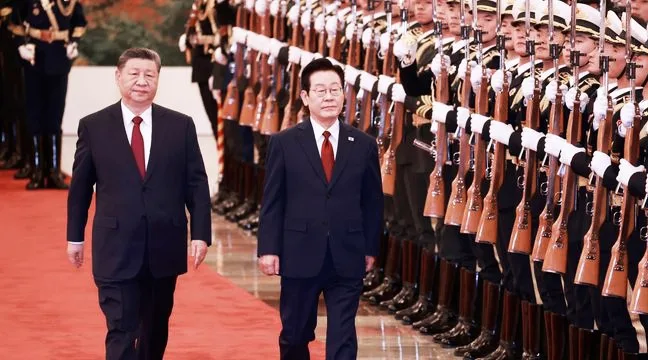
On Monday evening, January 5, 2026, President Xi Jinping hosted South Korean President Lee Jae Myung at the Great Hall of the People in Beijing, in a ceremony marked by full state honors, including a 21-gun salute at Tiananmen Square and a formal state banquet.
Xi emphasized that China views South Korea as a priority partner in its neighborhood diplomacy, underscoring continuity, stability, and long-term cooperation despite differences in political systems and ideology.
“China is ready to work with South Korea to strengthen strategic cooperation, expand mutually beneficial economic ties, and inject positive energy into regional peace and development,” Xi said.
The Chinese leader highlighted opportunities for deeper collaboration in artificial intelligence, green industries, supply chains, and aging-economy sectors, while jointly opposing protectionism and promoting genuine multilateralism in an increasingly multipolar world.
Seoul Reaffirms ‘One China’ Policy
President Lee Jae Myung responded by reaffirming Seoul’s commitment to respect China’s core interests, including adherence to the ‘One China’ policy—a diplomatic position that sharply contrasts with Japan’s more assertive posture on Taiwan.
South Korea, Lee said, is prepared to restore full momentum to bilateral relations, expand people-to-people exchanges, and deepen strategic coordination with Beijing at both bilateral and multilateral levels.
The two leaders jointly witnessed the signing of 15 cooperation agreements covering science and technology, environmental protection, transportation, trade, and other strategic sectors.
A Clear Message to Asia
Taken together, Beijing’s moves reveal a coherent regional strategy: pressure those perceived as challenging China’s Taiwan position, while strengthening ties with neighbors willing to prioritize stability and dialogue.
For Asia, this is more than a diplomatic dispute. It signals a new phase of geopolitical competition, where trade controls, technology access, and strategic partnerships are deployed as instruments of power.
As tensions over Taiwan intensify, East Asia is increasingly shaped not only by military calculations, but by economic leverage and diplomatic alignment—with China making clear that neutrality on Taiwan is rapidly becoming a strategic luxury few can afford. (AT Network)
Follow Us at Google News and WA Channel