
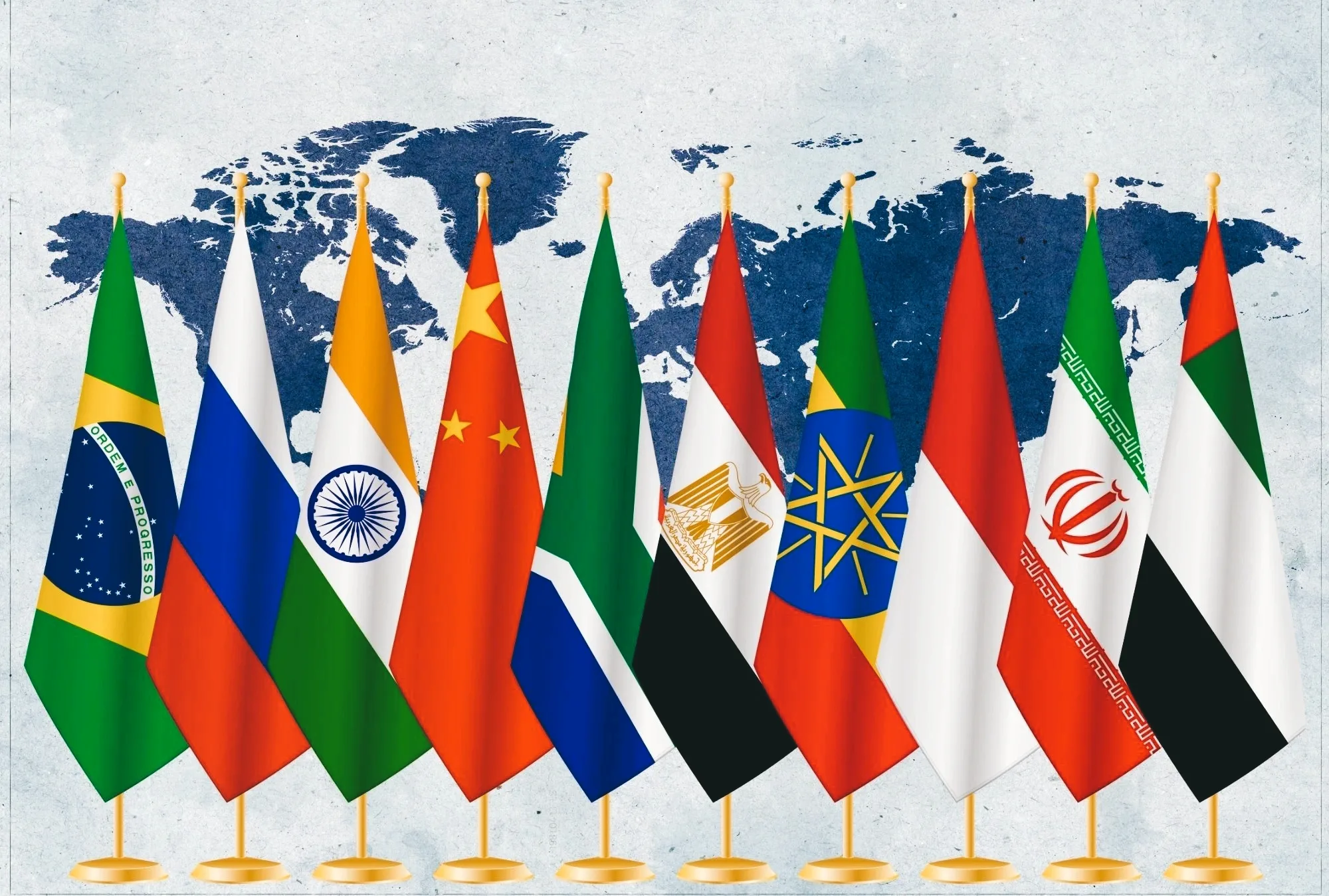
ASIATODAY.ID, JAKARTA – For much of the past century, the world’s economic gravity revolved around Washington, London, Tokyo, and Brussels.
Now, a new wave is rising from the South. The nations once labeled as “developing” are redefining that narrative. They are no longer just markets or recipients of global capital—they are becoming architects of a new economic order, driven by the power of BRICS and the Global South.
In the wake of the 2008 financial crisis, the COVID-19 pandemic, and mounting geopolitical tensions between East and West, a new movement has emerged. It is not merely a counterweight to the West—it is a demand for fairness in growth and sovereignty in decision-making.
BRICS: From a Symbolic Alliance to a Global Economic Engine
When BRICS was established in 2009, few believed it could evolve beyond rhetoric. Yet in 2025, the numbers tell a different story.
BRICS now accounts for over 32 percent of global GDP (PPP)—surpassing the G7 for the first time in modern history.
More importantly, BRICS is building the institutional backbone of a new global economy:
The New Development Bank (NDB) offers alternative financing without political conditionalities.
Local currency trade mechanisms are reducing dependence on the U.S. dollar.
Collaborative energy and technology programs are accelerating the global green transition.
With Indonesia now join as a new member, BRICS is no longer just an economic bloc—it has become the ideological and structural core of the Global South.
Indonesia, Brazil, and South Africa: A Strategic Southern Triangle
The recent trilateral meetings among Presidents Prabowo Subianto (Indonesia), Luiz Inácio Lula da Silva (Brazil), and Cyril Ramaphosa (South Africa) in Jakarta symbolize this shifting world order.
Each country represents a pillar of Southern strength:
Indonesia brings vast natural resources and maritime power.
Brazil contributes its dominance in agriculture, bioenergy, and tropical forests.
South Africa adds industrial depth and renewable energy innovation.
Together, they are crafting a South-South alliance based on mutual respect, economic justice, and shared sustainability.
“BRICS is not anti-West,” President Prabowo Subianto declared at the Merdeka Palace. “It is about reshaping the world so that every nation has a voice and an equal chance to prosper.”
Concrete outcomes emerged from these meetings, including eight Memoranda of Understanding (MoUs) between Indonesia and Brazil on renewable energy, agricultural research, and statistics cooperation, while discussions with South Africa focused on trade expansion and technology transfer.
Lula da Silva: The Architect of Southern Solidarity
Brazil’s President Luiz Inácio Lula da Silva—a long-time champion of Global South cooperation—has re-emerged as one of the moral and strategic voices of the new global order.
During his visit to Jakarta, Lula emphasized that a fairer world economy is not just a dream, but a necessity.
“The world needs a new balance,” Lula said. “We do not oppose anyone—but we refuse to remain the object of global economic policy.”
Under his leadership, Brazil is promoting cross-South trade, sustainable investment, and agro-technological collaboration to tackle global food insecurity.
Lula views partnership with Indonesia and South Africa as a geopolitical alignment of purpose—to rewrite the terms of engagement between North and South.
Cyril Ramaphosa: Reviving the Bandung Spirit
For South Africa’s President Cyril Ramaphosa, the modern Global South has deep historical roots.
He invoked the legacy of the 1955 Bandung Conference, held in Indonesia, which laid the foundation for the Non-Aligned Movement and the principles of anti-colonial solidarity.
“The Bandung Spirit is alive,” Ramaphosa stated. “Today, we renew it through economic, technological, and green energy cooperation among nations of the South.”
With its expanding industrial capacity and growing influence in Africa, South Africa aims—alongside Indonesia and Brazil—to transform the continent into a growth center rather than a resource supplier.
Prabowo Subianto: A Realist Statesman in a Multipolar Era
For Indonesia, President Prabowo Subianto’s leadership in the BRICS dialogue reflects a pragmatic yet visionary diplomacy.
He has positioned Indonesia as both a bridge and a catalyst—connecting Asia, Africa, and Latin America while advocating for economic sovereignty and equitable global governance.
Through cooperation with Brazil and South Africa, Indonesia seeks to:
Diversify its export and investment partners;
Secure access to renewable and clean energy technology;
Strengthen resilience in food and energy security;
Amplify its diplomatic voice on global issues such as climate and fair trade.
“Indonesia is ready to serve as a bridge between continents,” Prabowo noted. “Our role is not to choose sides, but to build new pathways of cooperation.”
From Alternative to Imperative: The Rise of a New Global Center
The 21st century’s defining contest is no longer West versus East, but North versus South.
And the South is no longer peripheral—it has become the world’s new center of growth and innovation.
With over six billion people, vast resources, and expanding domestic markets, the Global South now holds the key to future global prosperity.
In the coming decade, BRICS and its partners are projected to drive the majority of global economic expansion, challenging old hierarchies of wealth and power.
This is not a rebellion—it is an evolution. A call for a multipolar world built on cooperation, not domination.
A More Balanced World
The rise of BRICS and the Global South marks a historic inflection point.
For the first time in modern history, the nations of the South are not being shaped by the world—they are shaping the world.
Through shared prosperity, sustainable growth, and renewed solidarity, they are building a new axis of stability—one rooted not in military power, but in economic interdependence and moral balance.
“We are not challenging the old powers,” Prabowo concluded. “We are building a new one—born from solidarity and shared hope.”
And perhaps, for the first time in decades, the world stands at the threshold of becoming more balanced, more just, and more humane. (AT Network)
Follow Us at Google News and WA Channel