
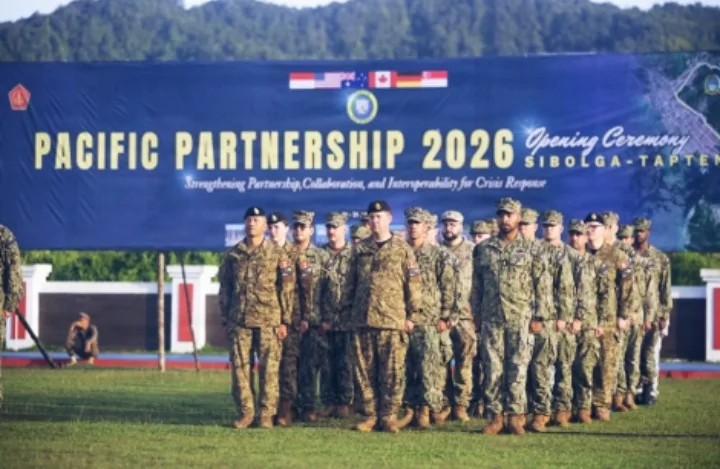
ASIATODAY.ID, JAKARTA — Indonesia and the United States are expanding their strategic partnership in the Indo-Pacific through two major multinational initiatives that connect humanitarian assistance, disaster preparedness, and international peacekeeping cooperation.
The Pacific Partnership 2026 (PP26) in Sibolga, North Sumatra, and the Garuda Canti Dharma III 2026 (GCD26) peacekeeping exercise in Bogor, West Java, demonstrate a broader commitment by Indonesia, the United States, and partner nations to building a more resilient and secure region.
The two initiatives bring together military personnel, government officials, medical experts, and humanitarian specialists from multiple countries to strengthen operational coordination, emergency response capabilities, and cooperation in addressing shared regional challenges.
Strengthening Humanitarian Resilience in the Indo-Pacific
The Pacific Partnership 2026 mission arrived in Sibolga on July 20, 2026, aboard the Royal Australian Navy’s Bay-class amphibious ship HMAS Choules (LSD 100).
Now in its 22nd edition, Pacific Partnership is the largest annual multinational disaster preparedness and humanitarian assistance mission led by the United States Navy in the Indo-Pacific.
The 2026 mission marks the seventh Pacific Partnership deployment to Indonesia since the program first came to the country in 2006.
Participating countries include Indonesia, the United States, Australia, Canada, Germany, and Singapore, working together to strengthen regional capacity in disaster response, medical cooperation, engineering support, and community resilience.
The program includes emergency preparedness training, medical exchanges, disaster management workshops, infrastructure improvement projects, and public engagement activities designed to improve cooperation between military and civilian communities.
Pacific Partnership 2026 Mission Commander Captain Robert Reyes said Sibolga’s history of facing natural disasters highlights the importance of collective action.
“Disaster preparedness is a shared effort to build resilience for future challenges,” he said.
US Embassy Jakarta Chargé d’Affaires Joy Sakurai emphasized that the mission reflects the enduring commitment between Washington and Jakarta to strengthen regional resilience.
“Together with Indonesia and multinational partners, we are enhancing capabilities that save lives and supporting a safer and more secure Indo-Pacific,” she said.
Advancing International Peacekeeping Cooperation
At the same time, Indonesia is hosting Garuda Canti Dharma III 2026, part of the Multinational Peacekeeping Exercise (MPE26), at the Peacekeeping Mission Center (PMPP) in Bogor.
Held from July 20 to August 2, 2026, the exercise involves more than 700 personnel from 22 countries across five continents, including ASEAN members Malaysia, the Philippines, Singapore, Thailand, and Vietnam, as well as Australia, Canada, New Zealand, the United Kingdom, the Netherlands, Argentina, Brazil, and Uruguay.
The exercise, conducted by the US Indo-Pacific Command (USINDOPACOM), the Indonesian Armed Forces (TNI), and international partners, focuses on strengthening readiness for United Nations peacekeeping operations.
Training activities include peacekeeping staff operations, field exercises, and the development of critical enabling capabilities to support multinational missions.
Hawaii National Guard Deputy Adjutant General Brigadier General Phillip L. Mallory said the exercise reflects a shared commitment among nations to prepare professional peacekeepers capable of operating together in complex environments.
“Today’s training strengthens our ability to work together in support of international peace and security,” he said.
Indonesia’s Strategic Role in a Changing Indo-Pacific
The simultaneous implementation of Pacific Partnership 2026 and Garuda Canti Dharma III highlights Indonesia’s growing role as a key security and humanitarian partner in the Indo-Pacific.
Beyond traditional defense cooperation, these initiatives represent a broader model of regional security — one that combines military readiness, humanitarian assistance, disaster resilience, and multilateral cooperation.
As climate-related disasters, humanitarian emergencies, and geopolitical challenges continue to reshape the regional landscape, cooperation among countries has become increasingly important.
Through these multinational missions, Indonesia and the United States are reinforcing a partnership built not only on security cooperation, but also on a shared commitment to protecting communities, supporting peace operations, and maintaining stability across the Indo-Pacific.
As the world’s largest archipelagic nation and a central ASEAN member, Indonesia continues to play a pivotal role in connecting regional security, humanitarian cooperation, and global peace efforts. (AT Network)
Follow Us at Google News, Instagram and LinkedIn