
ASIATODAY.ID, SAMOSIR — The Government of Indonesia is accelerating efforts to strengthen the foundations of the rural economy. Through Presidential Instruction (Inpres) No. 17 of 2025, the government has mandated the rapid development of warehouses, outlets, and supporting infrastructure for Koperasi Desa dan Kelurahan Merah Putih (Village and Subdistrict Merah Putih Cooperatives or KDKMP) across the country.
This initiative forms part of a broader national strategy to expand the cooperative-based economic network and promote equitable prosperity across rural communities.
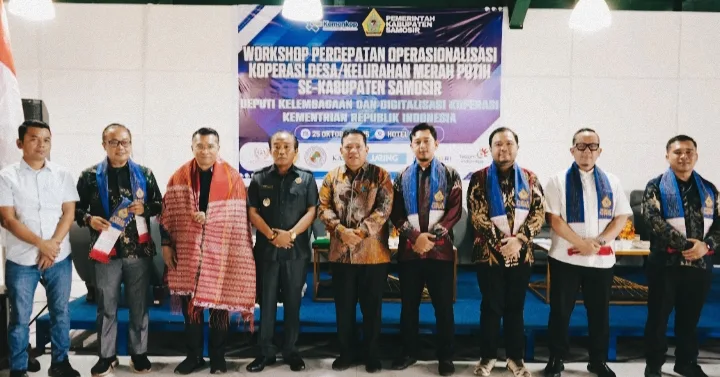
Henra Saragih, Deputy for Institutional and Digitalization Affairs at the Ministry of Cooperatives and SMEs, emphasized the importance of this acceleration during the Workshop on the Operationalization of KDKMPs held in Pangururan, Samosir, on Saturday, October 25, 2025.
The event was attended by Samosir Deputy Regent Ariston Tua Sidauruk, along with strategic partners such as Koperasi Kana, KSP Makmur Mandiri, KSP Nasari, Kopdit Pintu Air, and representatives from 134 KDKMP units throughout the region.
According to Henra, warehouse construction — each with a maximum area of 1,000 square meters — will be carried out by PT Agrinas Pangan Nusantara, financed up to Rp3 billion per unit through Himbara state-owned banks. The initiative has also been included in Indonesia’s list of National Strategic Projects (PSN) under Presidential Instruction No. 9 of 2025.
“The operationalization of KDKMPs must be accelerated because their benefits are directly felt by rural communities. These cooperative warehouses and outlets will serve as the backbone of local economies based on mutual cooperation,” Henra said.
He further explained that the government’s current priorities include four key agendas:
1. Activation of the Village Cooperative Information System (SIMKOPDES);
2. Establishment of cooperative outlets;
3. Preparation of financing proposals through Himbara banks; and
4. Strengthening partnerships with state-owned enterprises (BUMN).
Henra also encouraged residents to become active cooperative members. With a population of around 150,000 people, he noted, if half of Samosir’s residents save and invest through cooperatives, the potential capital circulation could reach billions of rupiah.
“Merah Putih Cooperatives must become the pillars of rural economic independence, rooted in the spirit of togetherness and national solidarity,” Henra asserted.
Kana Cooperative Enhances Food Distribution Synergy
In line with the government’s initiative, Kana Cooperative introduced the “Koperasi Manis” (Sweet Cooperative Program) — a collaborative effort inviting village cooperatives across Indonesia to build a national food distribution network, particularly for white sugar and essential goods.
The program is designed to maximize the use of warehouses and outlets developed by the government under the KDKMP framework.
As a form of concrete support, Kana Cooperative provides operational funding of Rp2 million per month for each participating KDKMP.
Food products are distributed on a consignment basis without any upfront payment, with potential monthly transactions of up to Rp200 million per cooperative. This scheme keeps cooperative cash flow liquid, reduces financial risks, and accelerates the circulation of essential commodities in local markets.
Anggara Putra Priwardana, representative of Kana Cooperative, described the synergy between infrastructure development and cooperative operations as a practical step toward strengthening Indonesia’s food supply chain.
“The warehouses and outlets built by the government serve as the logistical backbone for village cooperatives. Through the Koperasi Manis program, these facilities can be optimized as collective distribution centers for essential goods,” Anggara explained.
“The government provides the infrastructure, while cooperatives drive the economic movement. This is the true embodiment of synergy between the state and its people,” he added.
Henra Saragih welcomed the initiative, recognizing Koperasi Manis as an ideal model of collaboration between government policy and the people’s cooperative movement.
“The development of cooperative infrastructure must go hand in hand with productive economic activities. The warehouses built by the government will create greater value when used for the distribution of essential goods such as sugar and other basic necessities — ensuring their benefits reach the wider community,” Henra concluded.
Through this accelerated development and operational synergy, the Government of Indonesia aims to position cooperatives as the driving engine of rural economic growth, strengthen the national food supply chain, and create new employment opportunities in the real sector. (Silvia Andriani)
Follow Us at Google News and WA Channel