
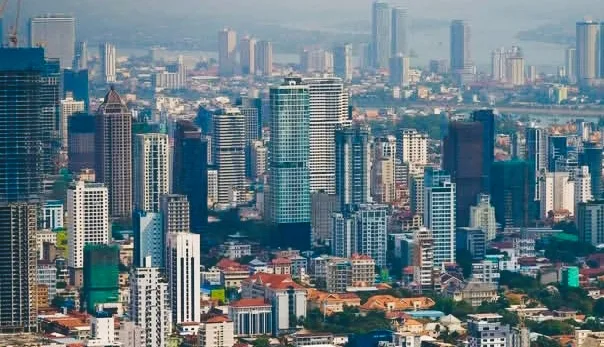
ASIATODAY.ID, WASHINGTON — The International Monetary Fund (IMF) has issued a stark warning on Cambodia’s economic outlook following the completion of its 2025 Article IV Consultation. The report—released after Executive Board discussions on November 21, 2025—highlights decelerating growth, weakening domestic demand, and mounting financial sector vulnerabilities that could place the Cambodian economy under significant pressure through 2026.
According to the IMF, Cambodia’s growth is expected to plunge to 4.8% in 2025 and fall further to just 4.0% in 2026, marking one of the sharpest projected slowdowns in the region. This downturn is driven by volatile exports, declining remittances, a slowdown in tourism, and anemic credit expansion. Inflation is projected to rise modestly next year before easing again in 2026.
Economic Gains Unravel as Multiple Shocks Hit Cambodia
Cambodia posted a strong recovery in 2024 with 6.0% growth, supported by rebounding garment exports, agricultural shipments, and tourism. Momentum continued into early 2025, with nowcasting indicating 6.2% year-on-year expansion in the first half.
But the IMF stresses that a string of simultaneous shocks—trade disruptions, border tensions, and slowing credit—has revealed deep-seated vulnerabilities in the economy. By the second half of 2025, clear signs of a downturn had already emerged.
Tariff pressures, weakening foreign demand, and declining remittances have further squeezed domestic consumption, while manufacturers face shrinking margins.
IMF Flags Downside Risks and Heightened Financial Fragility
The IMF underscores that risks are heavily tilted to the downside, led by vulnerabilities in Cambodia’s financial sector. These include:
Elevated private debt and rising non-performing loans
Weak governance and regulatory gaps
Real estate corrections undermining asset quality
Trade policy uncertainty that could squeeze export-driven industries
Border tensions that could further damage tourism and investor confidence
However, the Fund notes that Cambodia could benefit from deeper regional trade integration and stronger labor absorption if returning migrant workers are reintegrated effectively.
Policy Recommendations: Stabilize Now, Reform Fast
1. Fiscal Policies: Targeted Support, but With Discipline
IMF Directors urge Cambodia to provide temporary support to vulnerable households and displaced workers while preserving fiscal prudence. Medium-term efforts must include:
Growth-friendly fiscal consolidation
Improved expenditure efficiency
Stronger public infrastructure governance
Higher domestic revenue mobilization
2. Monetary Policy: Normalize Carefully
The Fund advises gradual normalization, including the return of reserve requirements to pre-pandemic levels. Directors emphasize:
Stronger monetary transmission in Khmer Riel
Improved liquidity management
Transparent policy communication to build credibility
3. Financial Sector: Strengthen Oversight Immediately
Recognizing the heightened fragility, IMF Directors call for:
Ending financial forbearance by end-2025
Enhanced supervisory capacity
Better asset quality assessment and stress testing
Reforms to insolvency frameworks
Establishment of a national deposit insurance system
Stronger efforts to address AML/CFT vulnerabilities
4. Structural Reforms: Diversify or Risk Falling Behind
The IMF warns that Cambodia’s overreliance on a narrow export base—notably garments—poses long-term risks. Structural reforms are deemed urgent to:
Diversify exports
Enhance trade facilitation
Boost productivity and competitiveness
Strengthen governance and investor confidence
Improve national data quality for policymaking
Key Economic Indicators Show Tightening Pressures
GDP growth: 6.0% (2024) → 4.8% (2025) → 4.0% (2026)
Inflation: 3.0% (2024) → 1.0% (2025) → 2.2% (2026)
Current account balance: From +0.5% of GDP in 2024 to –4.5% in 2026
Total public debt: Rising from 26.1% of GDP (2024) to 27.2% in 2026
Exports: Growth slowing from 13.5% (2024) to 4.2% in 2026
Overall, the IMF concludes that safeguarding stability will require decisive policy actions, improved financial oversight, and a renewed push for broader economic diversification. (AT Network)
Follow Us at Google News and WA Channel