
ASIATODAY.ID, SYDNEY — Indonesia and Australia have entered a new chapter in their strategic partnership after officially concluding negotiations on a new bilateral security agreement, reaffirming both nations’ commitment to maintaining peace and stability in the Indo-Pacific region.
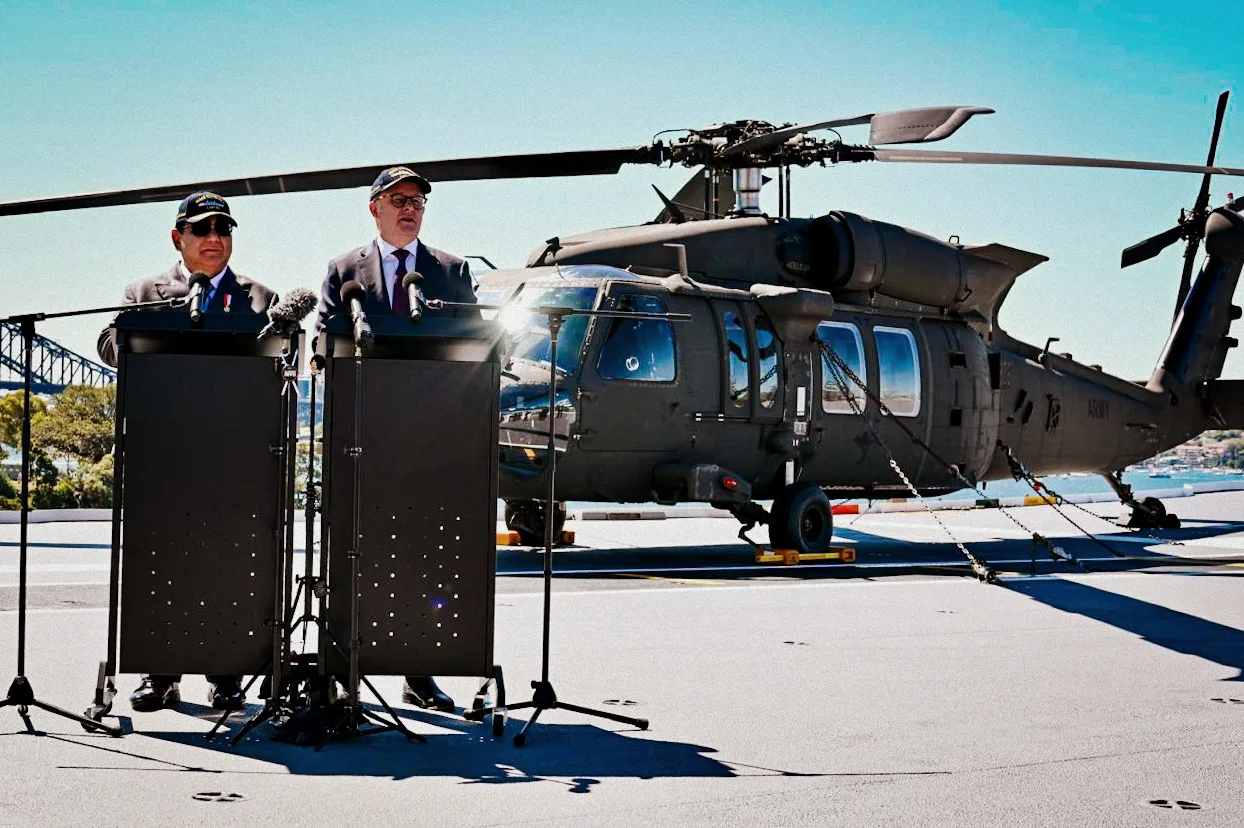
The announcement was made by Australian Prime Minister Anthony Albanese and Indonesian President Prabowo Subianto during a joint press conference aboard HMAS Canberra at the Garden Island Naval Base in Sydney on Wednesday, November 12, 2025.
“The Governments of Australia and Indonesia have just substantively concluded negotiations on a new bilateral agreement on our shared security. Our relationship is built on friendship, trust, mutual respect, and a shared commitment to peace and stability in our region,” said PM Albanese.
Strengthening the “Treaty of Lombok” and 2024 Defense Cooperation Agreement
PM Albanese emphasized that the new security pact strengthens the 2006 “Treaty of Lombok”, which reaffirms Indonesia’s territorial integrity and sovereignty, while also complementing the Defense Cooperation Agreement (DCA) signed in 2024.
Under the new framework, the two nations will hold regular consultations between leaders and ministers to address regional security issues and jointly implement mutually beneficial initiatives.
“If either party faces a security threat, both countries will consult and consider coordinated steps in response,” PM Albanese noted.
He described the agreement as marking a “new era in the Australia–Indonesia relationship,” continuing a legacy of security cooperation that began under Australian Prime Minister Paul Keating and Indonesian President Soeharto three decades ago.
PM Albanese also announced plans to visit Indonesia in January 2026 at the invitation of President Prabowo.
President Prabowo Subianto: “Indonesia and Australia Are Destined to Be Good Neighbors”
Indonesian President Prabowo Subianto expressed his sincere appreciation to the Australian Government for the warm welcome extended during his state visit.
“This is my first official state visit to Australia, although I’ve been here many times before. I deeply appreciate the generous hospitality extended by Prime Minister Albanese and the Australian Government,” said President Prabowo.
During the meeting, both leaders formalized an important defense and security agreement, marking a new milestone in the long-standing partnership between the two neighboring nations.
Commitment to Regional Peace and Shared Security
President Prabowo underlined that defense and security cooperation has become a central pillar of Indonesia–Australia relations.
Since the first defense memorandum in 1995, followed by the Lombok Treaty in 2006 and DCA in 2024, bilateral ties have continued to grow stronger.
“We have reached an important understanding — a renewed commitment to strengthen our friendship and safeguard the security of both our nations,” said President Prabowo.
Emphasizing the “Good Neighbour Policy”
President Prabowo highlighted the importance of maintaining a good neighbour policy as the foundation of bilateral relations.
“It is our destiny to be neighbors, so let us face that destiny with the best of intentions. In Indonesian culture, a good neighbor is someone who helps in difficult times. Our relationship with Australia must continue in that same spirit,” he affirmed.
President Prabowo also conveyed his gratitude to PM Albanese and the Australian Government for the spirit of friendship shown throughout the visit.
“Once again, Prime Minister, thank you very much for receiving me with such warmth and kindness,” concluded President Prabowo to applause from the audience.
Regional Significance: A Stronger Partnership for the Indo-Pacific
The new Indonesia–Australia security agreement represents a major advancement in regional cooperation and stability amid rising global geopolitical tensions.
The agreement focuses on strengthening collaboration in:
Maritime and cyber defense
Intelligence sharing and joint military training
Counterterrorism and transnational crime prevention
Disaster response and humanitarian coordination
With shared trust and mutual respect, both nations reaffirm their vision for an Indo-Pacific region that is peaceful, resilient, and balanced. (AT Network)
Follow Us at Google News and WA Channel