
ASIATODAY.ID, JAKARTA — Indonesia’s National Research and Innovation Agency (BRIN) underscored the urgency of accelerating the country’s strategic research infrastructure during the G.A. Siwabessy Memorial Lecture 2025, held at the B.J. Habibie Building Auditorium in Jakarta on Friday, December 5, 2025.
The event served not only as a scientific forum but also as an opportunity for Indonesia to draw direct lessons from Thailand—an ASEAN nation that has successfully built world-class nuclear and synchrotron facilities.
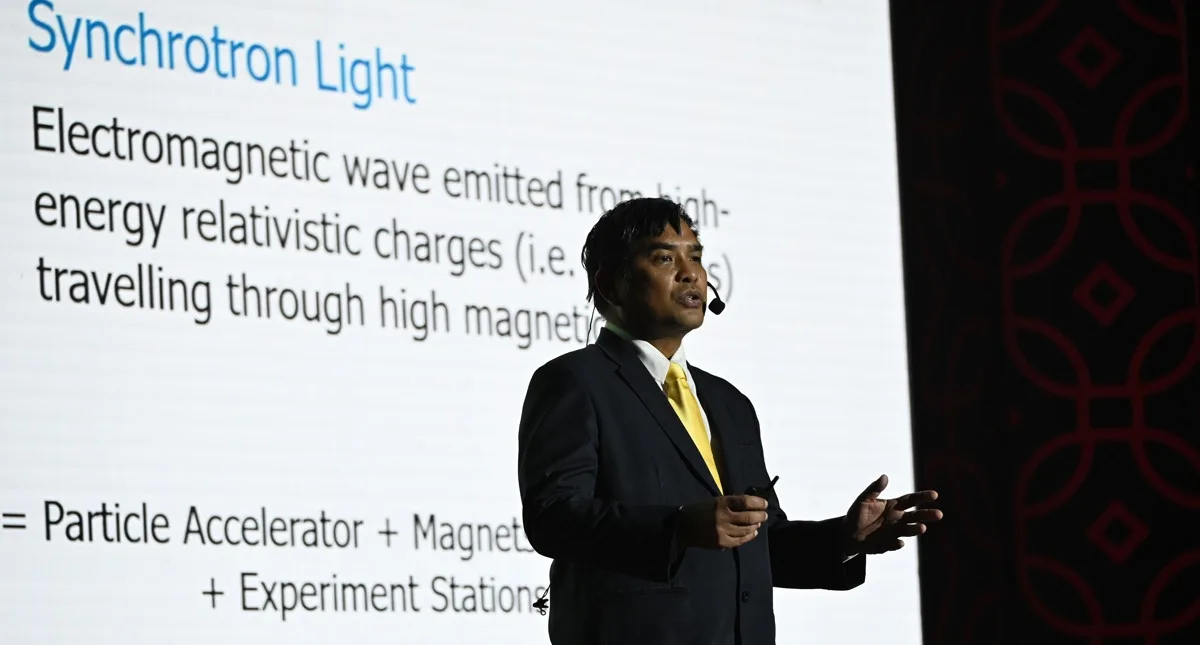
The lecture featured Prof. Dr. Saroj Rujirawat, Director of Thailand’s Synchrotron Light Research Institute (SLRI), who delivered a scientific address titled “Light for the Future: Synchrotron Science Driving the Country Innovation and Sustainability.”
Saroj outlined the evolution of synchrotron technology in five key phases, ranging from the fundamentals of high-intensity electromagnetic radiation to the development of first- to fourth-generation facilities, the utilization of SPS-1, and the construction of the next-generation SPS-2.
He explained how synchrotron radiation—millions of times brighter than sunlight—has become the backbone of diverse fields such as clean energy research, pollutant mapping, biomedical imaging, and cultural heritage analysis.
“This technology delivers direct impact to science and industry,” Saroj noted.
Thailand Builds from the Ground Up Through Global Co-Development
A central highlight of Saroj’s presentation was the long journey behind the establishment of the Siam Photon Source (SPS-1). The facility began with Japan’s donation of a SORTEC 1.0 GeV machine in 1996.
Yet Thailand chose not to merely inherit the equipment—they redesigned the lattice, rebuilt the vacuum and control systems, and developed beamlines from scratch through extensive co-development with experts from Japan, Taiwan, Korea, China, and the United States.
Following its first light in 2001, SPS-1 grew into a high-performance research facility operating more than 23 hours per day with a remarkable 98 percent availability rate. Its user community now produces over 300 scientific publications annually, including in leading journals such as Applied Physics Letters, Physical Review Letters, and Nature Communications.
SLRI’s synchrotron applications span a wide array of sectors: food and agriculture (24%), polymers and rubber (19%), automotive (13%), pharmaceuticals and cosmetics (10%), as well as energy, electronics, environmental science, and advanced materials.
Beyond that, SLRI has independently developed several instruments—ranging from mirror-coating systems to thermal vacuum chambers for satellite component testing—now utilized by Thai industries.
SPS-2: Thailand’s Ambition to Become ASEAN’s Scientific Hub
Saroj also highlighted progress on the Siam Photon Source 2 (SPS-2), a fourth-generation 3 GeV machine designed to deliver far greater brightness, improved stability, and compatibility with AI-assisted measurements.
“SPS-2 is expected to become a shared research center for ASEAN,” he emphasized.
Collaboration between SLRI and BRIN continues to deepen. Fourteen Indonesian students have participated in the PINT Program (2018–2020), and nine joint research projects have been ongoing between 2023 and 2025.
These initiatives support technical training, applied research, and the development of young Indonesian talent in accelerator science and synchrotron-based materials research.
BRIN: Thailand’s Experience Offers Valuable Lessons
BRIN’s Deputy for Human Resources and Science & Technology, Edy Giri Rachman Putra, stressed that Thailand’s achievements provide strategic insights for Indonesia as it develops its own nuclear and accelerator infrastructure.
“From Prof. Saroj, we learn the true meaning of co-development in building and operating nuclear facilities,” he said.
Edy emphasized that SLRI’s success did not come overnight. Long-term global collaboration, sustained user-community development, and the dedication of young scientists form the core lessons Indonesia must absorb.
“This inspires us to strengthen our commitment to improving national research quality through international cooperation,” he added.
BRIN reaffirmed that strengthening research talent, building robust scientific infrastructure, and engaging actively in global networks are essential pillars for accelerating Indonesia’s scientific advancement. These efforts are aimed at creating a more competitive research ecosystem aligned with the nation’s strategic priorities. (AT Network)
Follow Us at Google News and WA Channel