
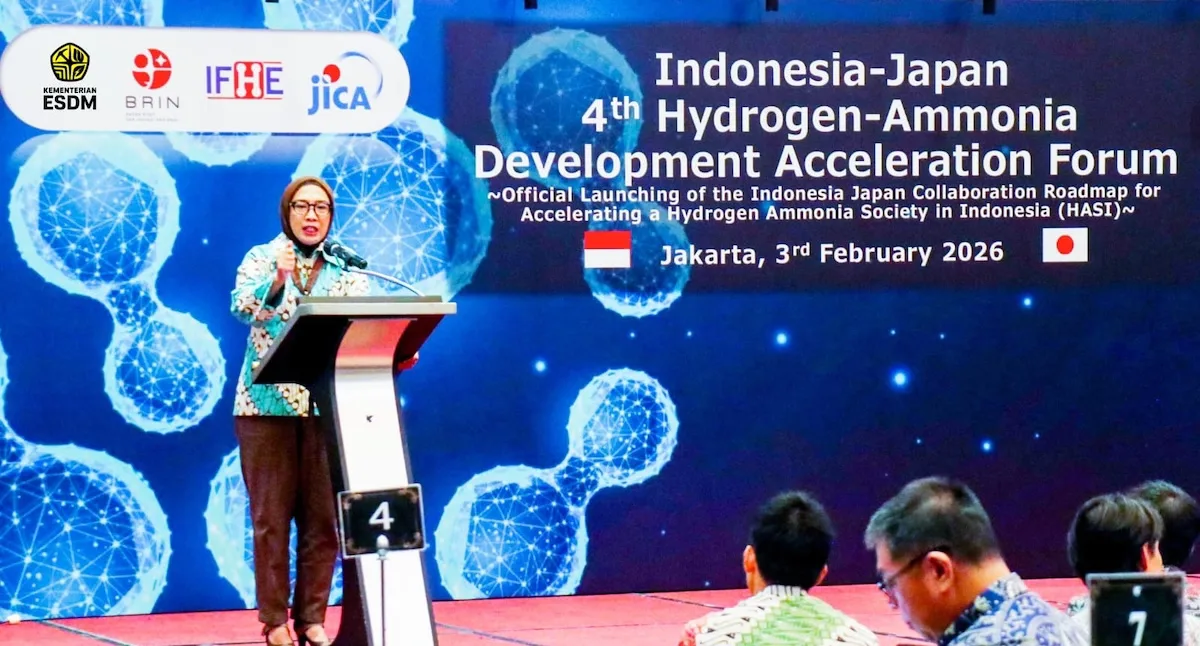
ASIATODAY.ID, JAKARTA — Indonesia has formally partnered with Japan to accelerate the development of hydrogen energy as part of its broader energy transition strategy and long-term industrial competitiveness agenda.
The collaboration underscores Indonesia’s ambition to move beyond decarbonization targets and position itself within the global hydrogen and ammonia value chain.
Through the Ministry of Energy and Mineral Resources (ESDM), the government is fast-tracking the build-out of a national hydrogen ecosystem in line with the National Hydrogen Strategy and the National Hydrogen and Ammonia Roadmap (RHAN).
Director General of New, Renewable Energy and Energy Conservation, Eniya Listiani Dewi, emphasized that Japan’s role is critical in accelerating hydrogen development in Indonesia, particularly in technology transfer, project readiness, and financing structures.
“Hydrogen development is not only a decarbonization tool, but a pillar of long-term economic transformation and industrialization. Partnership with Japan helps accelerate Indonesia’s readiness to enter the market phase,” Eniya said.
As an initial milestone, the government has set a target for nearly 200 tons of green hydrogen per year to be available in the domestic market by 2026. The target signals Indonesia’s entry into early hydrogen commercialization and the foundation of a low-carbon, export-oriented industrial base.
The policy direction and bilateral collaboration were reinforced at the 4th Indonesia–Japan Hydrogen Ammonia Development Acceleration Forum in Jakarta on Tuesday, February 3, 2026, which brought together government officials, industry leaders, and financial institutions from both countries.
In this partnership, the Japan International Cooperation Agency (JICA) plays a strategic role by providing technical expertise, project development experience, and financing instruments to help mitigate early-stage risks.
The collaboration combines Japan’s advanced hydrogen technologies with Indonesia’s vast renewable energy potential, large domestic market, and long-term demand outlook.
Senior Representative of JICA Indonesia, Akira Sato, noted that Indonesia’s policy direction under President Prabowo reflects a strong focus on energy self-reliance, macroeconomic stability, and inclusive growth.
“The policy direction is clear—strengthening national resilience, stimulating investment, and translating momentum into inclusive development,” Sato said.
Indonesia’s hydrogen ecosystem will be developed in phases: the Initiation Phase (2025–2034), the Development and Integration Phase (2035–2045), and the Acceleration and Sustainability Phase (2045–2060). This phased approach is designed to ensure regulatory readiness, infrastructure development, market creation, and domestic industrial capacity.
Through RHAN and the Indonesia–Japan Hydrogen and Ammonia Society Initiative (HASI) Roadmap, Indonesia aims to emerge not only as a hydrogen market, but as a strategic partner and competitive player in the regional and global hydrogen landscape. (AT Network)
Follow Us at Google News and WA Channel