
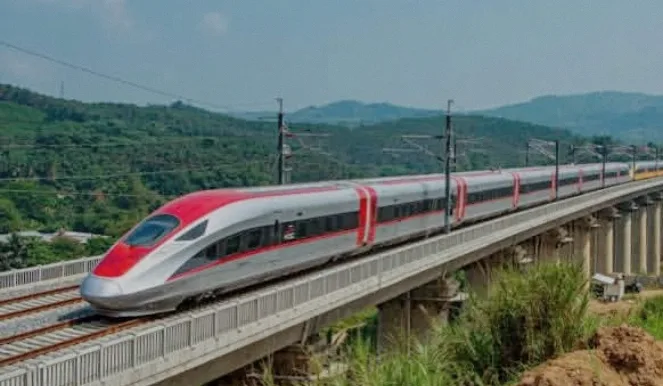
ASIATODAY.ID, JAKARTA — The Indonesian government has made it clear that it will not use the state budget (APBN) to repay the $7.2 billion debt tied to the Jakarta–Bandung High-Speed Rail (KCJB) project — known locally as Whoosh — developed in partnership with China.
Finance Minister Purbaya Yudhi Sadewa said the debt obligation should not be borne by taxpayers but by the Investment Management Authority (BPI) Daya Anagata Nusantara (Danantara), which oversees state-owned enterprise (SOE) investments and dividends.
“Whoosh is managed by Danantara. They’ve already taken over 80% of SOE dividends, so the payments should come from there,” Purbaya emphasized during a visit to Graha Segara, Tanjung Priok Port, North Jakarta, on Monday, October 13, 2025.
According to Purbaya, using public funds for a project managed by Danantara would be inappropriate and unfair.
“It’s strange to use the state budget when the profits go to them but the burden falls on us. If they’re taking the profits, they should also take the responsibility,” he added.
Danantara Must Bear the Debt, Not the Finance Ministry
Danantara currently manages the investment portfolios and dividend proceeds of Indonesia’s SOEs. Through PT Pilar Sinergi BUMN Indonesia (PSBI), Danantara controls a 60% stake in PT Kereta Cepat Indonesia China (KCIC) — the joint venture operating the Whoosh line.
Given this structure, Purbaya insisted that Danantara should assume full responsibility for the KCJB debt, not the government.
“Debt management should remain under Danantara since they already control SOE dividends,” he said.
Danantara Prepares Debt-Restructuring Options
Meanwhile, Danantara Chief Operating Officer Dony Oskaria revealed that several debt restructuring scenarios are under review. One involves transferring KCIC’s infrastructure assets to the government, effectively turning KCIC into an asset-light operator that focuses solely on operations rather than infrastructure ownership.
However, this proposal would shift the debt burden to the state — and ultimately to the APBN — something the Finance Ministry firmly rejects.
Another option is to inject additional state capital (PMN) into PT Kereta Api Indonesia (KAI) to strengthen its balance sheet and reduce debt-servicing costs.
“We’re reviewing two main options: either increase KAI’s equity or hand over the infrastructure to the government, as is common in other railway systems,” Dony said at JICC Senayan, Jakarta, on Thursday, October 9.
The Real Cost of Whoosh: $7.2 Billion
The Jakarta–Bandung High-Speed Rail — Indonesia’s first bullet train — was built with a total investment of $7.2 billion, equivalent to roughly IDR 116.5 trillion (based on an exchange rate of IDR 16,186 per USD).
The project’s cost ballooned from China’s original 2015 bid of $5.13 billion, which was lower than Japan’s competing offer of $6.2 billion at the time.
Of the total $7.2 billion, around 75% was financed through loans from the China Development Bank (CDB), while the remaining 25% came from shareholder equity. The shareholders are PT Pilar Sinergi BUMN Indonesia (PSBI), representing the Indonesian consortium with a 60% stake, and Beijing Yawan HSR Co. Ltd., holding 40%.
This massive debt has placed significant pressure on PT Kereta Api Indonesia (KAI), one of the key SOEs involved in Whoosh’s operations.
The Whoosh project — once hailed as a symbol of Indonesia–China cooperation — has now become a test of Indonesia’s fiscal independence and project governance.
By refusing to use public funds to settle commercial debts, the government signals a new approach: drawing a firm line between business risks and state financial obligations, particularly in foreign-backed infrastructure ventures. (AT Network)
Follow Us at Google News and WA Channel