
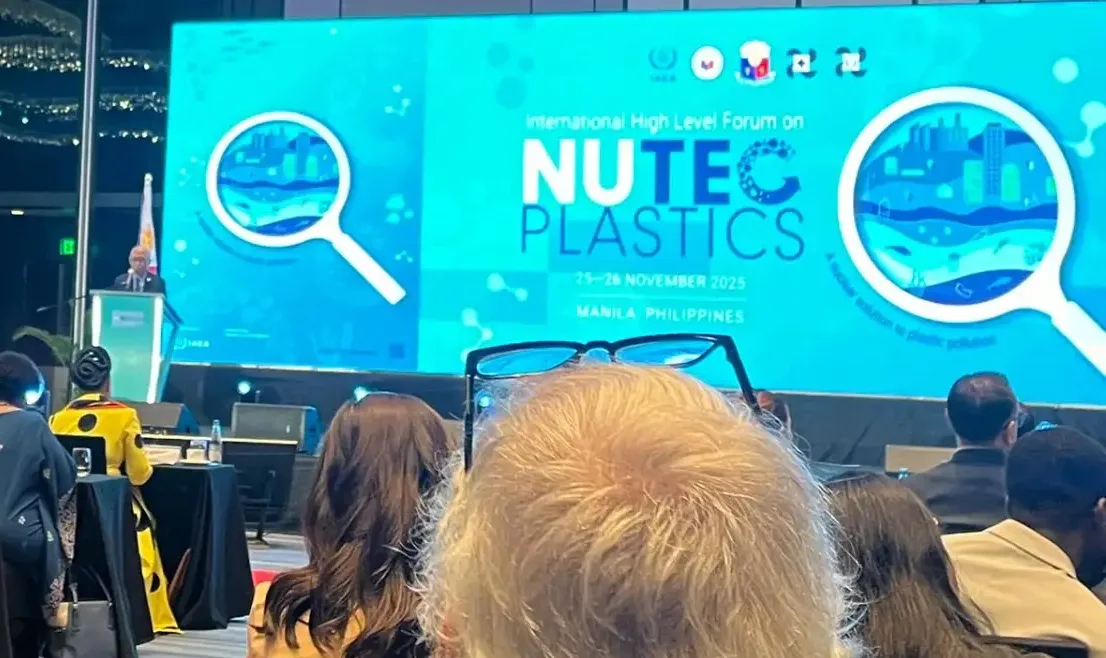
ASIATODAY.ID, JAKARTA – Indonesia, through the National Research and Innovation Agency (BRIN) and its Nuclear Energy Research Organization (ORTN), presented major advancements in the application of nuclear technology for plastic waste management at the International High-Level Forum on Nuclear Technology for Controlling Plastic Pollution (NUTEC Plastics).
The forum, organized by the International Atomic Energy Agency (IAEA) and held on 25–26 November 2025 in Manila, the Philippines, highlighted two key approaches: radiation-based plastic recycling and nuclear analytical techniques for monitoring microplastics in the oceans.
ORTN BRIN Chair Syaiful Bakhri underscored Indonesia’s strong commitment to science-based innovation in support of global environmental solutions.
“As one of the pilot countries, Indonesia is committed to delivering tangible and impactful innovation. The progress achieved—from research to technology demonstrations—signifies Indonesia’s readiness to support global efforts to reduce plastic pollution through nuclear technology,” Syaiful said on Wednesday, December 3, 2025.
The NUTEC Plastics Forum, opened by the President of the Philippines, the President of the Asian Development Bank (ADB), and the Director General of the IAEA, emphasized the critical role of nuclear innovation in environmental management and the circular economy. As one of the program’s pilot countries, Indonesia showcased substantial progress in developing radiation-based technologies for plastic recycling.
Under BRIN’s coordination, Indonesia has successfully developed a compatibilizer derived from recycled plastic waste for Wood-Plastic Composite (WPC) applications. This innovation has gone through research and proof-of-concept stages and has now reached the technical-scale prototype phase, equivalent to Technology Readiness Level (TRL) 5.
Beyond research, Indonesia is also active in regional capacity-building by sharing technical experience and supporting the adoption of nuclear technologies in other countries across the region.
“Plastic pollution poses a severe challenge, with millions of tons of waste entering the oceans every year. Through NUTEC Plastics, the IAEA promotes the use of nuclear technology through two main pathways: first, radiation-based plastic recycling, which allows plastic waste to be transformed into value-added industrial materials; and second, marine microplastic monitoring using nuclear analytical techniques to accurately map the movement and concentration of microplastics,” Syaiful explained.
He added that NUTEC Plastics is currently working with 53 countries on radiation-based plastic recycling and 102 countries on marine microplastic monitoring.
Indonesia, along with Argentina, Malaysia, and the Philippines, is among the leading nations demonstrating these technologies toward pilot-scale industrial applications.
“The IAEA provides analytical tools to assess plastic circularity, technology maturity, and the economic feasibility of electron-beam systems for recycling processes,” he noted.
Furthermore, through the IAEA’s RAS7038 program, Indonesia is actively contributing to the development of a global microplastic database. Since 2024, sampling has been conducted in Lampung Bay, the Cisadane Estuary, Pari Island, and Pekalongan.
“The Lampung data have been analyzed using ATR-FTIR and uploaded to the IAEA database. This collaborative program is supported by researcher training and equipment assistance from the IAEA, including an additional ATR-FTIR device currently being imported,” he added.
Despite challenges such as high sampling costs and complex analytical procedures, the program will advance to Phase II (2026–2029). This new phase will integrate advanced sediment dating techniques using Pb-210 isotopes—already mastered by BRIN—to reconstruct microplastic pollution history up to 150 years into the past.
“BRIN’s participation in this forum reaffirms Indonesia’s active role in harnessing nuclear technology for sustainable environmental management and its contribution to global efforts to reduce plastic pollution,” Syaiful concluded. (AT Network)
Follow Us at Google News and WA Channel