
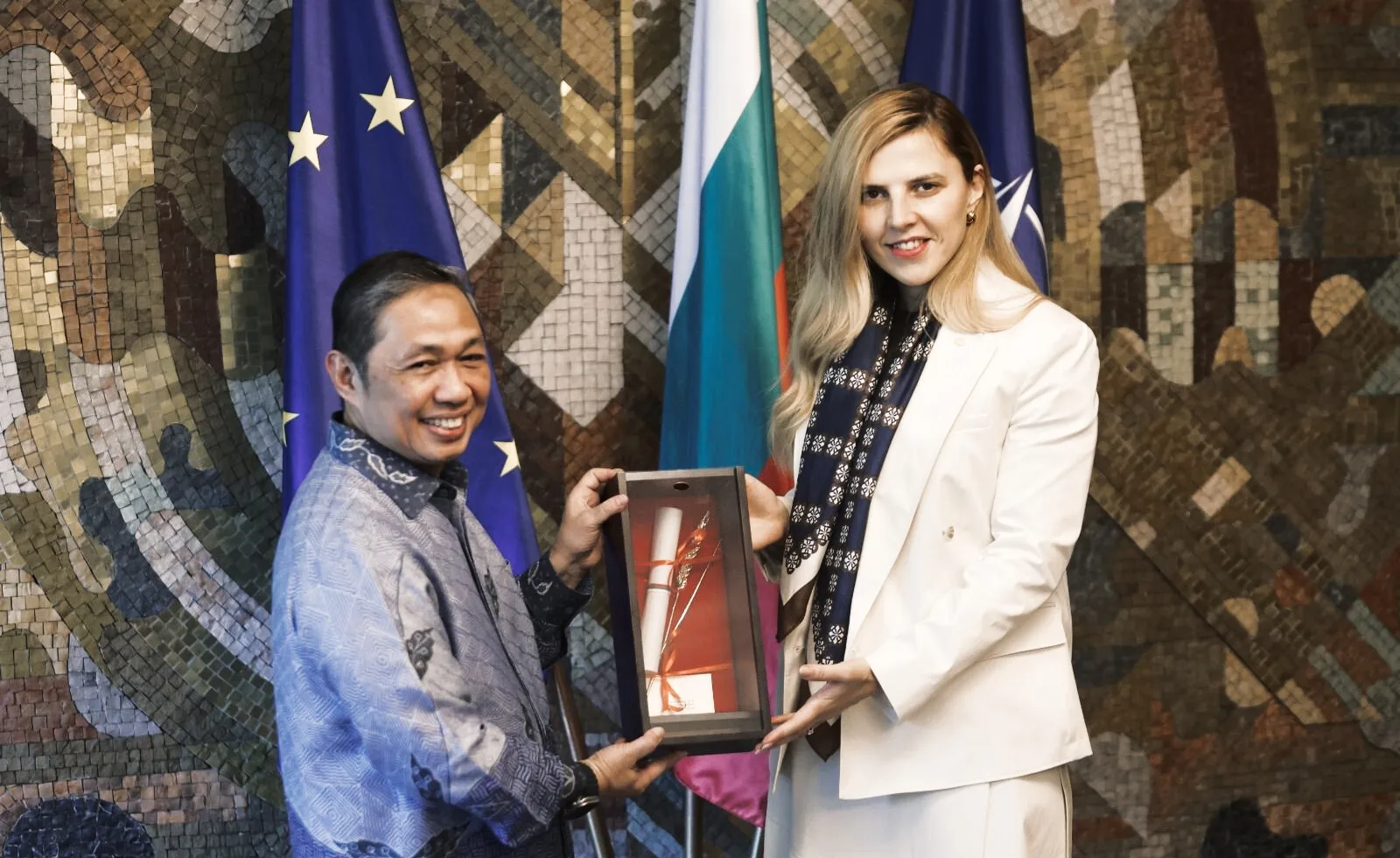
ASIATODAY.ID, SOFIA — Indonesia is stepping up its economic diplomacy in Eastern Europe, with Bulgaria emerging as a strategic gateway to broader European markets as Jakarta seeks to expand trade, investment, and halal industry partnerships across the region.
During an official visit to Sofia on June 22, Indonesian Vice Foreign Minister Muhammad Anis Matta held a series of high-level meetings with Bulgarian Foreign Minister Velislava Petrova, Deputy Foreign Minister Christo Polendakov, and Deputy Minister of Economy, Investment and Industry Krasimir Yakimov.
The visit coincided with the 70th anniversary of diplomatic relations between Indonesia and Bulgaria, providing fresh momentum for both countries to deepen cooperation in commerce, investment, tourism, culture, and people-to-people exchanges.
A key highlight of the visit was the official launch of the logo commemorating seven decades of bilateral ties.
Unveiled jointly by Anis Matta and his Bulgarian counterpart, the emblem features Indonesia’s Garuda and Bulgaria’s lion, symbolizing the enduring friendship between the two nations since diplomatic relations were established on September 20, 1956.
Beyond the ceremonial milestone, discussions focused on strengthening economic cooperation and leveraging the anticipated conclusion of the Indonesia-European Union Comprehensive Economic Partnership Agreement (IEU-CEPA). Both sides viewed the agreement as a strategic framework for expanding market access, diversifying trade flows, and encouraging new investment opportunities.
Indonesia and Bulgaria also explored cooperation in tourism and the creative economy, including cultural promotion, arts, language education, academic exchanges, and film production.
Officials said stronger collaboration in these sectors could increase tourist flows while creating new opportunities for creative industry players in both countries.
As part of his visit, Anis Matta met Bulgaria’s Grand Mufti, Mustofa Hadzi, to discuss prospects for cooperation in religious affairs, halal certification, and the broader Islamic economy. The talks also underscored the importance of interfaith dialogue in promoting moderation, tolerance, and mutual understanding.
The Indonesian vice foreign minister also traveled to Plovdiv, Bulgaria’s second-largest city and a major cultural hub, to explore additional opportunities in culture, economic cooperation, and people-to-people connectivity.
Anis Matta emphasized that future economic engagement between Indonesia and Bulgaria should be built on principles of equality and mutual benefit, creating tangible gains for both countries.
The visit reflects Indonesia’s broader strategy of strengthening partnerships across Eastern Europe while diversifying export destinations and investment opportunities.
For Jakarta, Bulgaria is increasingly viewed as a strategic entry point into the Balkans and a potential bridge to wider European markets, particularly as Indonesia seeks to capitalize on growing economic links with the European Union. (AT Network)
Follow Us at Google News and WA Channel