
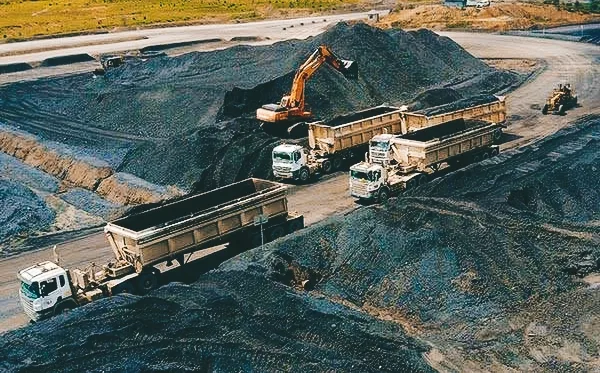
ASIATODAY.ID, JAKARTA — The Indonesian government has confirmed plans to cut national coal production this year as part of a strategic effort to stabilize global coal prices, which have been under pressure due to persistent oversupply. The policy will be implemented through a revision of the 2026 Mining Work Plan and Budget (RKAB).
The production cut is aimed at restoring balance between global supply and demand while ensuring the long-term sustainability of Indonesia’s energy reserves.
Authorities stressed that excessive exploitation of natural resources must be curbed to protect the environment and uphold intergenerational justice.
“We will reduce coal production so prices can recover and these mines can be passed on to our children and grandchildren. We must stop managing natural resources as if everything has to be exhausted now. This nation must continue forward, the environment must be protected, and justice must be upheld,” said Energy and Mineral Resources Minister Bahlil Lahadalia during the 2025 Performance Report Press Conference of the Ministry of Energy and Mineral Resources in Jakarta on Thursday, January 8, 2026.
Indonesia’s Market Dominance Weighs on Global Coal Prices
Minister Bahlil acknowledged that Indonesia’s dominance in the global coal market has significantly contributed to market imbalances. Global coal trade currently stands at approximately 1.3 billion tons, with Indonesia supplying a substantial share.
“Of the roughly 1.3 billion tons of coal traded globally, Indonesia supplies about 514 million tons, or around 43 percent. As a result, supply and demand are not balanced, which ultimately pushes coal prices down,” he explained.
National Coal Output to Be Sharply Reduced
Learning from this situation, the government has decided to recalibrate coal production quotas through the RKAB revision. Indonesia’s coal output target will be reduced significantly.
“Coal production realization reached 790 million tons in 2025. We will cut this to approximately 600 million tons,” Bahlil said.
Throughout 2025, coal allocated for domestic consumption under the Domestic Market Obligation (DMO) accounted for 32 percent, or 254 million tons, of total production. The remaining 514 million tons were exported.
The Directorate General of Minerals and Coal is currently calculating detailed production quotas for each mining company under the revised RKAB system. The government expects mining companies to immediately adjust their business plans in line with the new policy direction.
Similar Measures Planned for Other Mineral Commodities
Beyond coal, the government has signaled that similar production controls may be applied to other strategic minerals, including nickel. These measures are intended to support downstream industrial development, strengthen price stability, and ensure fair and sustainable natural resource management. (AT Network)
Follow Us at Google News and WA Channel