
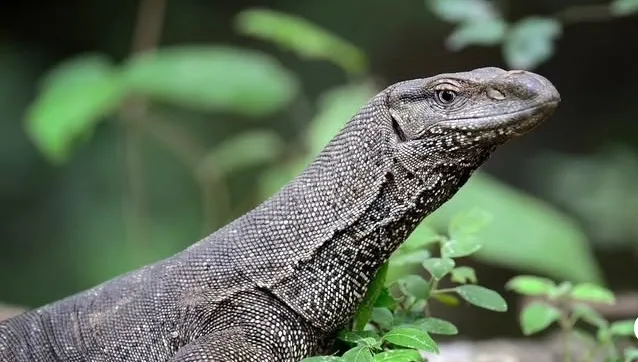
ASIATODAY.ID, JAKARTA — Indonesia is home to one of the world’s richest monitor lizard populations, offering immense opportunities for scientific research and economic development.Yet much of this potential remains unexplored.
This was highlighted by BRIN Research Professor Evy Ayu Arida during her inaugural scientific oration at the B.J. Habibie Building in Jakarta, December 10, 2025.
Delivering her oration titled “The Potential of Monitor Lizards for Research and Development in Indonesia,” Evy emphasized that modern science must underpin all efforts to conserve Indonesian monitor lizards, both as ecologically important wildlife and as valuable economic commodities.
Indonesia: A Global Hotspot for Monitor Lizard Diversity
Indonesia hosts 29 species of monitor lizards, making it the country with the second-highest diversity after Australia. Many are endemic, including the Komodo dragon, Lirung monitor, and blue tree monitor, found mostly across eastern Indonesia.
Despite this richness, Evy revealed a critical research gap:
“Less than 5% of Indonesia’s reptile species — including monitor lizards and snakes — have been studied in depth or utilized through modern scientific approaches,” she said.
The lack of scientific population data means no monitor lizard species traded nationally has a well-documented population status.
“There is a significant gap between actual population data and the scale of exploitation for export,” she added.
High Economic Value: From Luxury Leather to Global Pet Trade
Indonesian monitor lizards also carry substantial economic potential:
Water monitor (Varanus salvator) skins have been a major export commodity for luxury leather goods for more than 30 years.
Tree monitors from Papua, such as the blue and green tree monitors, are in high demand as exotic pets.
Monitor lizards are also used locally in traditional medicine and as a food source.
Yet sustainability remains a concern.
“Each species requires added value through standardized production quality. Sustainable management must be science-based,” Evy stressed.
Conservation Challenges: No CITES NDF, Rising Pressure on Wild Populations
Evy underscored a major conservation issue: Indonesia has yet to produce the required Non-Detriment Findings (NDF) under CITES for its monitor lizard trade. Without NDF documentation, long-term sustainability cannot be guaranteed.
Monitor lizard populations continue to face pressure due to: overharvesting from the wild, habitat loss and land-use change, increasing conflict with urban communities.
Field surveys in Merauke, Talaud, and the Riau Islands have even revealed new distribution records and potentially undescribed species, including a grey monitor from eastern Sumatra.
Modern Science and Molecular Genetics
Evy highlighted breakthrough applications of DNA molecular tools, which enable scientists to: map population structures, assess genetic diversity, trace inter-island gene flow, conduct rapid species identification using DNA barcoding.
These methods, previously applied to Komodo dragon population studies, are now seen as essential for conservation planning across the genus Varanus.
Strengthening Scientific Capacity for the Future
Evy expressed concern about the small number of Indonesian zoologists specializing in reptiles, despite the country’s extraordinary biodiversity.
“Research — from genetics to ecology and natural history — must serve as the foundation of conservation. Science will shape the future of Indonesia’s monitor lizard conservation,” said the zoologist, who earned her doctorate from the University of Bonn.
With robust data, sustainable policies, and stronger scientific capacity, Indonesia has the opportunity not only to secure the future of its native monitor lizards but also to unlock their full potential as global research assets and high-value economic commodities. (AT Network)
Follow Us at Google News and WA Channel