
ASIATODAY.ID, JAKARTA – Indonesia continues to strengthen its position as one of the world’s leading players in the Islamic economy and finance sector.
According to the State of the Global Islamic Economy Report, Indonesia now ranks third globally, moving up from fifth place in previous years.
The country’s key strengths lie in modest fashion, Muslim-friendly tourism, and the halal pharmaceutical and cosmetics industries. Yet, Indonesia still has vast potential to expand its dominance in halal food, Islamic finance, and halal media and recreation.
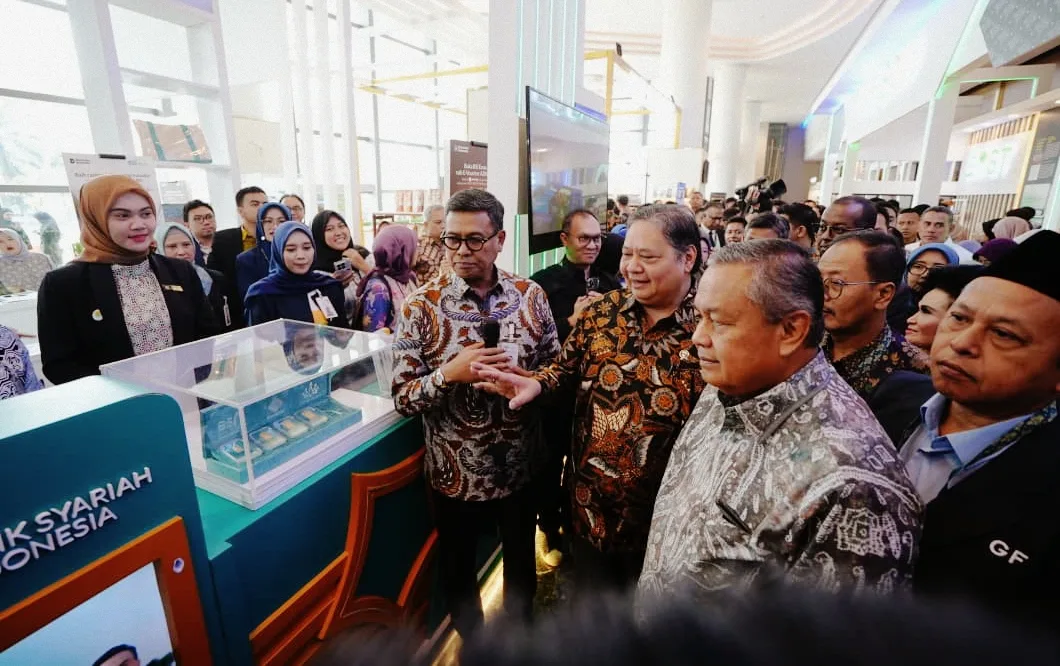
“In the modest fashion sector alone, consumer spending reaches USD 20 billion, or around IDR 289 trillion. Meanwhile, in the halal food and beverage industry, the total value is USD 109 billion, or about IDR 1,000 trillion. If we continue to strengthen syariah compliance across industries, Indonesia could soon surpass others to become number one in the world,” said Coordinating Minister for Economic Affairs Airlangga Hartarto during the opening of the Indonesia Sharia Economic Festival (ISEF) 2025 in Jakarta, Wednesday, October 8, 2025.
Strong Momentum for Indonesia’s Islamic Economic Growth
Indonesia’s Islamic economy continues to show solid growth and rising global competitiveness. The share of Islamic-based businesses in GDP is steadily increasing, the number of halal-certified products has surged, exports of halal goods are expanding, and Islamic financial assets have exceeded IDR 10,000 trillion in 2025.
“The Government has placed Islamic economy as a national priority under the National Long-Term Development Plan (RPJPN) 2025–2045. The focus is to strengthen Islamic finance, optimize Islamic social funds for poverty reduction, develop the halal industry and MSMEs, and build stronger regulations and institutions,” Minister Airlangga explained.
To accelerate the development of a robust and inclusive Islamic economic ecosystem, the Government has outlined three key strategies:
1. Expanding Access to Islamic Financing.
Through innovative schemes such as KUR Syariah (Islamic Microcredit) and the Bullion Bank, the Government has channeled over IDR 75 trillion in Islamic microloans to 1.3 million borrowers between 2015–2025. Since its launch in February 2025, the Bullion Bank has managed 45 tons of gold, which can be integrated with social instruments like productive waqf.
“Indonesia’s gold production reaches about 110 tons annually. If Islamic boarding schools (pesantren) start saving in gold, it will serve as a recession-proof and turbulence-proof asset. This is a potential foundation for a resilient Islamic economy,” Airlangga emphasized.
2. Enhancing Islamic Financial Literacy and Education.
Through the National Council for Financial Inclusion (DNKI), the Government continues to expand public access and literacy in Islamic financial products across the country.
3. Accelerating Digital Transformation in the Halal Ecosystem.
Digitalization is advancing rapidly through the SIHALAL system, which simplifies halal certification processes. By 2025, Indonesia has issued 5.9 million halal certificates—well on its way to the target of 10 million. The Government is also promoting digital waqf platforms and halal e-commerce that connect local producers with global markets.
“By synergizing financial access, literacy, and digital transformation, we can build a strong, inclusive, and globally competitive Islamic economic ecosystem,” said Airlangga.
Building the Foundation for Global Halal Leadership
The Government is also driving innovation through stronger collaboration among stakeholders, including the establishment of the Integrated Zakat, Infaq, and Sadaqah Information Center and the expansion of Bank Indonesia’s Sukuk (SUK-BI) for non-bank and foreign investors.
To support the halal industry, Indonesia has developed four Halal Industrial Zones (HIZ) in Jababeka Cikarang, Serang, Bintan, and Sidoarjo, alongside the Indonesia Islamic Financial Center (IIFC) to position Indonesia as a global hub for Islamic finance.
“The Islamic economy is not merely about what is halal or haram—it is a path toward justice, inclusivity, and sustainability. With optimism and prudence, let us strengthen collaboration to make Islamic economy the driving force of Indonesia’s Golden Vision 2045,” concluded Airlangga.
The event was attended by members of the Indonesian Parliament (Commission XI), senior officials from the Coordinating Ministry for Economic Affairs, the Governor and Senior Deputy Governor of Bank Indonesia, members of the Financial Services Authority (OJK), the Indonesian Ulema Council (MUI), and representatives from partner countries. (AT Network)
Follow Us at Google News and WA Channel