
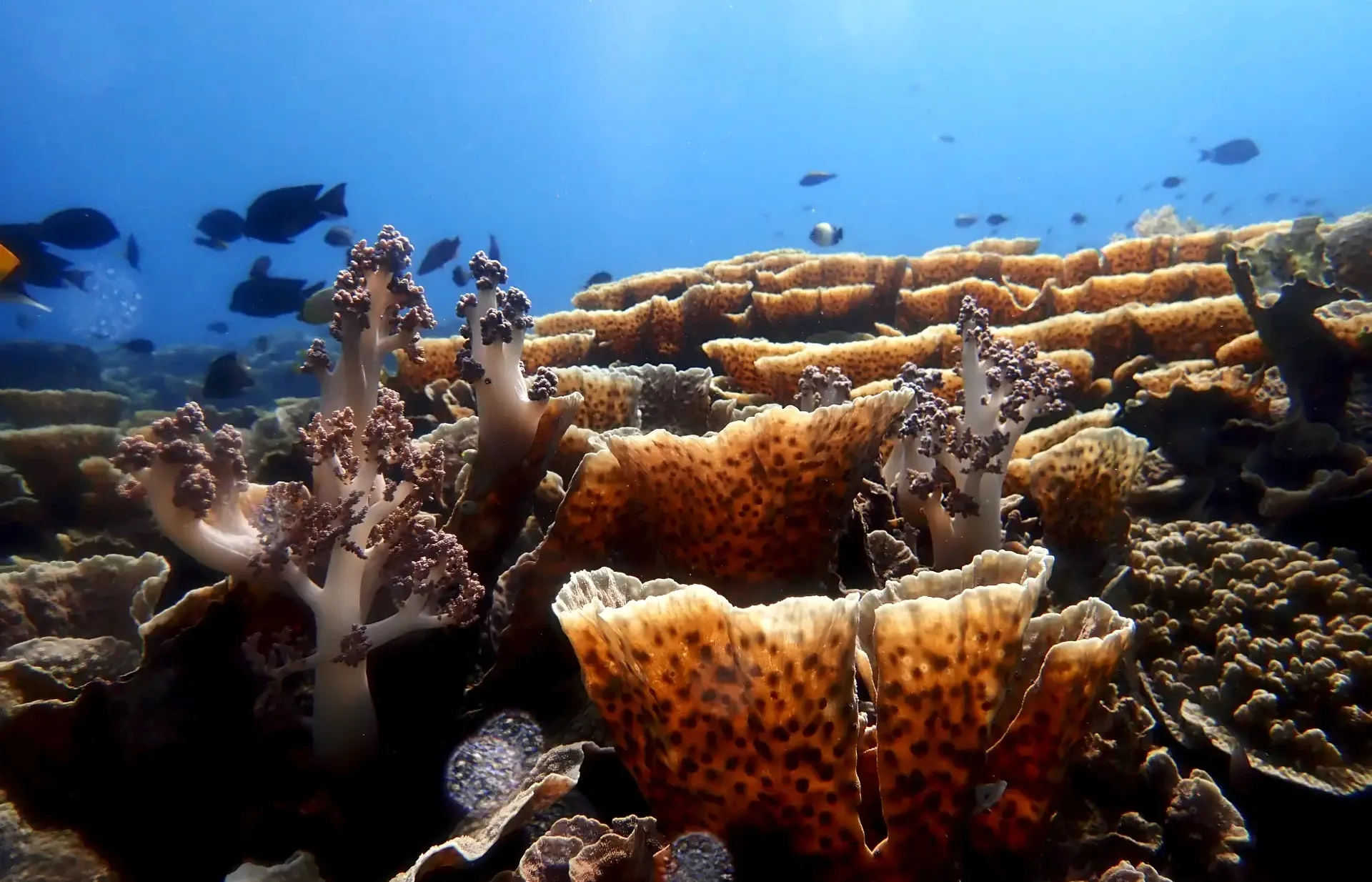
ASIATODAY.ID, JAKARTA – Indonesia’s crystal-blue seas—long celebrated for their vibrant coral reefs and rich marine life—are now facing a silent but accelerating threat: ocean acidification.
And the situation is far more alarming in the Sunda Shelf region, which includes the waters off western Indonesia, the Malacca Strait, Singapore Strait, Natuna Sea, Karimata Strait, and the Java Sea.
A new study led by BRIN’s Senior Research Professor in Marine Biogeochemistry, A’an Johan Wahyudi, reveals that the rate of pH decline in this region is occurring twice as fast as the global average.
In an interview on Tuesday, December 9, 2025, A’an explained that ocean acidification occurs when carbon dioxide (CO₂) from the atmosphere dissolves in seawater, forming carbonic acid and releasing hydrogen ions (H⁺), which lower the ocean’s pH.
The natural pH of seawater is around 8.1. A drop of just 0.1–0.2 units—for example to 7.9 or 7.8—is already enough to disrupt calcium-building organisms such as corals, clams, snails, and plankton.
“A more acidic ocean dissolves calcium carbonate, making it extremely difficult for coral reefs to grow and survive,” A’an said.
The situation in the Sunda Shelf worsens because the region receives an additional carbon load from peatland-derived organic matter flowing from Sumatra and Kalimantan. As this organic material decomposes in the ocean, it accelerates the decline in pH.
Seven-Year Study Confirms the Trend: pH Decline Twice the Global Rate
A long-term monitoring effort conducted by BRIN in collaboration with Nanyang Technological University (NTU) and the National University of Singapore (NUS) captured detailed chemical changes in these waters over seven years.
The findings are deeply concerning:
pH levels frequently fall below 8, already unsafe for many calcifying organisms.
Aragonite saturation, crucial for coral growth, often drops below 2.5, far from the ideal 2.5–4 range.
pH fluctuations reach 0.11–0.19 units per year, driven by monsoon cycles and river inflows.
Most importantly, the long-term trend shows a decline of –0.043 pH units per decade, double the global rate (–0.019).
At this pace, if today’s pH is around 8, it could fall to 7.96 within the next decade—a seemingly small change that could devastate coral ecosystems.
Ripple Effects: Fisheries, Biodiversity, and Tourism at Risk
As coral reefs weaken, entire marine ecosystems face cascading impacts: rapid declines in biodiversity, falling fish populations, disruptions to food webs, reduced coastal tourism, economic losses for millions of coastal residents.
With 60% of Indonesia’s population relying on coastal resources, the stakes are extraordinarily high.
Critical Threshold Detected in Just 5 Years
The study also calculated the Trend Detection Time (TDT)—the minimum monitoring duration needed to detect long-term shifts.
The result: only five years of consistent monitoring are needed to detect meaningful chemical changes in Indonesian waters.
This allows more accurate hindcasting (reconstructing past changes) and forecasting (predicting future conditions).
What Indonesia Must Do Now
Although ocean acidification cannot be stopped overnight, A’an outlined key measures that can slow the progression:
1. Reduce Carbon Emissions
Through forest conservation, nature-based carbon sequestration, and industrial emission reductions.
2. Build a National Ocean Observing System
One that monitors not only physical parameters (waves, tides, currents) but also pH, dissolved CO₂, oxygen, and nutrients.
3. Integrate Physical, Chemical, and Biological Monitoring
Following Global Ocean Observing System (GOOS) standards to ensure long-term, consistent, science-based data.
“Without robust chemical and biological monitoring, we cannot fully understand the state of our oceans. Long-term observation is essential for effective mitigation,” A’an emphasized.
Indonesia Still Has a Chance to Slow the Damage
The threat of ocean acidification is real—and it is advancing quickly, especially in the Sunda Shelf.
Yet with science-based policy, consistent monitoring, and strong emissions reductions, Indonesia still has an opportunity to protect its seas.
“Awareness of ocean acidification must grow. Only by understanding the threat can we take action to safeguard our marine ecosystems,” A’an concluded. (AT Network)
Follow Us at Google News and WA Channel