
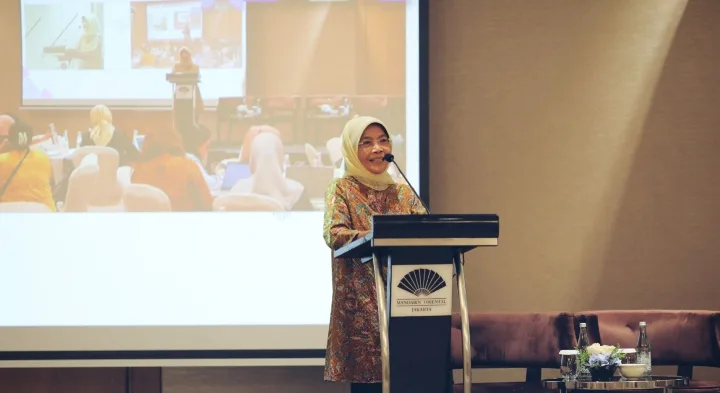
ASIATODAY.ID, JAKARTA — To support the Indonesian government in accelerating concrete protection measures for women human rights and environmental defenders, UNDP Indonesia and National Commission for Women convened a national policy dialogue titled “We All Have a Role: Strengthening Holistic Protection and Creating Safe Spaces for Women Human Rights Defenders.”
Across Indonesia, women defending forests, land, and community rights are increasingly being targeted for speaking out. Many face intimidation, criminalization, and technology-facilitated gender-based violence simply for protecting their communities and the environment.
Yet their role is irreplaceable: they are often the first to respond to environmental damage, the first to safeguard community well-being, and the frontline guardians of threatened ecosystems.
Attended by more than 100 participants, the dialogue served as the culmination of a four-day campaign marking the International Women Human Rights Defenders Day on November 29 and the 16 Days of Activism Against Gender-Based Violence from November 25 to December 10, 2025. The event brought together government institutions, civil society organizations, media, and most importantly, women environmental and human rights defenders from Aceh to Papua.
Discussions highlighted systemic barriers that continue to undermine their safety, including limited legal protection, a lack of rapid-response mechanisms, and persistent discrimination within both government structures and society.
“When we protect women human rights defenders, we protect democracy itself,” said Maria Ulfah Anshor, Chair of National Commission for Women.
“A multisectoral commitment to holistic protection—covering legal, digital, physical, and psychosocial dimensions—reflects our shared belief that every woman has the right to defend human rights, land, and justice safely and with dignity. Together, we are building a protection ecosystem that is not only responsive but also innovative and transformative in advancing a just, equal, inclusive, and environmentally conscious democracy,” she added.
Government representatives from key institutions—including the Coordinating Ministry for Human Development and Culture, the Ministry of Law and Human Rights, the Ministry of Environment and Forestry, the Ministry of Women’s Empowerment and Child Protection, and the Indonesian National Police—reaffirmed their commitment to closing these protection gaps while acknowledging the increasingly complex risks faced by women defenders.
“When we protect women human rights defenders, we protect the forests, the communities, the rights they fight for, and our collective future,” said Siprianus Bate Soro, Head of the Risk, Resilience and Governance Unit at UNDP Indonesia.
“At UNDP, we believe that protecting women defenders is not merely about safeguarding individuals; it is about safeguarding democratic space, the future of our environment, and Indonesia’s human rights landscape. We remain committed to supporting national efforts to enhance institutional capacities and create an enabling environment where women can lead, participate, and defend human rights safely.”
Women defenders working in environmental advocacy, gender-based violence response, press freedom, and socio-economic rights shared powerful testimonies. Despite coming from diverse sectors, their experiences reveal a common reality: threats are interconnected, and protection cannot occur in isolation.
They called for legal recognition of women human rights defenders, accessible emergency support systems, and policy processes that genuinely listen to and reflect their lived experiences.
This event is part of the global UNDP project “Strengthening Women’s Civil Society and Women Environmental Human Rights Defenders’ Participation and Influence for a Just, Green Future,” supported by the Governments of Denmark, Luxembourg, and the Republic of Korea through the Governance, Peacebuilding, Crisis, and Resilience (GPCR) Funding Window. The initiative aims to strengthen the capacities, agency, and collective voices of women defenders while creating environments that support their advocacy efforts at local, national, and global levels.
As Indonesia continues to address environmental degradation and shrinking civic space, today’s dialogue signals a growing national consensus: protecting women human rights defenders is not optional—it is foundational to building a just, green, and inclusive future. (AT Network)
Follow Us at Google News and WA Channel