
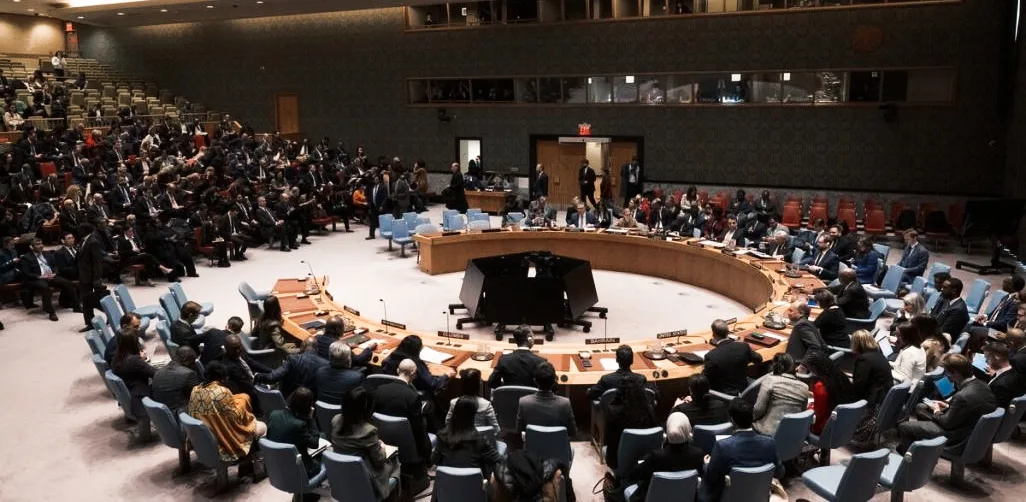
ASIATODAY.ID, NEW YORK — The crisis in Venezuela has reached a dramatic and unprecedented turning point after United States forces struck Caracas and seized President Nicolás Maduro, triggering a deep split inside the United Nations Security Council and raising alarms over the future of international law.
Meeting in emergency session on Monday, 5 January 2026, the Security Council confronted a sharply altered diplomatic landscape. At the heart of the debate was a fundamental question: does Washington’s action represent legitimate accountability—or a dangerous erosion of state sovereignty?
UN Secretary-General António Guterres set the tone by warning that international peace and security depend on full respect for the UN Charter, a message widely interpreted as a response to the US intervention.
His remarks framed a debate exposing profound and potentially lasting divisions among Member States, even as Maduro reportedly appeared in a federal courtroom in the United States.
US: ‘Law Enforcement Operation, Not War’
The United States rejected any characterization of its actions as military aggression. Addressing the Council, US Ambassador Michael G. Waltz described the operation as a targeted law-enforcement action, supported by the military solely to arrest an indicted fugitive.
According to Washington:
Nicolás Maduro is not a legitimate head of State following Venezuela’s disputed 2024 elections;
The operation was necessary to combat narcotics trafficking and transnational organized crime threatening regional and US security;
Historical precedents exist, including the 1989 arrest of former Panamanian leader Manuel Noriega.
“There is no war against Venezuela or its people,” Waltz said. “We are not occupying a country. This was a law-enforcement operation in furtherance of lawful indictments that have existed for decades.”
Venezuela: ‘Sovereignty Violated, a Dangerous Precedent’
Venezuela’s UN Ambassador Samuel Moncada forcefully rejected the US narrative, calling the operation an illegal armed attack with no legal justification.
He accused the United States of bombing Venezuelan territory, causing civilian and military casualties, and “kidnapping” President Nicolás Maduro and First Lady Cilia Flores.
“We cannot ignore a central element of this aggression,” Moncada told the Council. “Venezuela is being attacked because of its natural resources.”
Caracas called on the Security Council to:
– Demand the immediate release and safe return of Maduro and his wife;
– Condemn unequivocally the use of force against Venezuela;
– Reaffirm the principle of non-acquisition of territory or resources by force;
– Adopt urgent measures to de-escalate tensions and protect civilians.
UN Charter Under Scrutiny
Much of the debate centered on Article 2 of the UN Charter, which prohibits the use of force against the territorial integrity or political independence of any State. Many delegations warned that the Venezuela case now represents a critical test of the credibility of international law.
Latin American countries including Colombia, Brazil, Mexico, Chile, and Panama stressed the region’s long-standing commitment to remaining a zone of peace, cautioning that unilateral military action risks destabilizing the hemisphere and worsening displacement.
Brazil said the bombing and seizure of a head of State crossed an “unacceptable line”, while Mexico emphasized that externally imposed regime change violates international law regardless of political disagreements.
Limited Regional Support for Washington
A smaller group of countries took a different stance. Argentina welcomed the US operation as a decisive blow against narcotics trafficking and terrorism, arguing that Maduro’s removal could open a pathway toward restoring democracy and the rule of law.
Paraguay also endorsed Maduro’s removal, calling for the immediate restoration of democratic institutions and the release of political prisoners, while urging that any transition proceed through democratic means.
Russia and China: ‘Armed Aggression’
The strongest criticism came from Russia and China, which described the US action as armed aggression and warned against the normalization of unilateral force.
Their position was echoed by countries beyond the Americas, including South Africa, Pakistan, Iran, and Uganda, which cautioned that selective application of international law could undermine the entire collective security system.
Both Moscow and Beijing demanded the immediate release of President Maduro, stressing the inviolability of head-of-State immunity under international law and framing the crisis as a defining test of whether UN Charter principles apply equally to all nations.
A Defining Moment for the World Order
The Venezuela crisis has now evolved into far more than a national emergency. It has become a global reckoning over the balance between power and law, and whether the post-World War II international order can withstand unilateral action by major powers.
As Secretary-General Guterres warned the Council, “the power of the law must prevail over the law of power.” Whether that principle survives this crisis remains an open—and urgent—question. (AT Network)
Follow Us at Google News and WA Channel