
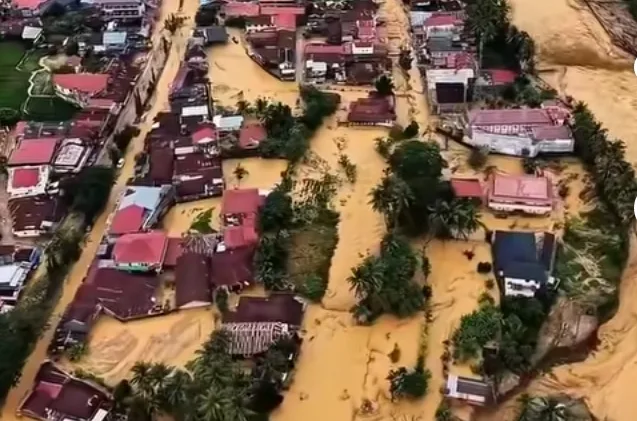
ASIATODAY.ID, JAKARTA — The government now faces a massive recovery challenge in Sumatra following a series of flash floods and landslides that struck Aceh, North Sumatra and West Sumatra.
The damage — physical, social, and economic — is currently estimated at IDR 51.82 trillion (roughly USD 3.11 billion), and this figure may still rise as casualty data and damage assessments are updated.
The head of the National Disaster Management Agency (BNPB), Lieutenant-General Suharyanto, stressed that the budget needs remain fluid.
“Of course the data are not yet final; we are still completing them. We coordinate with the Ministry of Public Works. As of now, for Aceh alone, restoring conditions to what they were before will cost Rp 25.41 trillion,” he said on Monday, December 8, 2025.
Estimates for recovery needs in North Sumatra are IDR 12.88 trillion (≈ USD 773 million), while West Sumatra requires around IDR 13.52 trillion (≈ USD 812 million).
Suharyanto said the sums for all three provinces have been compiled and submitted to the President as a preliminary assessment of national rehabilitation requirements.
The funds will be used to improve services for survivors, expedite compensation for families of the deceased or missing, and ensure proper logistical support.
BNPB also plans to transition into a rehabilitation and reconstruction phase, beginning with the construction of temporary shelters (huntara) followed by permanent housing (huntap) for displaced people.
“Permanent housing will be built after temporary housing is completed,” he confirmed.
Experts: Root Cause of Disaster Lies in Ecological Collapse Upstream–Downstream
While the government focuses on recovery, forestry and hydrology experts are calling for a long-term response — not only rebuilding infrastructure but also restoring the ecological foundations that once protected the region.
In a discussion on Forest Management and Disaster Mitigation at the Faculty of Forestry, Gadjah Mada University (UGM), academics pointed out that the floods and landslides affecting these three provinces are consequences of decades of massive deforestation, weak spatial planning, and a vulnerable mountainous geography.
1. Extreme Rainfall Strikes a Fragile Ecosystem
According to forest-hydrology researcher Dr. Hatma Suryatmojo, the disaster was not simply triggered by extreme weather — it was the result of heavy rainfall hitting forests and watershed ecosystems already severely degraded.
“The capacity of nature to buffer disasters has been drastically reduced due to deforestation, land-use conversion, and spatial planning that ignored disaster risk. The root problem is the destruction of upstream–downstream ecosystems and systematic negligence in spatial planning,” he said.
Dr. Hatma recommends a dual-pronged strategy:
Immediate halt to deforestation, protection of remaining primary forest, and vigorous efforts at watershed rehabilitation and reforestation.
Implementation of risk-based spatial planning, establishment of early-warning systems, and community education and involvement.
“This is not a failure of nature, but a failure in law enforcement and implementation of conservation and spatial regulations,” he emphasized.
2. Weak Coordination Between Central and Local Governments
Geospatial expert Dr. Belinda Arunarwati Margono (from the Geospatial Information Agency, BIG) pointed to a critical weakness in coordination between central and regional authorities. Although early-warning systems exist, many local governments fail to act effectively — often due to lack of understanding or commitment.
“Early detection is there, but the mechanism isn’t working. That’s why disasters keep happening,” she said.
3. High Geological Vulnerability Amplified by Forest Loss
Conservation specialist Prof. Ambar Kusumandari explained that several of the watersheds affected in the three provinces are intrinsically prone to disasters: steep terrain, geologic faults, and soil conditions that make the region vulnerable to landslides, especially when forests are stripped away.
“With rapid deforestation, hydrometeorological disasters will become more frequent. The consequences will include massive loss of biodiversity and depletion of water reserves,” she warned.
4. Deforestation Driven by Governance Failures Over Years
Finally, forestry professor Prof. Ahmad Maryudi noted that much of the deforestation in Sumatra’s protected areas is driven by human activities — often illegal — and exacerbated by weak implementation of laws.
“It is a result of decades of policy inflation and capacity collapse — many policies exist, but effectiveness is lacking because enforcement is weak,” he said.
Recovery Must Be Accompanied by Fundamental Ecological Reform
With the estimated cost of rehabilitation now at USD ~ 3.1 billion, experts stress that rebuilding infrastructure alone will not break the cycle of disasters. To reduce long-term risk, Indonesia must invest in large-scale reforestation, watershed restoration, risk-based spatial planning, and consistent law enforcement across forestry and land-use policies.
Short-term solutions like temporary and permanent housing are necessary for immediate relief, but structural reform and ecological restoration are essential to safeguard Sumatra from future catastrophes. (AT Network)
Follow Us at Google News and WA Channel