
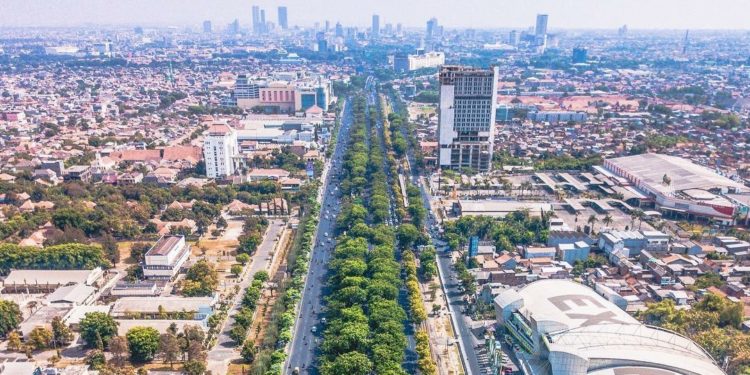
ASIATODAY.ID, JAKARTA – The Indonesian Government, through the Directorate General of New, Renewable Energy and Energy Conservation at the Ministry of Energy and Mineral Resources, in collaboration with the Deutsche Gesellschaft für Internationale Zusammenarbeit (GIZ), has officially designated Surabaya as a model city for national energy transition under the Sustainable Energy Transition in Indonesia (SETI) project.
This bilateral cooperation between Indonesia and Germany began in 2023 and is set to continue until 2028. The SETI project focuses on accelerating the decarbonization of urban buildings by promoting renewable energy adoption and energy efficiency practices.
On April 16, 2025, the Surabaya City Government officially launched the implementation of the SETI project, making it the pioneer city in the clean energy transition for urban buildings in Indonesia.
“If the use of solar power and other renewable energy sources, along with energy efficiency measures, can be effectively implemented in Surabaya, this will significantly contribute to reducing national greenhouse gas emissions,” stated Andriah Feby Misna, Director of Various New and Renewable Energy, in an official statement on Thursday, April 17, 2025.
Surabaya’s Strong Potential for Sustainable Growth
As Indonesia’s second-largest city, Surabaya offers numerous advantages that make it an ideal pilot for the energy transition initiative: Significant potential for energy savings, Existing green building certification standards, A rapidly growing construction sector, Strong capacity and engagement from local stakeholders.
“For these reasons, Surabaya is being positioned as a showcase for energy transition and building sector efficiency through SETI. We aim to ensure its economic growth goes hand in hand with decarbonization efforts, creating a low-carbon and sustainable urban environment,” she added.
SETI targets various building types—including public, commercial, and residential properties—as pilot projects. The initiative focuses on: Strategic planning for building decarbonization, Implementation of renewable energy technologies, Technical assistance and local capacity building.
Edison Siagian, Director of Regional Government Affairs Synchronization I at the Ministry of Home Affairs, emphasized the need for policy alignment.
“To successfully implement energy transition policies, we must ensure inclusive and sustainable development planning between national and local governments. Cross-sector collaboration should begin at the planning stage and continue through execution, monitoring, and evaluation,” he said.
Lisa Tinschert, Director of the Energy Program at GIZ, reiterated Germany’s strong commitment to supporting Surabaya’s ambition to become a low-carbon city.
“With the implementation of SETI in Surabaya, the city government will receive support in the form of planning studies, technical assistance, capacity development, participation in urban energy networks, and other forms of collaboration,” she said.
Backed by strong local potential and solid international support, Surabaya is set to become a national model in achieving a sustainable energy transition. This initiative not only accelerates the country’s path to reduced carbon emissions but also strengthens Surabaya’s reputation as a modern, environmentally responsible city. (AT Network)
Follow Us at Google News and WA Channel