
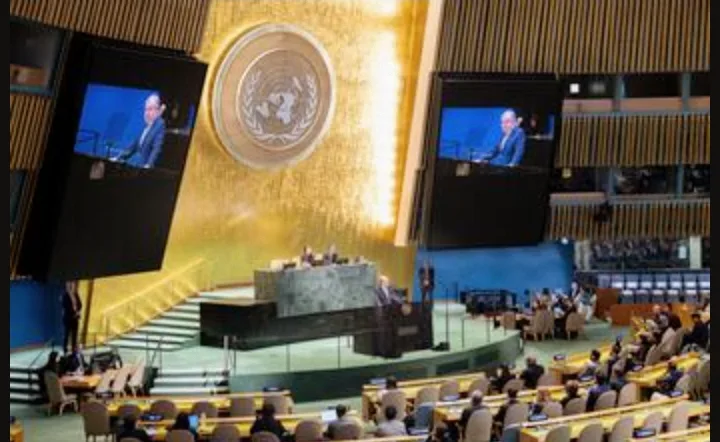
ASIATODAY.ID, NEW YORK — United Nations Secretary-General António Guterres has issued one of the starkest warnings of his tenure: the world is sliding toward systemic chaos, marked by conflict, impunity, extreme inequality, and growing unpredictability—precisely when international cooperation is most urgently needed.
Delivering his final annual priorities address to the UN General Assembly on Thursday, January 15, 2026, Guterres painted a grim portrait of a global system under unprecedented strain.
“The context is chaos,” Guterres told world leaders.
“We live in a world brimming with conflict, impunity, inequality, and unpredictability.”
Rather than presenting a routine agenda, the Secretary-General framed his speech as both a diagnosis of global disorder and a personal commitment to push for change in his final year in office.
Global Governance Under Historic Pressure
According to Guterres, today’s international system is being battered simultaneously by prolonged wars, geopolitical fragmentation, climate breakdown, and the visible erosion of respect for international law.
From Gaza and Ukraine to Sudan and Yemen, armed conflicts continue unabated, while attacks on civilians and humanitarian workers increasingly occur in plain sight.
“The erosion of international law is not happening in the shadows,” he said.
“It is unfolding before our eyes, live on our screens, in 4K.”
Unconstitutional seizures of power, silencing of dissent, widespread human rights violations, and the plundering of natural resources, he warned, are becoming normalized.
Three Final Priorities for a Fractured World
Guterres outlined three guiding principles he believes must steer the United Nations and its Member States through the current global crisis:
1. Defend the UN Charter—Without Exception
Respect for international law, protection of civilians, human rights, and the rule of law must apply universally, without double standards.
2. Peace Between Nations—and Peace with Nature
Ending wars is not enough. Poverty, inequality, underdevelopment, and climate breakdown must be addressed as root causes of violence.
“Sustainable peace requires sustainable development,” he stressed.
3. Unity in an Age of Division
Rising inequality, exclusion, racism, and disinformation must be countered by building inclusive, united societies.
Multilateralism at a Crossroads
Guterres warned that multilateralism itself is being tested, as geopolitical rivalries widen and funding for development and humanitarian action is cut.
“This is the paradox of our time: when international cooperation is needed most, we appear least willing to invest in it,” he said.
Rejecting growing skepticism toward global institutions, he added:
“Some want to put international cooperation on death watch. I assure you—we will not give up.”
Extreme Inequality: A Moral and Political Time Bomb
The UN chief sounded the alarm over unprecedented concentration of wealth and power, noting that the richest 1 per cent now control 43 per cent of global financial assets.
“This level of concentration is morally indefensible,” Guterres said, warning that such disparities fuel instability, social unrest, and the breakdown of trust in institutions.
Technology, Climate, and the Future of Humanity
On emerging technologies, particularly artificial intelligence, Guterres cautioned against allowing a handful of corporations to dominate systems shaping public life.
“We must ensure that humanity steers technology, not the other way around,” he said.
Turning to climate change, he warned that a world in climate chaos cannot be a world at peace. While a temporary overshoot of the 1.5°C warming threshold now appears inevitable, he insisted it is not irreversible—if governments act decisively.
He called for:
– Faster and deeper emissions cuts
– A just transition away from fossil fuels
– A dramatic scale-up of climate finance
Reform or Irrelevance
Guterres emphasized the urgent need to reform global institutions, including international financial bodies and the UN Security Council.
“1945 problem-solving will not solve 2026 problems,” he warned, adding that institutions failing to reflect today’s realities risk losing legitimacy altogether.
A Final Personal Commitment
Striking a personal tone, Guterres reminded delegates that this was his last annual priorities address as Secretary-General.
“I will make every day of 2026 count,” he said.
“I am fully committed, fully determined, to keep working, to keep fighting, and to keep pushing for the better world we know is possible.”
Guterres took office in January 2017, succeeding Ban Ki-moon, at a moment of optimism for multilateralism following the adoption of the Paris Climate Agreement and the 2030 Agenda for Sustainable Development.
Nearly a decade later, his farewell message is unequivocal:
without law, justice, and genuine global cooperation, the world is heading toward irreversible disorder. (AT Network)
Follow Us at Google News and WA Channel