
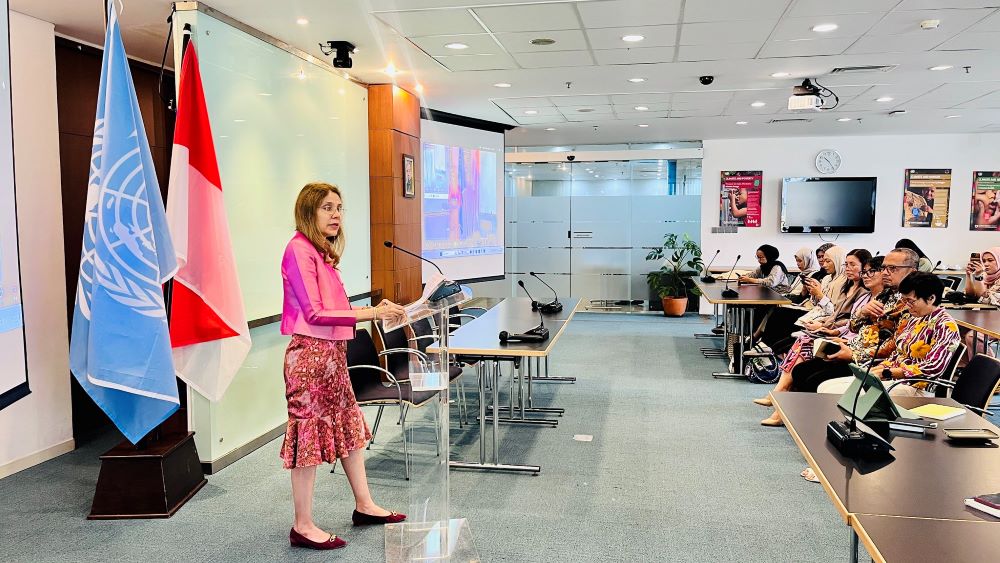
ASIATODAY.ID, JAKARTA – The Head of the UN Representative Office in Indonesia, Gita Sabharwal said Indonesia is doing better than most countries in Asia and the Pacific in the achievement of the SDGs – though in some areas acceleration is required. Gender equality is one of these.
“Despite the challenges, let’s not lose sight of the bigger picture: most Indonesian women are optimistic about the future, and specifically their future,” said Gita in International Women’s Day 2025 Press Conference, at the UN House, Thursday, March 6, 2025.
This year, the UN call for generational momentum for gender equality—a commitment to act decisively for all women and girls in making rights, equality, and empowerment a reality, as reflected in the Asta Cita and RPJMN.
“The development work of the UN centres on the Sustainable Development Goals – and equality between men and women is central to this agenda,” said Gita.
In a global survey by the UN, called We the Women, conducted last year
– Three quarters of Indonesian respondents said they expected to be better off in 5 years’ time, and
– More than two thirds said they were in control of their future.
In the same survey, education, health and decent jobs were identified by women in Indonesia as the most important SDGs.
The UN in Indonesia works in partnership with the government on the acceleration of the SDGs, and many of the projects specifically support women.
Gita Sabharwal highlighted highlight 5 areas of cooperation:
First, technology has the potential to drive equality, and nearly every other woman in Indonesia (47%) considers AI an opportunity.
“UN agencies, including UNESCO, UN Women, UNICEF, are supporting the government’s AI regulatory frameworks and ensuring women and children can meaningfully and safely participate in the digital space and benefit from the digital economy while increasing the proportion of women in STEM training,” she explained.
Second, women’s economic empowerment is the backbone of Indonesia’s economy with six out of 10 micro, small and medium enterprises being women owned and run.
“UN agencies, including ILO, UNDP, UNIDO and ITC, are working with the government to increase small businesses’ access to finance and markets to enable women owned businesses to grow and prosper,” she explained.
Third, women are disproportionately affected by climate change, yet they are leaders in sustainable solutions. For instance, in a UNDP-led initiative, 22 off-grid solar power plants were installed in remote rural areas. Half of the local operators trained to maintain these plants are women.
“Similarly, UNEP in partnership with local governments support women driven land use businesses to secure private financing. One of them is a coconut farmer in rural Yogyakarta, largely employing women, where the funding is enabling them to replace old coconut trees with a drought tolerant variety. This increases yields, income for women while protecting soil erosion,” said Gita.
Fourth, the UN, through UNFPA, UNODC, WHO and others is working with the government to strengthen services and prevention mechanisms to address violence against women.
Fifth, Indonesia, is the fifth largest contributor to UN peacekeeping globally. It is leading in the representation of women in peacekeeping with nearly 600 women as part of its peacekeeping contingent. This is expected to further increase in coming years.
These are just a few examples, and my colleagues will elaborate on more such initiatives.
“UN is as good as the partnerships that it fosters with government, civil society and the private sector. Through further strengthening such partnerships we can make gender equality a reality as we celebrate International Women’s Day today,” she said.
Ministerial Expert Staff for Institutional Relations, Ministry of Women’s Empowerment and Child Protection of Indonesia, Indra Gunawan, said that Indonesia as part of the international community also celebrates, how the achievements have been made, although of course there are still many challenges faced.
Based on the results of the 2024 survey, the number of violence against women shows that 1 in 4 women aged 15-64 years have experienced physical and/or sexual violence perpetrated by a partner or non-partner during their lifetime.
“This figure is indeed quite large, and of course it is our concern, if we reflect back on what we have achieved, since the Beijing conference, there have been many efforts that we have also made,” explained Indra.
After the Beijing conference, Indra said, the Indonesian government issued a policy by trying to mainstream gender issues into the main part of the government, where the policy programs and activities carried out were integrated into the RPJMN and RPJPN.
“We will certainly continue this effort, although there are still many challenges and this can be implemented up to regional heads to be more gender responsive, to ensure that various women’s issues are the concern of all parties,” he explained. (AT Network)
Follow Us at Google News and WA Channel