
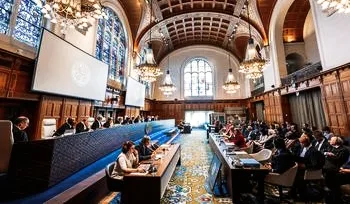
ASIATODAY.ID, THE HAGUE — Public hearings opened Monday at the International Court of Justice (ICJ) in a historic case brought by Gambia accusing Myanmar of committing genocide against the Rohingya minority.
The proceedings, held at the Peace Palace, mark the start of the merits phase after years of preliminary legal arguments.
Over the next three weeks, ICJ judges will hear oral arguments, examine witnesses and experts, and determine whether Myanmar violated its obligations under the Convention on the Prevention and Punishment of the Crime of Genocide.
“By all measures, this case is not about esoteric issues of international law,” said Gambia’s Attorney General Dawda Jallow on January 12, 2026.
“It is about real people, real stories, and a real group of human beings.”
A Case Years in the Making
Gambia filed its application in November 2019, alleging that Myanmar’s military, the Tatmadaw, carried out systematic “clearance operations” in Rakhine State, escalating in 2017. Over 700,000 Rohingya fled to Bangladesh amid killings, sexual violence, and the destruction of villages. UN officials described the crisis as a “textbook example of ethnic cleansing.”
A UN-mandated fact-finding mission in 2018 concluded there were reasonable grounds to believe serious international crimes, including genocide, crimes against humanity, and war crimes, had been committed. Nearly one million Rohingya remain in refugee camps in Bangladesh, while countless others are displaced inside Myanmar.
Provisional Measures and Accountability
In January 2020, the ICJ ordered Myanmar to prevent genocidal acts, preserve evidence, and report on compliance. Despite challenges to the Court’s jurisdiction, judges affirmed in July 2022 that they could hear the case. Eleven other states submitted written support for Gambia’s interpretation of the Genocide Convention.
“Myanmar remains trapped in a cycle of atrocities and impunity,” Jallow told the Court.
“Accountability is imperative to prevent the repetition of these crimes.”
The February 2021 military coup, which ousted Myanmar’s civilian government, has further escalated nationwide conflict and deepened the plight of the Rohingya.
Myanmar’s Defense and the Road Ahead
Myanmar is expected to present its defense later this week. The ICJ’s final judgment, legally binding on the state, could take months or longer after hearings conclude. Unlike criminal tribunals, the ICJ does not prosecute individuals but determines state responsibility under international law.
The world is now watching as the UN’s highest court tackles one of the most egregious human rights crises of the 21st century. (AT Network)
Follow Us at Google News and WA Channel