
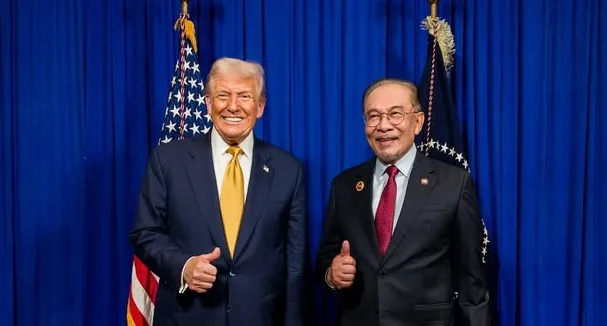
ASIATODAY.ID, JAKARTA – The recently signed tariff agreement between Malaysia and the United States (US), announced on the sidelines of the 2025 ASEAN Summit, has sparked widespread criticism in Kuala Lumpur.
Many observers argue that the deal threatens Malaysia’s economic sovereignty, effectively placing its trade policies under Washington’s influence.
The US Mission to ASEAN published the Reciprocal Trade Agreement between the United States and Malaysia on October 26, 2025. However, critics say the deal offers minimal benefits while imposing heavy obligations on Malaysia.
One of the harshest critics, former Malaysian Minister of International Trade and Industry Azmin Ali, called the deal a “surrender of Malaysia’s economic sovereignty.”
He warned that the agreement compels Malaysia to comply with US trade and investment rules, undermining its independence in global trade decisions.
“The most alarming clause requires Malaysia to mirror US trade sanctions against other nations. If the US blocks imports from China or Russia, Malaysia must follow suit — even if it harms our economy,” Azmin said, as quoted by Free Malaysia Today on Friday, October 31, 2025.
Azmin referred to Article 5, Section 1, which concerns Economic and National Security. He argued that the clause jeopardizes Malaysia’s long-standing neutrality — a key factor in its diplomatic strength in Southeast Asia.
“By aligning Malaysia’s trade policy with Washington’s decisions, the deal risks driving away investors who value Malaysia’s neutrality and stability,” he added.
Azmin also criticized other provisions that, he claimed, restrict Malaysia’s right to regulate its domestic market.
He highlighted clauses requiring Malaysia to adopt US standards on food, medicine, and vehicle safety, as well as the potential erosion of the country’s halal certification system, which would be forced to recognize foreign certifiers.
“Short-term gains are nothing compared to the long-term damage. This agreement won’t strengthen Malaysia — it symbolizes the surrender of our sovereignty, neutrality, and economic future,” he warned.
Anwar Ibrahim Denies Sovereignty Threat
Responding to the backlash, Prime Minister Anwar Ibrahim defended the agreement, asserting that Malaysia’s sovereignty remains intact.
He told the Malaysian Parliament that the government can terminate the deal at any time through an exit clause.
“Every trade agreement includes an exit clause. Malaysia retains full control over its economic and trade decisions,” Anwar said, emphasizing that the deal had been carefully reviewed by senior officials before signing with US President Donald Trump.
Key Provisions of the US-Malaysia Tariff Agreement
According to the official document from the US Mission to ASEAN, Article 5.1 stipulates that Malaysia must align its economic measures with any trade restrictions imposed by the US for national or economic security reasons.
Other controversial sections include:
– Article 2.3 (Agriculture): Malaysia may not enter agreements with third countries that impose non-scientific or preferential technical standards inconsistent with US or international norms.
– Article 2.5: Malaysia cannot restrict US market access for certain dairy or meat products listed in Annex II.
– Article 2.12: Malaysia may not impose discriminatory value-added taxes on US companies.
– Article 3 (Digital Trade and Technology): Malaysia is prohibited from requiring US companies to transfer technology, source code, or proprietary knowledge as a condition for doing business.
Despite these restrictions, the agreement maintains a 20% tariff on most Malaysian exports, with only a few categories eligible for zero tariffs.
A Blow to Malaysia’s Neutral Trade Policy
Analysts warn that the deal could reshape Malaysia’s economic direction and compromise its traditionally balanced stance between Western and Eastern powers.
By tying its trade policy closely to the US, Malaysia risks alienating key partners such as China — its largest trading partner — and undermining ASEAN’s principle of neutrality.
With global geopolitical tensions rising, several economic experts and lawmakers have urged Putrajaya to review the agreement before it comes into full effect. (ATN)
Follow Us at Google News and WA Channel