
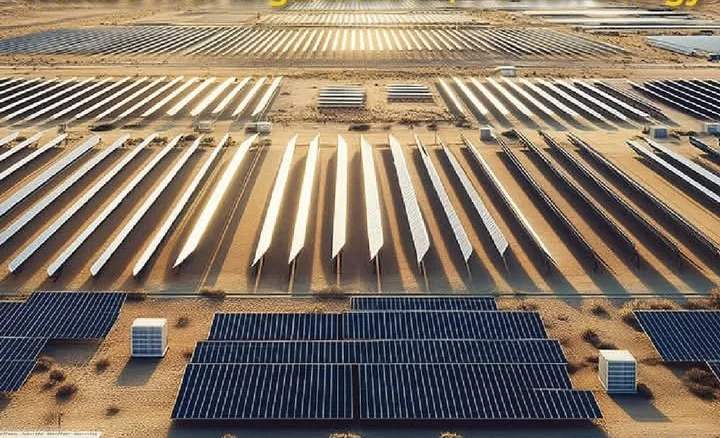
ASIATODAY.ID, TASHKENT — Uzbekistan is accelerating its shift away from fossil fuels, underscored by a US$30 million financing agreement between the Asian Development Bank (ADB) and Abu Dhabi–based clean energy company Masdar to develop a large-scale solar power project integrated with battery energy storage systems (BESS).
The deal supports the Guzar Solar and Battery Energy Storage Project, which will deliver a 300-megawatt (MW) solar power plant combined with a 75-megawatt-hour (MWh) BESS in Guzar City, Kashkadarya Region. The project is positioned as a key pillar in Uzbekistan’s push toward a low-carbon, energy-secure future.
Sun and Batteries as the Backbone of Energy Transition
Unlike conventional solar developments, the integration of battery storage allows electricity to be stored and dispatched during peak demand periods.
This approach addresses the intermittency challenge of renewable energy while significantly improving grid stability and power reliability—critical factors for reducing dependence on fossil-fuel-based generation.
The project also includes the construction of 1.6 kilometers of transmission lines and a 220-kilovolt substation, ensuring that solar power can be seamlessly integrated into Uzbekistan’s national electricity grid and reducing pressure on thermal power plants.
Financing Structure and the Role of Global Capital
The US$30 million financing package comprises:
– US$12.5 million loan from ADB
– US$12.5 million loan from Leading Asia’s Private Infrastructure Fund 2 (LEAP 2)
– US$5 million loan from the Canadian Climate and Nature Fund for the Private Sector in Asia (CANPA)
All facilities are administered by ADB, highlighting the role of multilateral development banks in mobilizing private capital for climate action and energy transition.
“This project demonstrates ADB’s strong commitment to supporting the clean energy transition across Asia and the Pacific, and specifically Uzbekistan’s path toward energy security,” said Kanokpan Lao-Araya, ADB Country Director for Uzbekistan on January 15, 2026.
“By combining large-scale solar generation with battery energy storage, the project will help meet growing electricity demand, improve power reliability, and reduce greenhouse gas emissions.”
Tangible Energy and Climate Impact
Once fully operational, the Guzar project is expected to:
– Generate 634 gigawatt-hours (GWh) of electricity annually
– Avoid at least 354,000 tons of carbon dioxide emissions each year
– Contribute to Uzbekistan’s goal of achieving a 40% renewable energy share in its power generation mix by 2030
ADB is also providing a partial credit guarantee of up to US$9 million to Nur Kashkadarya Solar PV Foreign Enterprise LLC, the project’s special purpose vehicle wholly owned by Masdar. The guarantee mitigates payment risks from the power offtaker and strengthens investor confidence in Uzbekistan’s power sector.
Accelerating a Fossil Fuel Exit
The agreement comes as ADB and Uzbekistan mark 30 years of partnership, with total ADB support since 1995 reaching US$15.8 billion. The Guzar project, however, signals a new phase—where renewable energy becomes central to national development and energy security strategies.
For Masdar, Uzbekistan is a strategic growth market. By the end of 2025, Masdar’s global renewable energy portfolio exceeded 50 gigawatts (GW), with a target of 100 GW by 2030. Of the nine Masdar projects financed by ADB, six are located in Uzbekistan, reinforcing the country’s role as an emerging clean energy hub in Central Asia.
With US$30 million invested in solar power and battery storage, Uzbekistan is not merely expanding electricity capacity—it is accelerating its exit from fossil fuels.
The Guzar project underscores a decisive policy direction: a cleaner, more resilient, and more sustainable energy system aligned with global climate goals and long-term economic growth. (AT Network)
Follow Us at Google News and WA Channel