
ASIATODAY.ID, BALIKPAPAN — Indonesia has officially entered a new phase in strengthening its national energy sovereignty.
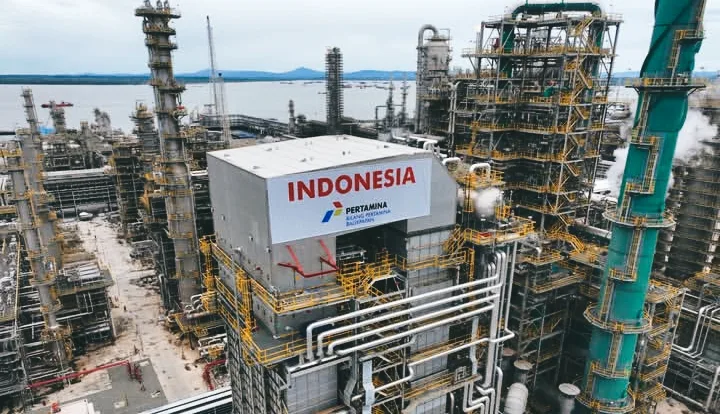
President Prabowo Subianto on Monday, January 12, 2026 inaugurated the Integrated Energy Infrastructure of Pertamina’s Refinery Development Master Plan (RDMP) Balikpapan in East Kalimantan, marking one of the country’s largest energy investments to date.
Valued at US$7.4 billion (approximately IDR 123 trillion), the RDMP Balikpapan project is a strategic national initiative aimed at boosting energy security, reducing fuel imports, and accelerating Indonesia’s transition toward a more resilient and sustainable energy system.
President Prabowo described the inauguration as a historic milestone for Indonesia’s energy sector, praising the collaboration between the government, state-owned enterprises, engineers, workers, and local communities.
“I extend my appreciation to all parties who worked tirelessly to make this project a reality. This is a significant achievement for our nation and clear proof that Indonesia is capable of executing large-scale strategic projects that meet international standards,” President Prabowo said.
Refinery Capacity Expansion, Import Reduction Ahead
Through the RDMP Balikpapan project, crude oil processing capacity has increased substantially from 260,000 barrels per day to 360,000 barrels per day. The upgrade not only enhances volume but also significantly improves the quality of fuel products produced domestically.
Minister of Energy and Mineral Resources Bahlil Lahadalia stated that the Balikpapan refinery is now capable of producing Euro 5–equivalent fuels, which are cleaner and more environmentally friendly, supporting Indonesia’s net-zero emissions ambition.
“With the RDMP in operation, Indonesia can save more than Rp60 trillion in foreign exchange annually. The fuel quality has improved significantly and is now approaching Euro 5 standards, aligning with our long-term energy transition goals,” Bahlil said.
The minister further emphasized that the expanded refinery capacity could enable Indonesia to halt diesel fuel imports starting in mid-2026.
National diesel demand currently stands at 39.8 million kiloliters per year, a significant portion of which is now met through domestic production, supported by the B40 biodiesel program.
For gasoline, Indonesia’s annual demand reaches approximately 38.5 million kiloliters. Optimization of the RDMP Balikpapan is expected to increase production of gasoline with octane ratings above RON 90 by up to 5.8 million kiloliters per year, significantly reducing imports of higher-octane gasoline such as RON 92, RON 95, and RON 98.
Strengthening Energy Sovereignty Under the Constitution
Bahlil stressed that ensuring domestic fuel supply is a constitutional mandate, as stipulated in Article 33 of Indonesia’s 1945 Constitution, which requires that key sectors affecting public welfare be controlled by the state.
To achieve long-term energy independence, the government is pursuing three core strategies:
– Expanding national refining capacity, including through RDMP Balikpapan;
– Diversifying energy sources, particularly by strengthening biodiesel programs such as B40;
– Maintaining a balance between supply and demand to safeguard national fuel availability.
Integrated Infrastructure to Support Eastern Indonesia
The RDMP Balikpapan project is equipped with key facilities, including a Crude Distillation Unit (CDU) and a Residual Fluid Catalytic Cracking (RFCC) unit, enabling the conversion of refinery residues into higher-value products.
The project is further integrated with two massive crude oil storage tanks in Lawe-Lawe, with a combined capacity of 2 million barrels, as well as the Tanjung Batu Fuel Terminal, which has a storage capacity of 125,000 kiloliters and serves as a major distribution hub for eastern Indonesia.
With the official launch of this integrated energy infrastructure, Indonesia has reinforced its commitment to energy self-sufficiency, positioning the country as a more resilient and competitive player in the global energy landscape while advancing sustainable industrial development. (AT Network)
Follow Us at Google News and WA Channel