
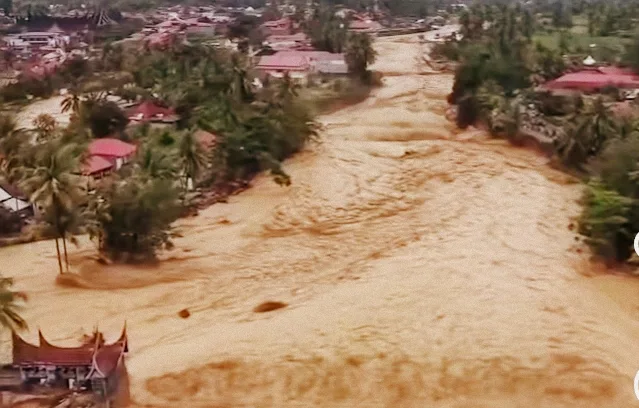
ASIATODAY.ID, JAKARTA – Torrential rainfall across South and Southeast Asia has triggered catastrophic floods that have killed hundreds, displaced millions, and caused severe economic disruption.
National meteorological and hydrological agencies are operating around the clock to deliver life-saving forecasts, while the WMO Coordination Mechanism (WCM) continues to provide expert guidance to support humanitarian operations.
The worst-affected countries include Indonesia, the Philippines, Sri Lanka, Thailand, and Viet Nam, all hit by an intense combination of monsoon rains and tropical cyclone activity.
According to WMO climate assessments, Asia remains one of the planet’s most flood-vulnerable regions, with global warming amplifying the frequency and intensity of extreme rainfall events.
“The Asia-Pacific region faces the world’s most intense and frequent tropical cyclones,” said WMO Secretary-General Celeste Saulo on December 2, 2025.
“Record-breaking rainfall and flooding are displacing millions and causing billions of dollars in losses. No country can tackle these challenges alone.”
Early Warning Systems Under Strain
The WMO Coordination Mechanism has been central to supplying authoritative weather, water, and climate information to UN and humanitarian partners. Seasonal climate outlooks issued since November highlighted elevated risks of above-normal rainfall, flash floods, landslides, and storm surges—conditions now playing out across the region.
Country-by-Country Impact
Indonesia
Tropical Cyclone Senyar triggered devastating floods and landslides across northern Sumatra—an exceptionally rare event so close to the equator.
BNPB’s 2 December 2025 update reports:
604 dead
464 missing
2,600 injured
1.5 million affected
570,000 displaced
50 districts impacted
Viet Nam
Storm Koto, intensified by a strong cold surge, continues to bring extreme rainfall to Viet Nam’s south-central region.
Key impacts:
Nearly 100 deaths
Major tourist sites and historic areas flooded
Agricultural losses in the multi-million-dollar range
A 24-hour rainfall reading of 1,739.6 mm—potentially a new Asian and Northern Hemisphere record pending WMO verification
Philippines
The Philippines is still recovering from two major early-November typhoons:
Typhoon Kalmaegi (Tino): 220+ deaths, 2.4 million affected
Followed by Typhoon Fung-Wong (Uwan)
The country has endured an unprecedented sequence of tropical cyclones since 2024.
Sri Lanka
Cyclonic Storm Ditwah unleashed the worst flooding and landslides seen since the early 2000s.
OCHA reports:
998,918 affected
212 deaths
218 missing
All 25 districts impacted
The UN has activated its emergency coordination mechanism to support nationwide response efforts.
Thailand
Heavy rains have inundated southern Thailand.
As of 1 December:
178 deaths
2.3 million affected
Flooding across 9 provinces, 74 districts, 407 sub-districts, and 2,725 villages
Hat Yai, the region’s largest city, recorded 370.2 mm of rainfall—an extreme event with a 300-year return period.
WMO Response: Strengthening Forecasting and Early Action
WMO is scaling up support across Asia through:
The Flood Forecasting Framework & Initiative (FFI) used in more than 70 countries
Severe Weather Forecasting Programmes in South and Southeast Asia
The South Asia HydroMet Forum (SAHF) to enhance forecasting capabilities
The global Early Warnings for All initiative
The 2025 launch of the Community of Practice for Flood Forecasting and Warning
These efforts aim to improve scientific capacity, enhance forecast accuracy, and ensure early warnings reach vulnerable communities faster. (AT Network)
Follow Us at Google News and WA Channel