
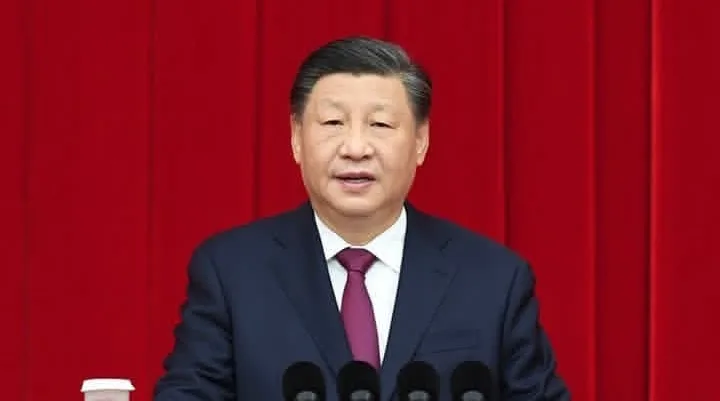
ASIATODAY.ID, BEIJING – Chinese President Xi Jinping has reiterated Beijing’s determination to reunify Taiwan with the mainland, declaring the process an inevitable historical trend that cannot be stopped.
Speaking during his New Year’s Eve address on December 31, 2025, Xi emphasized what he described as an unbreakable bond between people on both sides of the Taiwan Strait.
“Chinese people on both sides of the Taiwan Strait share a bond of blood and kinship. The reunification of our motherland is a trend of the times — and it is unstoppable,” Xi said.
Taiwan has been governed by the Republic of China (ROC) since 1949, after nationalist forces retreated to the island following their defeat by the Communist Party in the Chinese Civil War.
Beijing considers Taiwan an inseparable part of its sovereign territory under the One China policy.
Military Drills Send a Clear Signal
Xi’s remarks come amid heightened military tensions in the Asia-Pacific region. The People’s Liberation Army (PLA) has just concluded two days of large-scale military drills around Taiwan, simulating blockades of key ports, precision strikes on maritime targets, and scenarios aimed at countering external military intervention.
While Beijing continues to stress its preference for peaceful reunification, Chinese leaders have repeatedly stated that the use of force remains an option if Taiwan’s authorities pursue formal independence or if foreign powers intervene.
The drills began just 11 days after the United States announced an $11.1 billion arms sales package to Taiwan, the largest such deal in the island’s history — a move Beijing condemned as a serious provocation.
Russia’s Backing and the Global Context
China has also received explicit diplomatic backing from Russia. Russian Foreign Minister Sergey Lavrov recently reaffirmed Moscow’s support for Beijing’s position on Taiwan, citing the 2001 Treaty of Good-Neighborliness and Friendly Cooperation between the two countries.
Lavrov argued that Taiwan is increasingly being used by Western nations as a tool of “military-strategic deterrence” against China, driven in part by economic and technological interests.
On the international stage, Beijing’s position is reinforced by long-standing diplomatic recognition. Since 1971, the United Nations has recognized the People’s Republic of China (PRC) as the sole legitimate representative of China.
Although the United States formally recognized the PRC in 1979, Washington continues to maintain close ties with Taipei, including high-level political visits and military cooperation — a policy that Beijing consistently criticizes.
A Hard Signal for 2026
Xi Jinping’s New Year address is widely seen as a firm strategic signal at the start of 2026: Beijing is prepared to combine political pressure, military power, and global diplomacy to advance its goal of reunification with Taiwan.
As rivalry between China and the United States intensifies, Taiwan remains at the center of an increasingly volatile global geopolitical contest. (RT)
Follow Us at Google News and WA Channel