
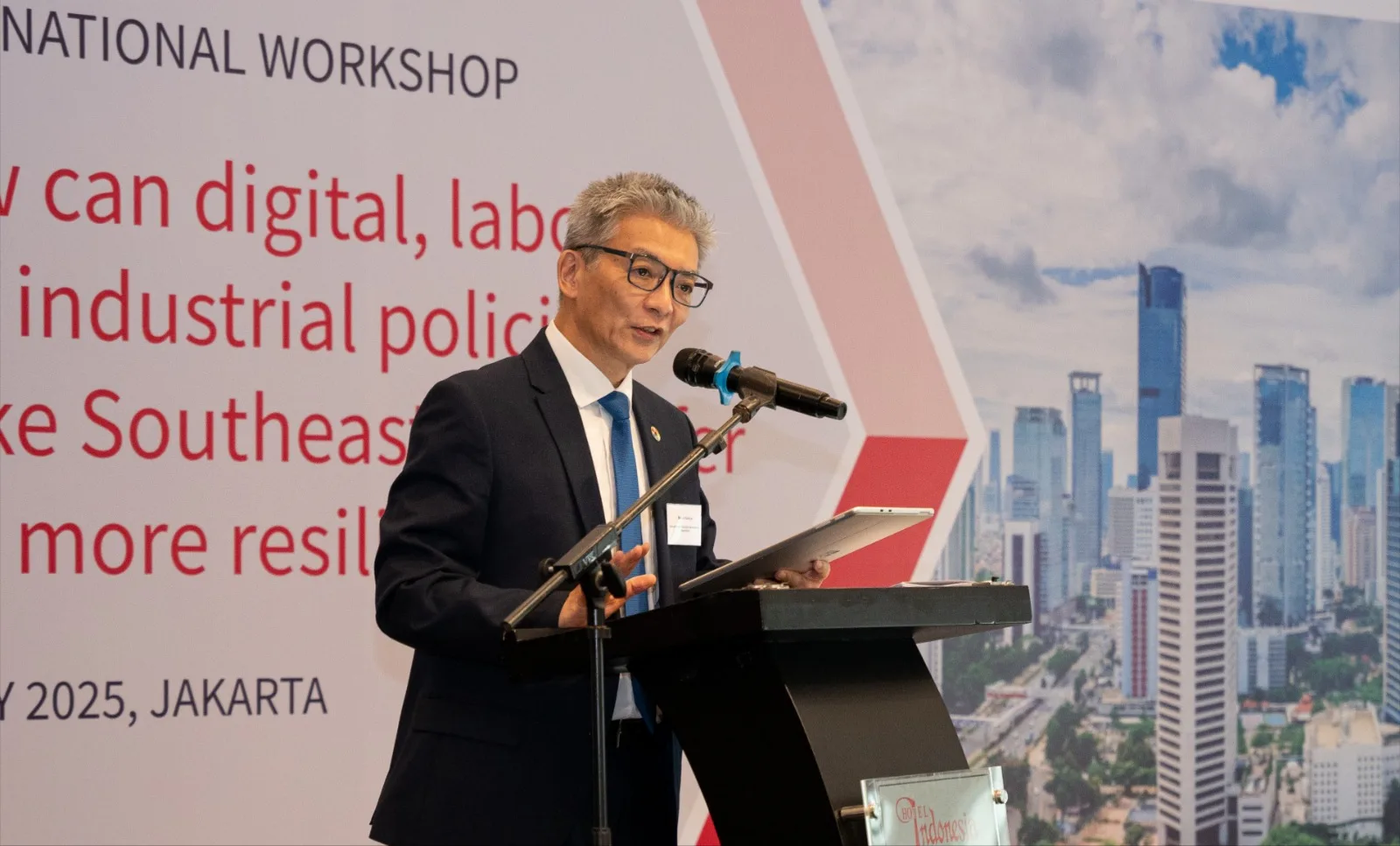
ASIATODAY.ID, JAKARTA – The Ministry of Industry of the Republic of Indonesia, in collaboration with the United Nations Industrial Development Organization (UNIDO), Cambridge Industrial Innovation Policy (CIIP) at the University of Cambridge, and the Lloyd’s Register Foundation, hosted an international workshop to explore how Southeast Asia can develop future-ready policies to manage rising risks ranging from AI disruption to industrial safety and digital trust in Jakarta, July 16, 2025.
The event highlighted the urgent need for adaptive policies that respond to a rapidly shifting landscape. Southeast Asia stands at a crossroads: artificial intelligence (AI), industrial change, and digital trade offer new opportunities but also bring new risks for workers, industries, and national security.
In his remarks, Syahroni Ahmad, the Secretary of the Directorate General of Regional Resilience and International Industrial Access (KPAII) on behalf of Mr. Tri Supondy, Director General for Industrial Resilience, Region, and International Access of the Ministry of Industry emphasized that Indonesia’s industry is already adjusting its business strategies in response to complex global and domestic challenges including shifting demand patterns, rising production costs, and more selective markets.
“Many industry players are now focusing on optimizing the potential of the domestic market, which contributes around 80% of manufacturing GDP. Therefore, protecting the national market and strengthening public purchasing power are crucial to maintaining the competitiveness of the national industry.”
He further underlined Indonesia’s commitment to sustaining and even elevating its industrial performance through international collaboration.
“Our close partnership with UNIDO exemplifies one of our key strategies to continuously enhance industrial sector accomplishments” he stated.
During the event, four policy briefs were launched based on data from the Lloyd’s Register Foundation World Risk Poll. The briefs provide practical guidance to address occupational safety, industrial strategy, AI governance, and digital trade policy.
Southeast Asia’s Safety and Innovation Gaps
In Southeast Asia, only 48% of workers who experience serious harm report it—compared to 80%+ in Australia, New Zealand, and North America. In Indonesia, reporting rates and safety training are among the lowest in the region, with only 21% of workers having received occupational safety and health (OSH) training in the past two years. Gender disparities persist: across the region, only 25% of women received OSH training versus 34% of men.
The policy brief on industrial strategy emphasized the role of manufacturing in resilience—supporting emergency responses, stabilizing economies, and providing quality employment. Workers in manufacturing feel notably safer, with over 40% saying conditions have improved in the past five years. Indonesia’s R&D is 0.28% of GDP, it ranks behind Thailand (1.14%), Vietnam (0.53%), and far below China (2.4%).
Thirty three percent of people in the region believe AI will mostly help society below the global average of 39%. In Singapore and Vietnam, optimism is higher, while Indonesia and Malaysia show more skepticism. Indonesian men are far more optimistic than women about AI’s impact, pointing to persistent digital equity challenges.
“Strong and inclusive industrial sectors build resilient societies. This partnership shows how data-driven collaboration helps governments make informed decisions in a rapidly changing world,” said Dr. Marco Kamiya, UNIDO Country Representative for the Subregional Office covering Indonesia, the Philippines, and Timor-Leste.
“UNIDO is proud to support Indonesia’s leadership in promoting industrial strategies that advance safety, sustainability, and inclusive growth.”
According to the World Risk Poll, 92% of Indonesians are worried their personal data may be misused, the highest figure in Southeast Asia. This deep concern around data privacy is reflected in the demand for stronger data protection laws and stricter regulation of AI and automated decision-making.
“Artificial intelligence and digital trade promise significant opportunities for Southeast Asia, but they also create new forms of risk and uncertainty” said Dr. Jennifer Castañeda-Navarrete, Principal Policy Analyst at IfM Engage, University of Cambridge.
“This project underscores the importance of embedding public trust at the core of AI governance and digital trade policy. Evidence-based, inclusive, and adaptive policy frameworks are key to navigating this transition successfully.”
Policy Recommendations: A Regional Roadmap
The four policy briefs released today provide detailed recommendations to help Southeast Asia respond to these converging risks:
– Promote inclusive AI governance and align national laws with regional AI ethics frameworks
– Harmonize data protection laws and support sovereignty-conscious digital trade agreements
– Increase investment in R&D, with a focus on green innovation and resilience
– Expand occupational safety training, especially for women and workers in informal sectors
– Strengthen industrial localization and diversification to reduce dependency and increase self-reliance. (AT Network)
Follow Us at Google News and WA Channel