
ASIATODAY.ID, JAKARTA – Indonesia has officially affirmed its dominance as the largest digital market in Southeast Asia, surpassing Singapore, Malaysia, and Thailand.
Under the leadership of Minister of Communication and Digital Affairs Meutya Hafid, Indonesia has become the driving force behind the growth of the ASEAN digital economy.
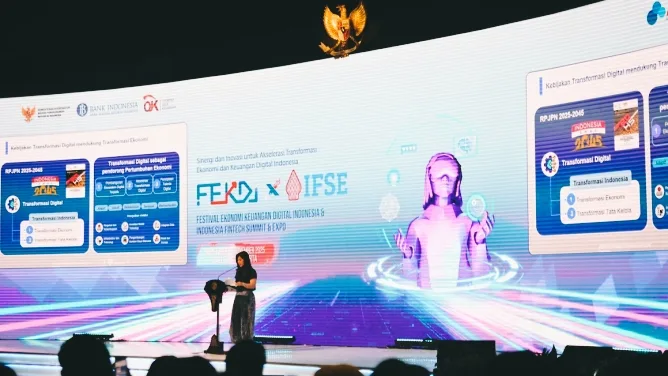
Speaking at the Festival Ekonomi dan Keuangan Digital (FEKDI) x Indonesia Fintech Summit & Expo (IFSE) held at the Jakarta Convention Center on Thursday, October 30, 2025, Minister Meutya Hafid revealed that Indonesia’s digital economy reached a value of USD 90 billion (IDR 1,496 trillion) in 2024. This figure is projected to quadruple to USD 366 billion (IDR 6,086 trillion) by 2030, far exceeding other ASEAN economies.
“Indonesia’s digital economy has now surpassed Thailand, Malaysia, and Singapore. We are leading the region’s digital revolution,” said Meutya optimistically.
229 Million Internet Users: Indonesia Leads ASEAN’s Digital Ecosystem
Indonesia now boasts 229.4 million internet users, representing 80.6 percent of its population, according to the latest survey by the Indonesian Internet Service Providers Association (APJII) in 2025.
Internet penetration in urban areas has reached 84 percent, while rural areas stand at 77 percent, marking a strong acceleration of digital inclusion nationwide.
“The year-on-year increase in internet penetration shows significant progress, but extending connectivity to remote regions remains a top priority,” Meutya noted.
The government continues to accelerate the development of national digital infrastructure, including expanding fiber optic networks, 4G/5G base stations, and launching new satellites to strengthen connectivity across the archipelago.
SATRIA I and Nusantara V Satellites: Indonesia Tops ASEAN in Connectivity
Indonesia’s commitment to equitable internet access is embodied in the SATRIA I satellite program, which now provides connectivity to 27,865 public service points, including 1,631 locations in Papua.
Additionally, the launch of the Nusantara V Satellite by Pasifik Satelit Nusantara (PSN) has boosted national broadband capacity to 370 Gbps, the highest in Southeast Asia—surpassing Australia’s 186 Gbps.
“This milestone strengthens Indonesia’s digital sovereignty and lays the foundation for inclusive economic growth, MSME empowerment, and the acceleration of AI-driven innovation,” Meutya emphasized.
Three Pillars: Inclusive, Innovative, and Human-Centered
In her keynote address at FEKDI x IFSE 2025, Meutya Hafid outlined three key pillars of Indonesia’s national digital transformation strategy:
1. Building an inclusive digital ecosystem to ensure equitable access for all citizens.
2. Accelerating innovation and efficiency, particularly in financial and public services.
3. Developing world-class digital talent through programs such as the Digital Talent Scholarship and AI Talent Factory.
The Ministry of Communication and Digital Affairs has also established the Garuda Spark Innovation Hub and HUB.ID Connection Hub to bridge young digital talents with the industry, fostering collaboration between the government and the private sector.
“Digital transformation is not just about technology—it’s about people, and creating fair opportunities from cities to the most remote areas,” Meutya emphasized.
QRIS and MSMEs: The Heart of Indonesia’s Digital Economy Revolution
Digital transformation has brought tangible benefits to grassroots communities. Minister Meutya highlighted the widespread adoption of QRIS, Indonesia’s national QR-based payment system, across the country—even among small street vendors and traditional markets.
“Even small carts in local markets like Tangerang Selatan now use QRIS. It’s a sign that digitalization has truly reached the grassroots economy,” she said proudly.
This inclusive ecosystem has accelerated local economic growth, expanded financial access, and strengthened the global competitiveness of Indonesia’s micro, small, and medium enterprises (MSMEs).
Government–Industry Synergy for Digital Sovereignty
Meutya underscored that collaboration between the government, regulators, industries, and academia is essential to sustain Indonesia’s digital transformation.
Through joint initiatives, Indonesia aims not only to become a major user of digital technologies but also a regional creator of innovation.
“Progress can only be achieved when we move together. Digitalization must become a national strength—not just a trend,” Meutya concluded.
Indonesia, the New Leader of ASEAN’s Digital Economy
With the largest internet user base, advanced satellite infrastructure, and the fastest-growing digital economy in the region, Indonesia is now recognized as the new leader of the ASEAN digital economy.
Under Meutya Hafid’s leadership, the Ministry of Communication and Digital Affairs continues to advance Indonesia’s vision of digital sovereignty and inclusive growth, marking a new era for the nation’s digital future. (AT Network)
Follow Us at Google News and WA Channel