
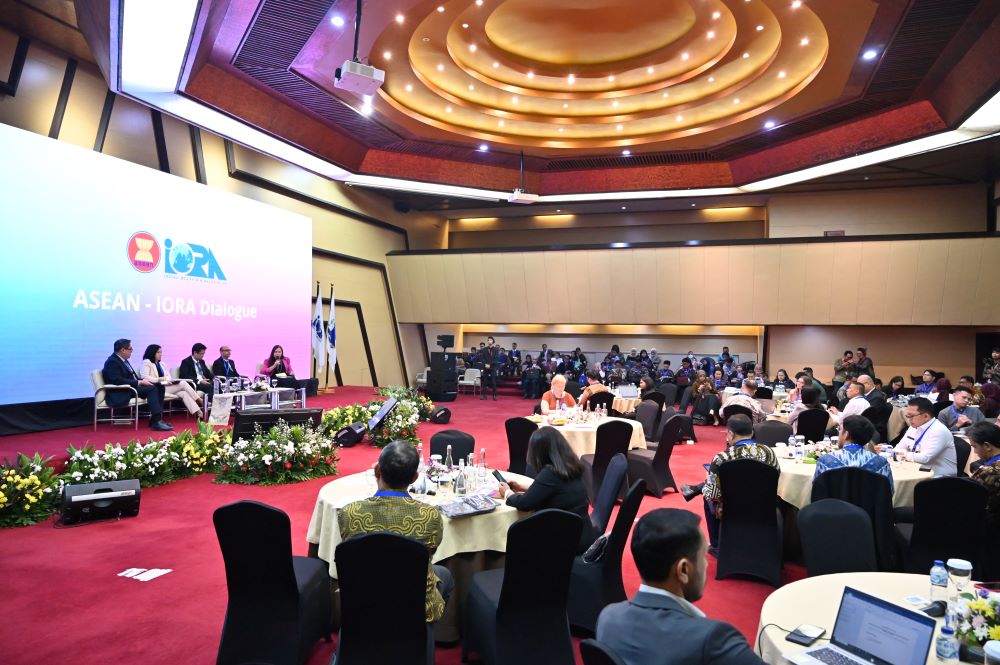
ASIATODAY.ID, JAKARTA – The ASEAN-IORA and ASEAN-PIF dialogue forum with the theme “Implementing Collective Commitment to Establish Cooperation” was held at ASEAN Headquarters, Jakarta, Thursday, 19 September 2024.
This event aims to explore and advance concrete projects in accordance with the cooperation sectors listed in the Memorandum of Understanding (MoU) between ASEAN and the Indian Ocean Rim Association (IORA) and ASEAN and the Pacific Islands Forum (PIF), which was signed in Jakarta on September 4 2023.
Through this MoU, ASEAN, IORA, and PIF are committed to promoting cooperation in several key areas, including maritime cooperation, connectivity, Sustainable Development Goals (SDGs) 2030, blue economy, people-to-people exchanges, disaster risk reduction and humanitarian assistance, as well as the digital and green economy.
Sidharto Reza Suryodipuro, Director General of ASEAN Cooperation at the Indonesian Ministry of Foreign Affairs, emphasized that the signing of the MoU last year had provided a strong foundation for ASEAN, PIF and IORA to advance regional cooperation. Given that these regions are geographically connected and face similar challenges, cooperation on maritime and blue economy initiatives becomes increasingly important.
He also highlighted the need to focus on the digital and green economy, sustainable development, and job creation amidst rapid geopolitical changes and global economic changes. Strengthening people-to-people exchanges, he added, is equally important for deepening inter-community ties and providing a long-term impact on people’s daily lives.
“Consisting of 47 countries and approximately 4 billion people, the region has enormous economic potential. By prioritizing development, economic growth and solidarity among developing countries in the Indo-Pacific, we can position ourselves to achieve real progress in the environment.” “The world is increasingly complex,” said Sidharto, quoted from a broadcast by the Indonesian Ministry of Foreign Affairs.
Meanwhile, Nararya Soeprapto, Deputy Secretary General of ASEAN for Community and Corporate Affairs, emphasized the importance of this dialogue as a follow-up to the signing of the MoU between ASEAN-PIF and ASEAN-IORA. He emphasized that the ASEAN Secretariat is ready to support efforts to translate the MoU into practical, feasible and real projects that will benefit the people of the region.
Furthermore, Esala Nayasi, Deputy Secretary General for Strategic Policy and Programming of the PIF added that ASEAN and the PIF face similar challenges in a unique context. The signing of the MoU between ASEAN and PIF in 2023 is an important step in facing shared regional issues, such as SDGs 2030, people-to-people exchanges, disaster risk reduction and humanitarian assistance.
He also expressed optimism regarding the further development of a mutually beneficial cooperation framework.
Likewise, Ms. Amanda Aspden, Director of IORA, emphasized that both ASEAN and IORA have their own views on the Indo-Pacific. He explained that this dialogue offers an important opportunity for both organizations to develop a strategic partnership in addressing shared challenges, particularly in the areas identified in the MoU.
He emphasized that the dialogue opened the door for closer engagement and cooperation to build a peaceful, safe, stable, inclusive and sustainable region.
During the discussion session, speakers and participants from ASEAN, PIF, and IORA shared perspectives on implementing cooperation in the identified areas, exploring concrete projects aimed at increasing resilience and connectivity in the region. Several “quick win” projects were also proposed, including sharing best practices and experiences as well as capacity development initiatives in the fields of blue and green economy, digital economy, disaster risk reduction and connectivity.
The ASEAN Hall was filled with participants consisting of various stakeholders, including ASEAN sector bodies, academics, as well as representatives from ministries and government agencies. ASEAN entities, think-tanks and non-governmental organizations were also present to provide ideas. The dialogue is interactive, providing a platform for participants from various backgrounds to share their insights and expertise. This diversity of perspectives significantly enriches discussions, creates a collaborative atmosphere and produces actionable project activity proposals. (AT Network)
Follow Us at Google News and WA Channel