
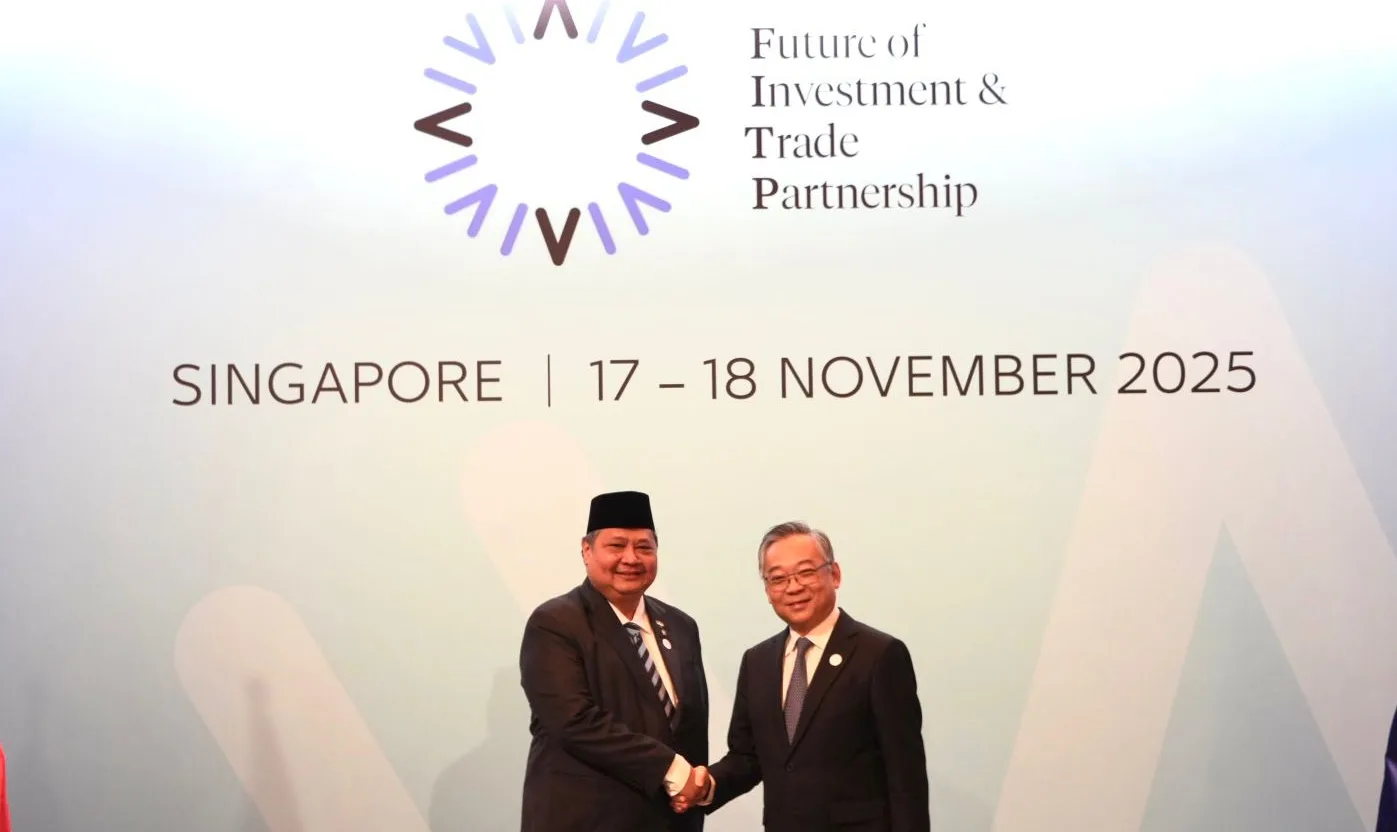
ASIATODAY.ID, SINGAPORE — Indonesia is strengthening its economic diplomacy in Southeast Asia, with Singapore emerging as a pivotal partner in shaping the region’s future.
Amid shifting global dynamics and the rapid rise of Asia’s new economic landscape, both countries reaffirmed their commitment to deeper economic integration, high-quality investment, and collaborative leadership through the Future Investment and Trade Partnership (FIT).
This renewed momentum was underscored through a series of high-level meetings led by Indonesia’s Coordinating Minister for Economic Affairs Airlangga Hartarto, including bilateral discussions with Singapore’s Minister for Trade and Industry Gan Kim Yong, the 1st FIT Ministerial Meeting (FMM), and the Batam–Bintan–Karimun (BBK) Investment Forum.
In a bilateral meeting, both ministers exchanged views on regional developments including ASEAN integration, CPTPP expansion, and emerging cooperation opportunities with the Gulf Cooperation Council.
Singapore reaffirmed its support for Indonesia’s accession to the CPTPP, signaling stronger regional trade alignment.
Both nations also revisited the long-standing SiJORI growth triangle—Singapore, Johor (Malaysia), and Indonesia—agreeing on the need for a more balanced, future-oriented framework that supports digital connectivity, green investment, and regional supply chain resilience.
A key highlight was Indonesia’s expression of interest in joining the FIT initiative, a new global platform dedicated to strengthening supply chain security, future-oriented trade policies, and digital economic cooperation. Singapore welcomed Indonesia’s intention and signaled its readiness to support the entry process.
FIT: A New Engine for Asia’s Economic Transformation
During the 1st Future Investment and Trade Partnership Ministerial Meeting on November 18, 2025, Minister Airlangga underscored Indonesia’s readiness to collaborate in shaping a more resilient and innovative global trade architecture.
“FIT provides a crucial platform for countries—large and small—to collectively safeguard prosperity, strengthen supply chains, and embrace digital transformation,” he stated.
Indonesia highlighted three strategic priorities:
1. Strengthening Multilateral Trade
Indonesia emphasized that global economic stability requires rules-based cooperation and predictable trade mechanisms, particularly as Asia positions itself as the new center of global growth.
2. Accelerating Digital Transformation
Indonesia is pushing for interoperable digital systems, cybersecurity alignment, and paperless trade, which can significantly cut transaction costs and support the digital economy—projected to reach USD 360 billion by 2030.
3. Supporting MSME Integration into Global Value Chains
Digital standardization, electronic documentation, and simplified customs processes are expected to benefit MSMEs and ensure inclusive economic growth across Southeast Asia.
Indonesia also affirmed that digital trade is essential for enabling the green economy transition and supporting commitments toward a net-zero future.
Boosting Investment Momentum Through the BBK Free Trade Zone
At the Joint Investment Promotion Event for the Batam, Bintan, and Karimun (BBK) Free Trade Zone, Minister Airlangga highlighted Indonesia’s commitment to creating a more predictable and investment-friendly environment.
Singapore remains Indonesia’s largest source of Foreign Direct Investment for more than a decade, contributing over USD 20 billion in 2024, with bilateral trade reaching USD 57.6 billion.
Key policy reforms showcased include:
Risk-based licensing simplification (PP 28/2025 & PP 25/2025)
Service Level Agreement (SLA) mechanism for faster processing
BBK Master Plan (Perpres 1/2024)
Streamlined land provision regulations (Perpres 21/2025)
These reforms have strengthened investor confidence, reflected in rising BBK investment from USD 1.74 billion (2023) to USD 3.26 billion (2024), along with tourism growth in the Riau Islands.
The BBK region now hosts five Special Economic Zones, offering fiscal and non-fiscal incentives geared toward green manufacturing, renewable energy, digital infrastructure, and logistics.
“We warmly invite Singapore-based companies to expand their investment in BBK, particularly in green manufacturing, digital economy, healthcare, renewable energy, and regional logistics,” Minister Airlangga emphasized.
Asia’s Economic Reawakening: Indonesia Positions Itself at the Center
Across all three major engagements in Singapore, Indonesia projected a clear message:
Asia’s economic resurgence is underway, and Indonesia is ready to lead through collaboration, digital innovation, and sustainable investment.
By aligning with FIT, strengthening Singapore–Indonesia bilateral ties, and accelerating development in strategic regions like BBK, Indonesia aims to anchor long-term regional growth and contribute to a more resilient, future-ready Asian economy. (AT Network)
Follow Us at Google News and WA Channel