
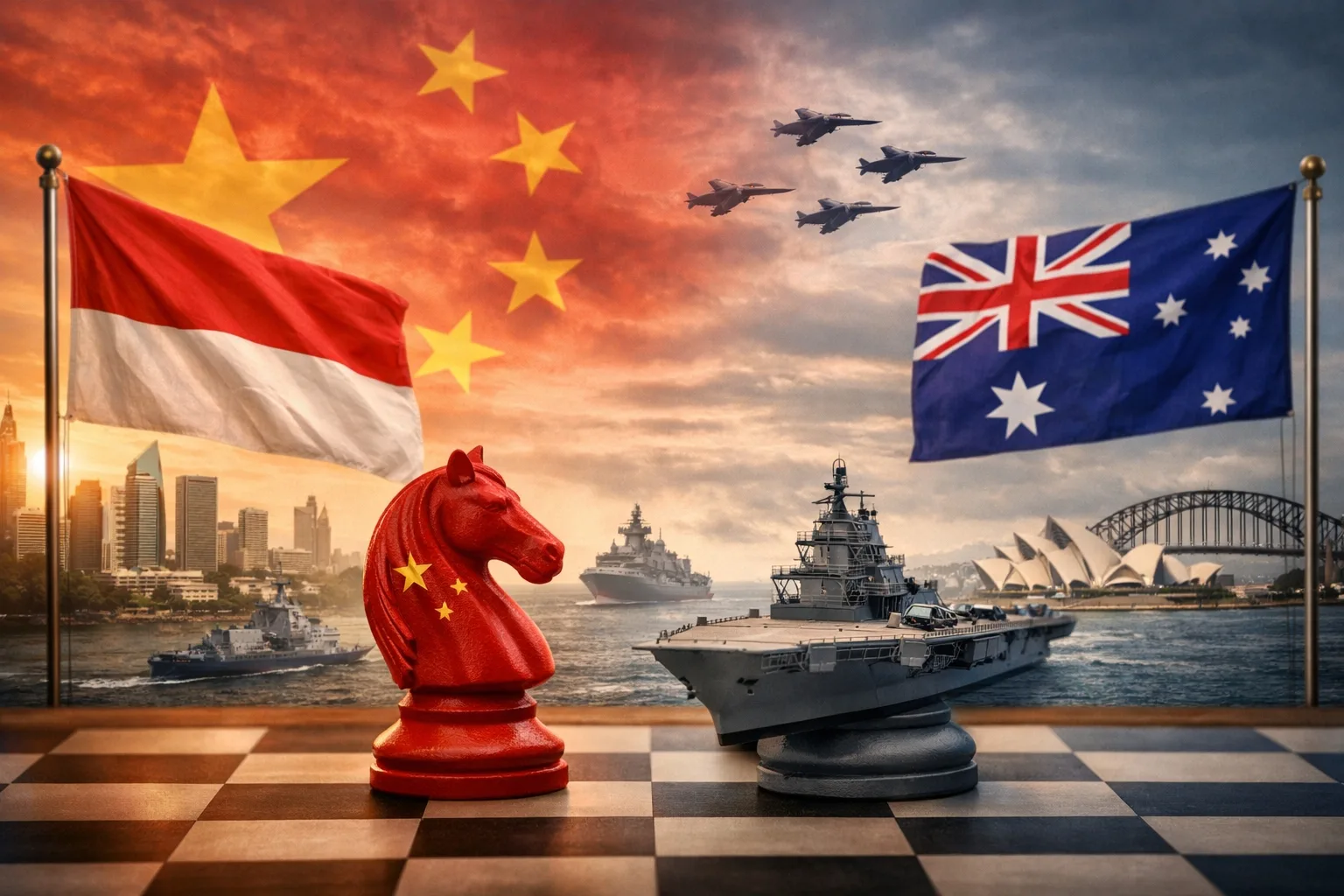
ASIATODAY.ID, JAKARTA — China’s expanding influence in the Indo-Pacific is no longer confined to trade and investment. It has emerged as a strategic force shaping regional security dynamics and testing the resilience of bilateral relationships—including those between Indonesia and Australia.
These issues were examined during the webinar “The China Factors in Indonesia–Australia Relations”, hosted by the Research Center for Politics at Indonesia’s National Research and Innovation Agency (BRIN) on Tuesday, January 27, 2026, with support from Australia Awards. The forum explored how Beijing’s rise is recalibrating the strategic calculations of two middle powers operating in an increasingly polarized regional order.
Head of BRIN’s Research Center for Politics, Athiqah Nur Alami, noted that Indonesia and Australia face comparable challenges in managing China’s multidimensional influence, spanning economic engagement, political leverage, and military considerations—each carrying direct implications for defense policy and regional stability.
“China’s growing role can encourage closer Indonesia–Australia cooperation in preserving a free, open, and rules-based Indo-Pacific. At the same time, differing national approaches toward China may introduce new tensions in bilateral relations,” Athiqah said.
Diverging Approaches, Shared Strategic Space
As keynote speaker, BRIN Research Professor Dewi Fortuna Anwar stressed that China’s rise has become a defining variable in Indonesia–Australia relations across the Indo-Pacific.
For Indonesia, engagement with China is framed by its long-standing free and active foreign policy, enabling Jakarta to capitalize on economic opportunities—particularly in strategic mineral investment and downstream processing—while preserving national autonomy.
“Indonesia seeks to maximize economic benefits from China’s rise without compromising its strategic independence,” Dewi explained.
Australia, by contrast, tends to adopt a security-focused approach, relying more heavily on Western strategic alliances in responding to China’s growing influence. While this reflects distinct strategic cultures, Dewi emphasized that it does not preclude deeper cooperation between Indonesia and Australia as fellow middle powers.
Nickel, Energy, and the Risk of Strategic Dependence
Economic considerations also featured prominently.
Yeremia Lalisang, Assistant Professor of International Relations at the University of Indonesia, highlighted China’s expanding investments in Indonesia’s energy sector and mineral downstreaming, particularly in nickel and renewable energy.
“While these investments support industrial development, they also raise concerns over strategic dependence. Diversifying economic partnerships—including with Australia—is increasingly important,” he said.
Meanwhile, Greta Nabbs-Keller, Associate Director for Defence, Space and National Security at The University of Queensland’s Strategic Partnership Office, underscored the need for Indonesia–Australia collaboration across multiple sectors.
She emphasized balancing economic engagement with China against the imperative of safeguarding regional security interests.
US–China Rivalry and Strategic Autonomy
Adding a broader geopolitical perspective, Indriana Kartini, a researcher at BRIN’s Research Center for Politics, pointed to intensifying US–China rivalry as a critical challenge for Indo-Pacific stability.
“Indonesia must continue to safeguard its strategic autonomy through its free and active foreign policy. In the Indonesia–Australia context, strengthening strategic dialogue and reinforcing ASEAN centrality are essential to maintaining regional stability,” she noted.
The discussion underscored the importance of sustained, research-based policy dialogue as Indonesia and Australia navigate an increasingly complex geopolitical environment—under the growing shadow of China in the Indo-Pacific. (AT Network)
Follow Us at Google News and WA Channel