
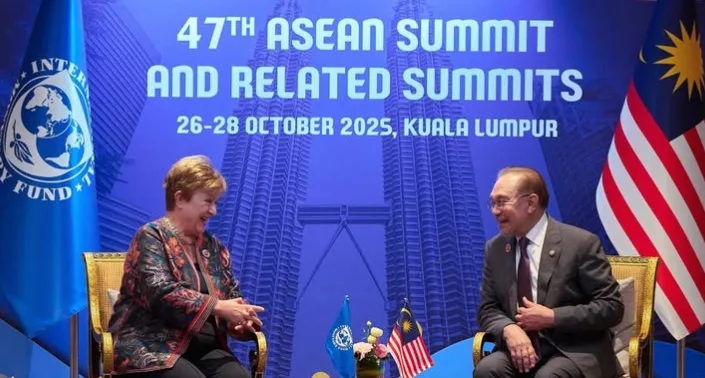
ASIATODAY.ID, KUALA LUMPUR — International Monetary Fund (IMF) Managing Director Kristalina Georgieva has called on ASEAN member states to adopt next-generation policies to strengthen economic integration, accelerate digital transformation, and create new jobs for millions across Southeast Asia.
She made the remarks during her keynote address at a high-level ASEAN forum in Kuala Lumpur, Malaysia, on October 26, 2025, attended by Malaysian Prime Minister Anwar Ibrahim, regional heads of state, and business leaders.
Georgieva emphasized that ASEAN now stands on the threshold of a “golden era” as a major global economic power.
“With a collective GDP of over US$4 trillion, ASEAN has become the world’s fourth-largest economy, growing 25% faster than the global average,” she said.
ASEAN: A Pillar of Global Growth Amid Uncertainty
According to IMF projections, the global economy is expected to grow by 3.2% in 2025 and 3.1% in 2026, while ASEAN’s growth will outpace that at 4.3% for both years.
Georgieva said this performance highlights ASEAN’s remarkable resilience amid shifts in geopolitics, technology, demographics, and the ongoing climate crisis.
She identified three key drivers of this resilience:
1. Strong economic fundamentals — including independent central banks, disciplined fiscal policies, and credible inflation targets.
2. Dynamic private sector adaptability — marked by rapid supply chain realignments and adoption of emerging technologies such as artificial intelligence (AI).
3. Deepening regional cooperation — in both trade and finance, serving as a buffer against growing global fragmentation.
Trade and Technology Integration: The Key to ASEAN’s Future
The IMF urged ASEAN to deepen trade and technology integration to achieve long-term, inclusive growth.
Currently, intra-ASEAN trade accounts for only about 20% of the bloc’s total trade, far below the 60% achieved within the European Union.
Georgieva stressed that removing non-tariff barriers could raise ASEAN’s GDP by 4.3% in the long run, equivalent to adding more than one-third of Malaysia’s current GDP, and generate around 4 million new jobs if accompanied by smart labor market reforms.
“Yes to upgrading the ASEAN Trade in Goods Agreement. Yes to opening trade in services. Yes to deeper financial integration and transformative joint investments,” she affirmed.
AI and Safe Digital Finance to Lead IMF 2026 Annual Meetings in Bangkok
The IMF chief also highlighted the region’s rapid progress in digital innovation and artificial intelligence. Singapore, she said, is emerging as a global leader in AI and digital infrastructure, while Malaysia, Thailand, and Indonesia are also making significant advances.
To support this momentum, the IMF and its Thai partners will make “safe and inclusive digital finance” the central theme of the IMF Annual Meetings in Bangkok in 2026 — aiming to promote digital transformation that benefits all segments of society.
ASEAN Poised for a New Era of Global Economic Integration
Georgieva concluded her speech by expressing confidence that the 21st century could become ASEAN’s defining era, much like the European Union’s rise in the 20th century.
“If the last century was defined by Europe’s four freedoms — of goods, services, capital, and labor — let this century be remembered as ASEAN’s time: a highly integrated, dynamic community working for the good of the region and the world,” she said. (AT Network)
Follow Us at Google News and WA Channel