
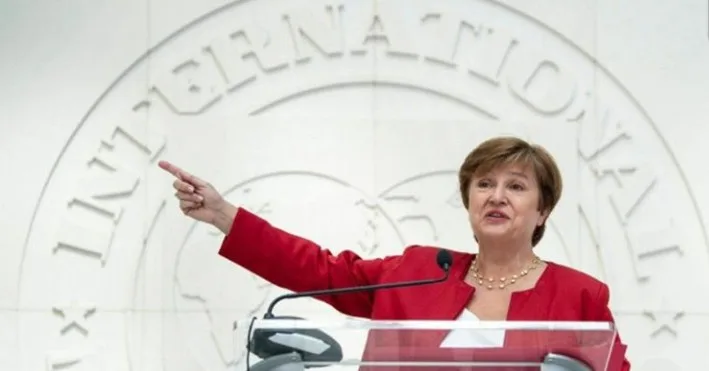
ASIATODAY.ID, DUBAI — The International Monetary Fund (IMF) has issued a stark warning that the global economy, despite showing resilience, is standing on increasingly fragile ground as soaring debt levels, geopolitical tensions, and prolonged conflicts threaten to derail growth.
Speaking at the Tenth Annual Arab Fiscal Forum in Dubai on February 2, 2026, IMF Managing Director Kristalina Georgieva cautioned policymakers against complacency, stressing that headline growth figures mask deep structural vulnerabilities across both advanced and emerging economies.
“The world economy has held up remarkably well—but this resilience will continue to be tested,” Georgieva said, pointing to converging shocks from geopolitics, trade fragmentation, technology disruption, and demographic pressures.
Global Growth Holds—But Risks Are Mounting
The IMF projects global economic growth of 3.3 percent in 2026, easing slightly to 3.2 percent next year, supported by private-sector agility, accommodative financial conditions, and reforms in emerging markets.
Inflation is expected to decline to 3.8 percent this year, falling further to 3.4 percent by 2027, helped by softer demand and lower energy prices.
Yet Georgieva warned that these figures could quickly unravel.
Rising public debt—already at historic highs—is expected to climb further in the coming years, potentially pushing up global borrowing costs. At the same time, escalating geopolitical tensions, protectionist trade policies, and unresolved conflicts pose significant downside risks.
“Even small shifts in investor sentiment could have outsized effects,” she noted.
Arab Region: Resilient, But Exposed
The Arab region is projected to grow 3.7 percent this year, benefiting from higher oil production among exporters and lower prices, remittances, and rebounding tourism for oil importers.
Several countries have regained market access, while others are advancing diversification strategies, investing in infrastructure, and positioning themselves for artificial intelligence–driven growth.
However, the IMF underscored that oil price volatility remains a central risk, especially if global demand weakens amid trade tensions or if the unwinding of OPEC+ production cuts intensifies supply-demand imbalances.
Structural challenges persist across the region:
– Oil exporters face the dual task of managing price volatility while accelerating economic diversification.
– Oil importers remain vulnerable to high debt and tighter global financing conditions.
– Low-income and fragile states continue to struggle with conflict, displacement, food insecurity, and urgent financing needs.
Private Sector or Stagnation
Georgieva emphasized that governments must recalibrate their role in the economy—shifting from direct growth drivers to enablers of private-sector–led expansion.
“Only the private sector can generate enough jobs for the vast numbers of young people entering the labor force,” she said, urging reforms to reduce the state’s footprint and improve the business climate.
Key priorities include opening economies to foreign direct investment, deepening trade integration, and leveraging emerging technologies such as AI to boost productivity.
Fiscal Reform: From Momentum to Urgency
Reflecting on a decade of progress since the forum’s inception, the IMF highlighted improvements in fiscal transparency, domestic revenue mobilization, and expenditure reforms across several Arab economies. Yet the message from Dubai was clear: progress must accelerate.
The IMF stressed the need to:
– Rebuild fiscal buffers and credibility, particularly in highly indebted countries.
– Raise tax revenues, with a benchmark tax-to-GDP ratio of at least 15 percent to support strong institutions and sustainable growth.
– Spend smarter, directing limited public resources toward diversification, reconstruction, and long-term productivity.
“Spending smarter is not just good fiscal management—it is a good growth strategy,” Georgieva said.
A Decade Ahead: Reform or Risk
As conflicts linger and global uncertainty deepens, the IMF warned that failure to act decisively could leave economies dangerously exposed to future shocks.
“The next decade must be about renewal, not resilience alone,” Georgieva concluded, reaffirming the IMF’s commitment to supporting the region through policy advice, financing, and capacity development.
Behind the optimism of steady growth projections, the IMF’s message from Dubai was unmistakable: without bold reforms, the global recovery could prove short-lived—and painfully costly. (AT Network)
Follow Us at Google News and WA Channel