
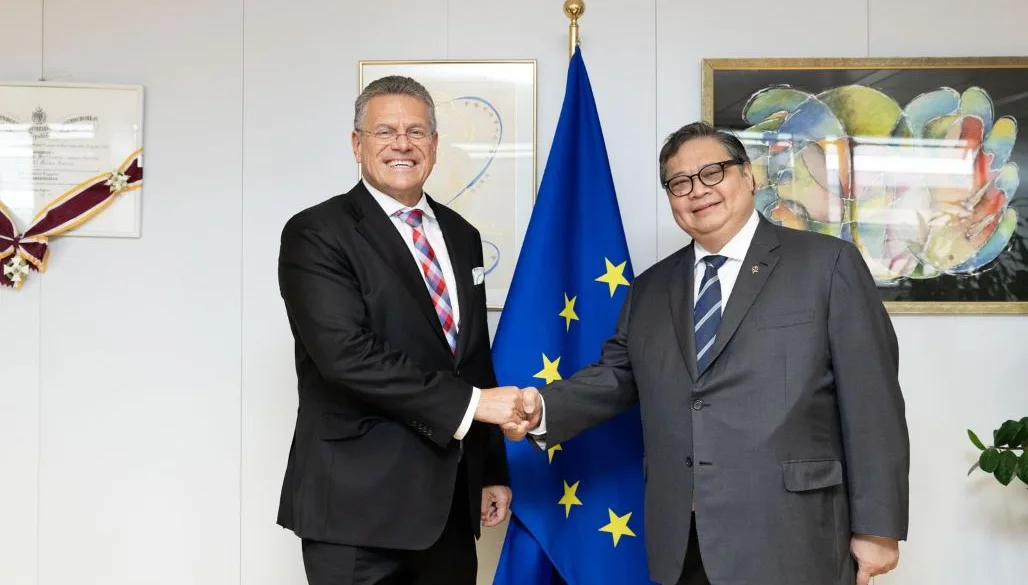
ASIATODAY.ID, JAKARTA — Indonesia advanced two of its most important trade initiatives this week as the European Commission moved forward the Indonesia-European Union Comprehensive Economic Partnership Agreement and its accompanying Investment Protection Agreement (IPA), while the United Kingdom reaffirmed support for Indonesia’s accession to the Comprehensive and Progressive Agreement for Trans-Pacific Partnership>, underscoring Jakarta’s expanding role in the global trading system.
The parallel developments mark a significant step in Indonesia’s strategy to broaden market access, attract higher-quality investment, and strengthen its integration into regional and global supply chains amid shifting trade and manufacturing patterns.
At the 10th CPTPP Commission Meeting on June 26, member economies agreed to launch formal preparation discussions with Indonesia, the Philippines, and the United Arab Emirates. The discussions are the first formal stage before the establishment of an Accession Working Group that will guide candidate economies toward full membership.
Indonesia aims to complete its accession by 2027, joining one of the world’s most influential free trade agreements, whose 12 members account for around 15% of global GDP and nearly 600 million consumers.
Coordinating Minister for Economic Affairs Airlangga Hartarto said most CPTPP commitments are already consistent with Indonesia’s obligations under the World Trade Organization, the Regional Comprehensive Economic Partnership, ASEAN economic frameworks, and the country’s ongoing accession process to the Organisation for Economic Co-operation and Development, requiring only limited regulatory adjustments.
The United Kingdom has remained one of Indonesia’s strongest supporters throughout the accession process. Earlier this year, both countries signed the Indonesia–United Kingdom Economic Growth Partnership, expanding cooperation in trade, investment, clean energy, semiconductor development, higher education, the digital economy, and human capital.
At the same time, Indonesia’s negotiations with the European Union reached another milestone after the European Commission submitted the IEU-CEPA and the IPA to the Council of the European Union for approval.
If endorsed by the Council, both agreements will proceed to the European Parliament for final approval before entering into force, bringing Indonesia and the European Union closer to establishing one of the region’s most comprehensive economic partnerships.
According to the Indonesian government, the agreement would eliminate tariffs on 98.5% of tariff lines, simplify customs procedures, strengthen investment protection, enhance intellectual property safeguards, and improve supply-chain resilience across strategic industries, including electric vehicles, electronics, pharmaceuticals, and critical raw materials.
For Indonesia, the agreement is expected to expand exports, attract higher-quality investment, strengthen industrial competitiveness, and accelerate integration into global value chains.
Substantive negotiations on the IEU-CEPA were concluded in 2025, with both sides targeting ratification in the second half of 2026 and implementation in early 2027.
President Prabowo Subianto has placed trade liberalization and regulatory reform at the center of his economic agenda, positioning both the CPTPP and the IEU-CEPA as strategic pillars to diversify export markets, strengthen competitiveness, and improve Indonesia’s investment climate.
If both initiatives proceed on schedule, Indonesia will secure preferential access to two of the world’s most influential trading networks across the Indo-Pacific and Europe, reinforcing its position as Southeast Asia’s largest economy and an increasingly important destination for global investment, manufacturing, and supply-chain diversification. (AT Network)
Follow Us at Google News, WA Channel, and LinkedIn