
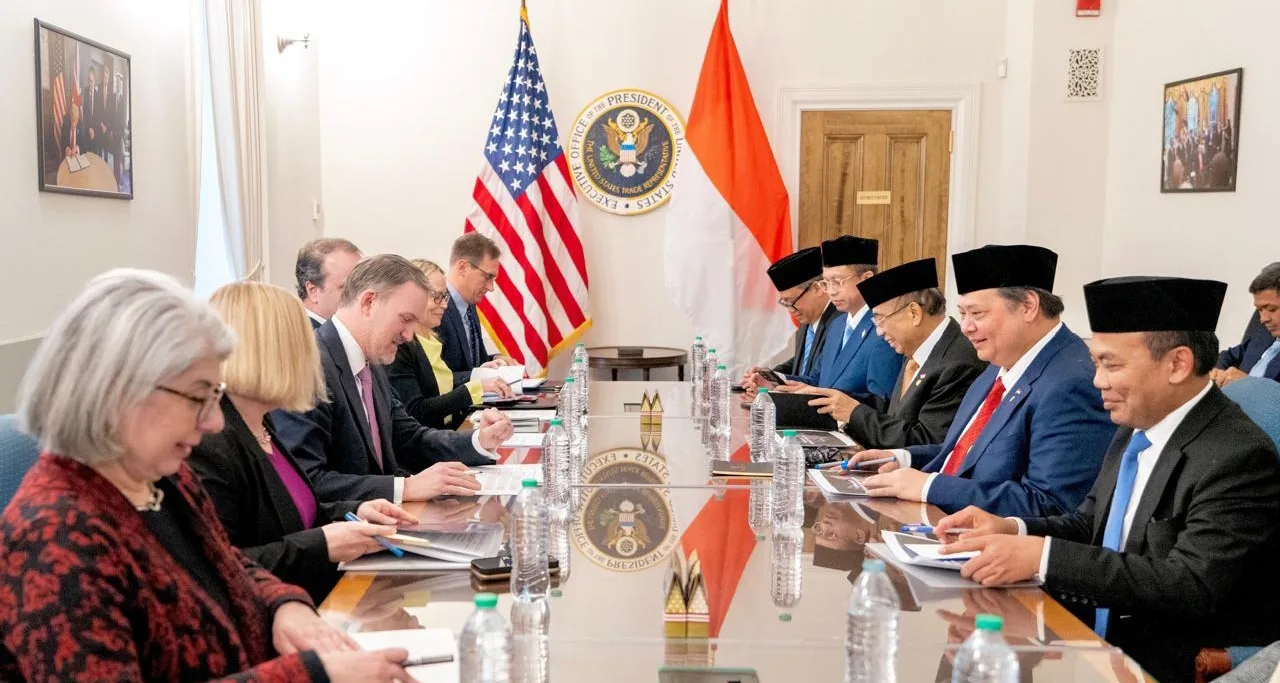
ASIATODAY.ID, JAKARTA — Indonesia is increasingly cementing its position in the global economic order by leveraging critical minerals as both a trade asset and a geopolitical instrument.
Amid intensifying competition among major powers to secure strategic supply chains, Indonesia has secured tariff exemptions from the United States while simultaneously opening access to the Eurasian market, reinforcing its role as a pivotal node in global trade and mineral geopolitics.
Coordinating Minister for Economic Affairs Airlangga Hartarto said critical minerals have emerged as one of the most sensitive and strategic pillars in Indonesia–United States trade negotiations.
He made the remarks during a media briefing in Jakarta on Friday, December 26, 2025.
“All sectors are being discussed, including access to critical minerals. There have already been engagements with US export authorities, as well as direct talks between American companies and Indonesian critical mineral producers. The government is facilitating this access as part of a broader national strategy,” Airlangga said.
US Tariff Relief Signals Strategic Alignment
Intensive negotiations between Indonesia and the United States Trade Representative (USTR) in Washington, D.C. have resulted in agreement on all principal and technical elements of the Agreements on Reciprocal Trade (ART), based on a balance of interests between the two countries.
Under the ART framework, the United States has granted tariff exemptions for several of Indonesia’s key export commodities, including crude palm oil (CPO), coffee, tea, cocoa, and labor-intensive manufactured products.
While commercially significant, the exemptions are also widely seen as part of Washington’s broader strategy to diversify supply chains for critical minerals and reduce structural dependence on China.
Indonesia—home to some of the world’s largest reserves of nickel and other minerals vital to electric vehicles, renewable energy, and advanced manufacturing—has increasingly positioned itself as a reliable and strategic partner for Western economies seeking long-term supply security.
Beyond tariff relief, cooperation between Indonesia and the US has expanded into critical minerals and downstream industrial development.
Airlangga emphasized that US involvement in Indonesia’s mining sector dates back to Freeport’s entry in 1967, providing a historical foundation for deeper strategic engagement.
The ART document has now entered the legal scrubbing and finalization phase, with the government targeting formal signing by the Presidents of Indonesia and the United States before the end of January 2026.
Balancing Power Blocs: Indonesia Expands into Eurasia
While strengthening economic ties with Washington, Indonesia is simultaneously pursuing market diversification and geopolitical balance by expanding trade relations beyond traditional partners. A major milestone was achieved with the signing of the Indonesia–Eurasian Economic Union Free Trade Agreement (I-EAEU FTA) on December 21, 2025.
The agreement grants Indonesian exporters access to Russia, Kazakhstan, Kyrgyzstan, Belarus, and Armenia—a combined market of nearly 180 million people with a total GDP of USD 2.56 trillion.
More than 95% of traded goods under the agreement will benefit from preferential tariffs, with average import duties approaching zero percent.
Through the I-EAEU FTA, Indonesia aims to boost exports of CPO and its derivatives, footwear, coffee, cocoa, textiles, fisheries products, as well as digital economy and creative industry services. The government projects the agreement could raise national economic growth by up to 2.36%, while accelerating Indonesia’s shift toward higher value-added exports.
From Resource Holder to Strategic Actor
To ensure that trade agreements translate into concrete commercial outcomes, the government is encouraging the establishment of business councils and the organization of business forums with partner countries, including those in Eurasia and the European Union.
These initiatives are designed to allow businesses to capitalize on new market access without waiting for lengthy ratification processes.
“The government is safeguarding domestic purchasing power, opening new markets, and maintaining national economic resilience at the same time. With average import tariffs already near zero, this presents a major opportunity for Indonesian businesses, including MSMEs, to compete more effectively in global markets,” Airlangga said.
Critical Minerals and Indonesia’s Global Trajectory
Indonesia’s success in securing US tariff exemptions while simultaneously opening the Eurasian market underscores a broader strategic shift in its economic diplomacy.
Rather than acting solely as a supplier of raw materials, Indonesia is increasingly locking in its global position by leveraging critical minerals as geopolitical capital—aligning trade policy with industrial ambition and global power dynamics.
As demand surges for minerals essential to the energy transition and next-generation technologies, Indonesia is no longer operating on the periphery of global value chains.
Instead, it is positioning itself as a central player in a fragmented, multipolar global economy. (AT Network)
Follow Us at Google News and WA Channel